
Travel guides and resources
Indonesia: Java
Not Just Bali’s Neighbour
An Island Overview
Our first view of Java was watching a storm pass down its east coast whilst sitting in a warung on the beach in Balian, and then later in the day, we could see a few lights marking the coastline in the inky blackness of the evening. When planning the trip, and allowed to expand the time we could spend in Indonesia, Java was pencilled in above Flores and Sulawesi. Flores certainly has Komodo National Park and stunning landscapes, and Sulawesi is excellent for underwater life, wildlife, and cultural traditions, which does nothing to help explain the decision to visit Java. Hopefully, as I develop this content, the case for Java can be answered.
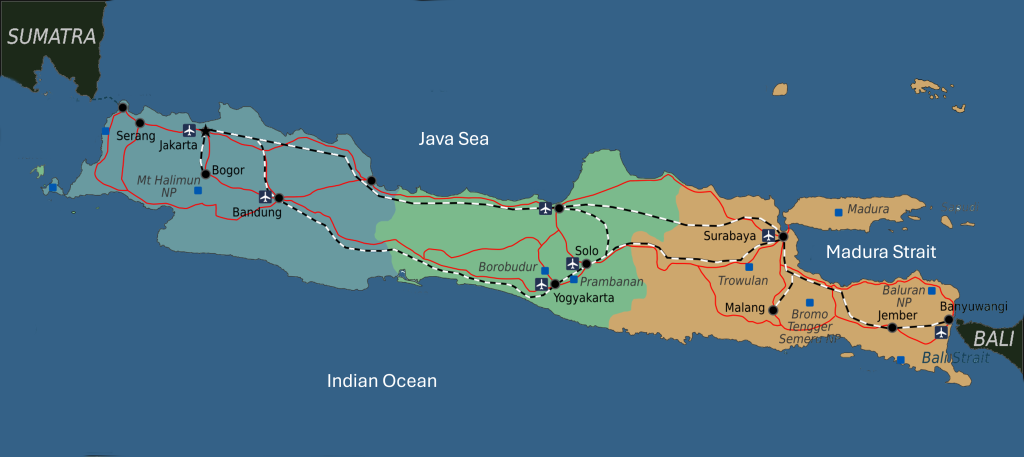
Java is one of the Greater Sunda Islands in Indonesia, sandwiched between the Indian Ocean to the south and the Java Sea to the north. The island covers over 132,000 km², making it the fifth-largest island in the Indonesian archipelago, about the size of England and Wales. However, whilst the population of England and Wales is 61.8 million, the population of Java is 157 million, around 56% of Indonesia’s population, making it the world’s most populous island. A quick look at a map of Java, it is easy to see that about 85% of the island is dominated by agriculture, villages, volcanoes and forested uplands. Which, if my maths holds up, means there is an urban density of about 7,500 people/km² (Jakarta has a density of about 15,000 people/km², about 25× higher than Dereham and four times denser than London).
Despite Java’s obvious demography, there is still wild beauty to enjoy, from the steaming volcanoes, waterfalls, the pockets of rainforest that hide endemic species – including rhino, slow loris and gibbons – to the beautiful Buddhist and Hindu temples. In this trip we will focus our attention on two areas, the first around Malang and then around Yogyakarta.
Java’s strategic location, fertile volcanic soils, and deep historical legacy have made it the political, economic, and cultural heart of Indonesia. With the current capital, Jakarta, on its northwestern coast, Java continues to shape national identity through its rich traditions, thriving urban centres, and historical landmarks.
A bit of History
Java’s history spans thousands of years, beginning with prehistoric settlements that evolved into sophisticated early societies. Java Man, an early human fossil discovered in 1892, the first-ever evidence of Homo erectus, and has been estimated to be up to 1.49 million years old. At the time of its discovery, it was the oldest hominid fossil ever found and shocked the scientific community as it was seen as evidence to further support Charles Darwin’s theory of evolution.
Over the centuries, it became home to powerful Hindu-Buddhist kingdoms such as the Mataram and Majapahit, whose architectural legacies survive in UNESCO-listed temples like Borobudur and Prambanan. During the Islamic era, sultanates rose across the island, blending indigenous culture with Middle Eastern influences. Dutch colonisation transformed Java into the centre of the Dutch East Indies, deeply shaping its infrastructure, urban design, and political structure. In the 20th century, Java played a pivotal role in Indonesia’s struggle for independence, hosting major nationalist movements and political resistance.
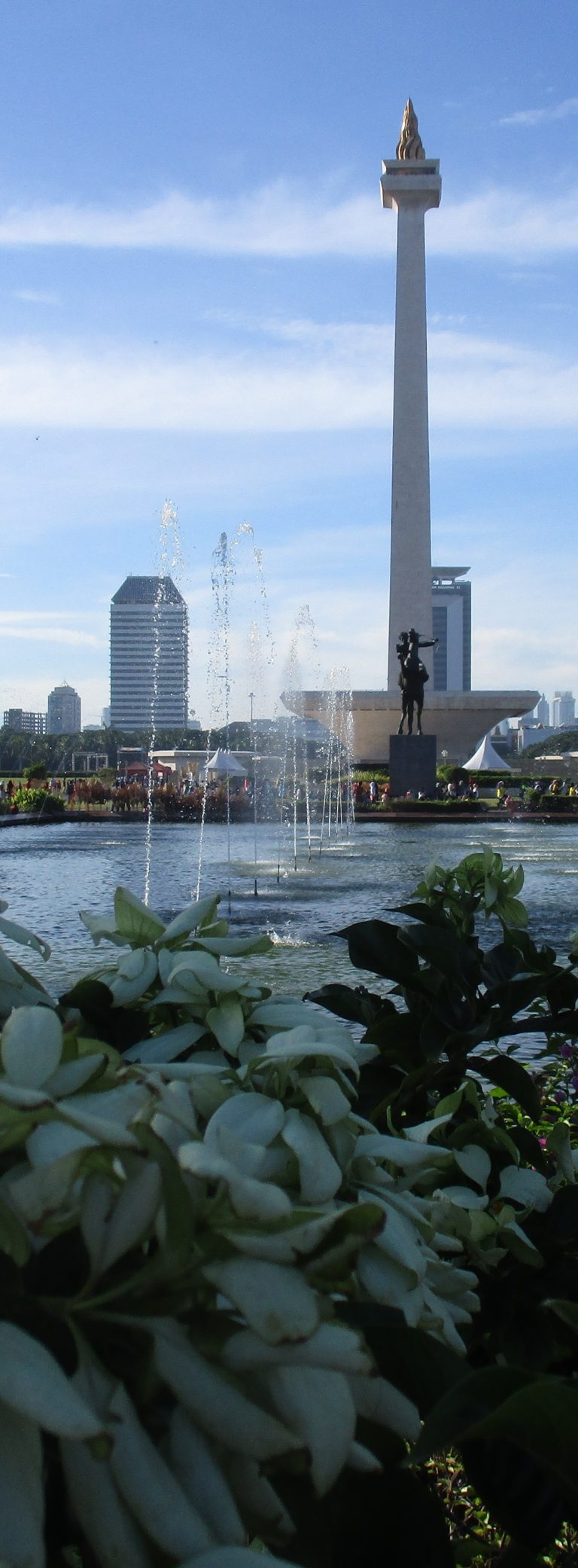
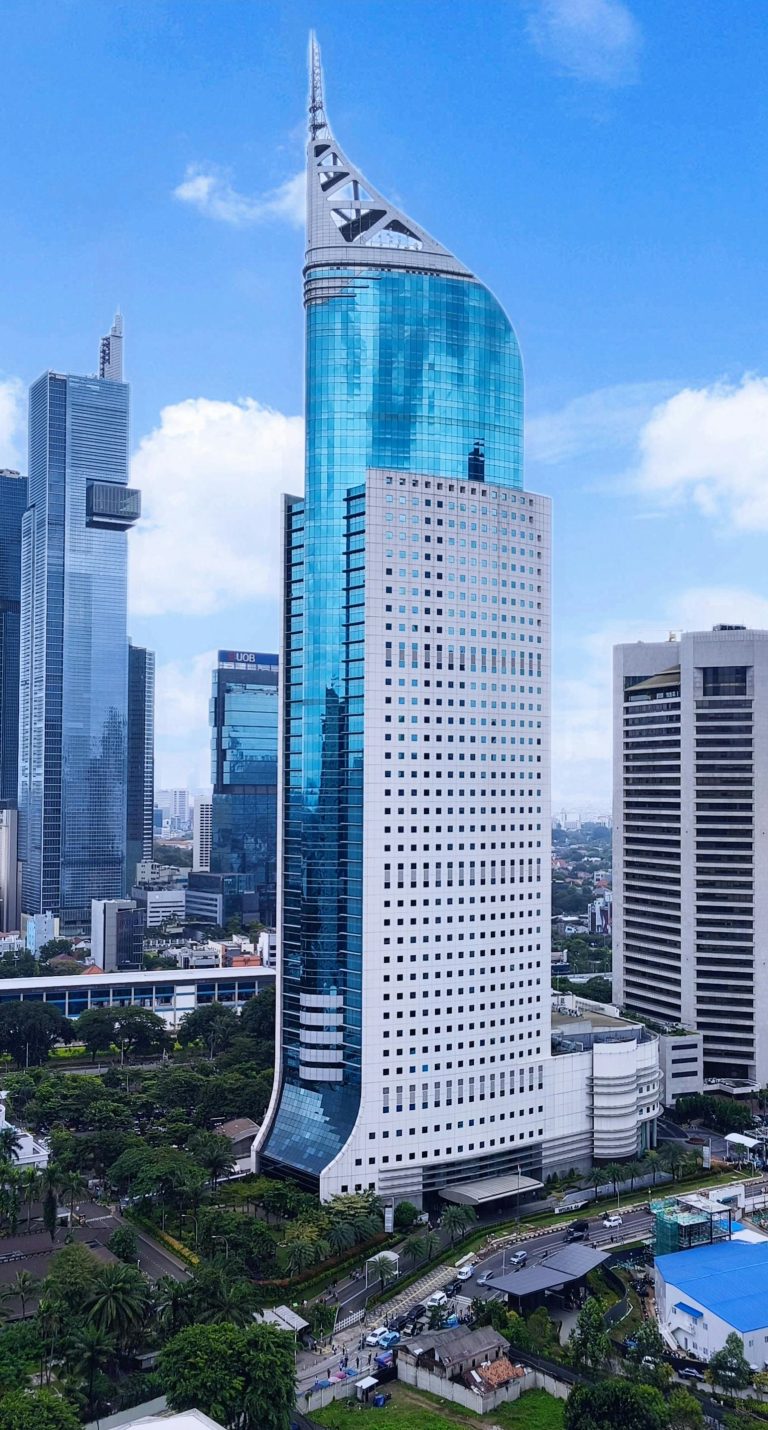
Jakarta: A City Leaning Toward the Sea
A Capital Moving Toward Higher Ground
So the decision to move Indonesia’s capital is not a symbolic reshuffling of political furniture. It is a response, practical, reluctant, and inevitable, to the slow physics playing out beneath Jakarta. Nusantara, the new capital rising in Borneo, lies on firmer ground, away from the coastal floods and subsidence that threaten Jakarta’s future. The relocation does not promise a sudden exodus; Jakarta will remain the nation’s commercial and cultural heartbeat. But it gives the government room to breathe, shifting administrative weight off a city whose land is literally collapsing under its responsibilities. For planners, Nusantara is a chance to build with intention. A modern city with water systems that do not rely on wells, with transport designed before congestion hardens into habit, with infrastructure planned rather than retrofitted. Meanwhile, Jakarta continues patching defences: seawalls, pumps, giant proposed barriers along Java’s northern coast. These help, but they cannot reverse the ground’s slow descent, especially while groundwater extraction continues to undermine the city’s stability.
Jakarta is a city suspended between persistence and inevitability. It hums with a kind of restless brilliance, vibrant, improvised, endlessly creative, yet beneath that energy lies a quiet fragility. Decades of groundwater pumping have left the metropolis perched on softened clay, slowly sinking toward the sea as the land compacts beneath its own weight. The decision to move the capital is not just political choreography; it is an acknowledgement of a future the ground itself is already scripting. Jakarta will keep fighting the tides and the storms, because that is what the city has always done, and it will remain Indonesia’s economic nerve centre for years to come, but Nusantara stands as a gentle concession: some battles unfold too gradually, and on too vast a scale, to be won on the soil that first gave rise to them.
In terms of its people, there is no plan, nor any political or practical mechanism, for a mass relocation. Analysts emphasise that the shift to Nusantara will not trigger an exodus from the old capital. Jakarta will continue to hold the millions who built their lives in its neighbourhoods and along its canals. The new city may absorb government institutions and a sliver of civil servants, but Jakarta’s population will remain largely in place, bound not by policy but by work, family, and the gravitational pull of a megacity that has long been Indonesia’s beating heart.
Yet even the most loyal cities are shaped by physics as much as by culture. With around 40% of Jakarta already below sea level and scientific projections warning that nearly half the city could be inundated or uninhabitable by 2050, the timeline for intervention grows shorter each year. For now, Jakarta still rises before dawn: markets clatter awake, buses full to the brim, and the skyline shimmering behind its familiar veil of humidity and pollution. However, the water creeps higher, the land sinks lower, and at some point the daily resilience of its residents will collide with the limits of habitable space. When that moment comes, the question of population movement, once hypothetical, may shift from planning to necessity, less an act of policy than a humanitarian challenge demanding an answer.
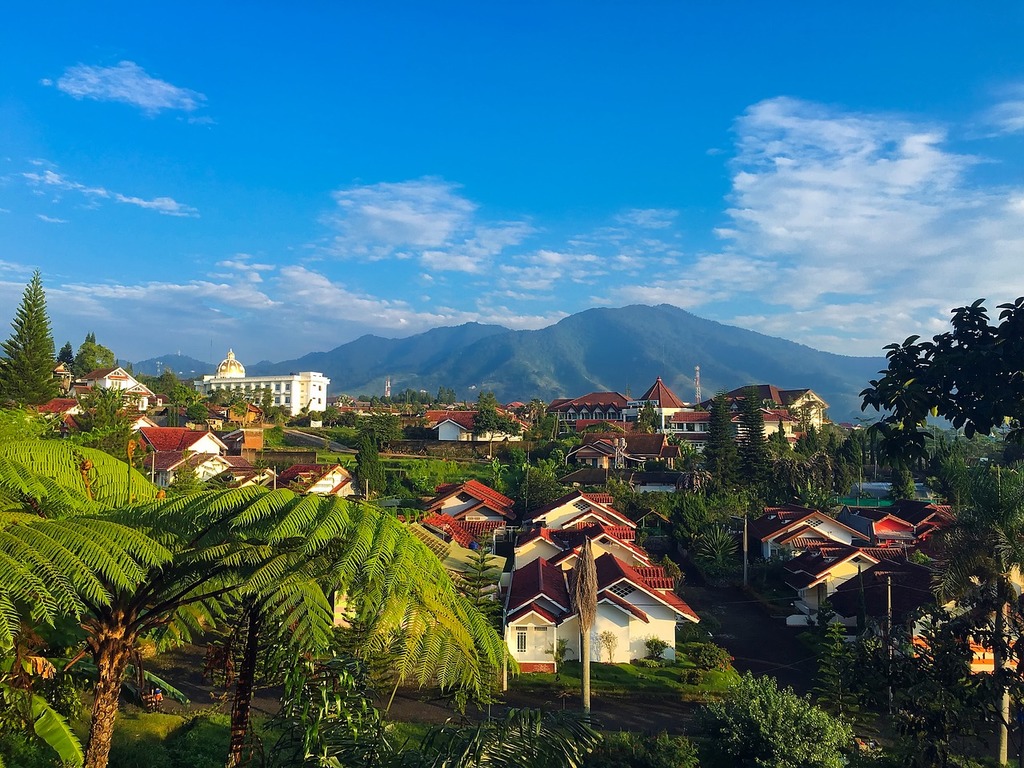
Malang
Malang is a historic inland city in East Java, known for its cool highland climate, mountain backdrop, and well‑preserved colonial architecture. Once a retreat for Dutch planters and civil servants escaping the heat of the lowlands, it has long balanced natural beauty with cultural depth. Settled since the era of the Singhasari Kingdom, the city later developed into an important administrative centre and was formally incorporated in 1914. Today, with a population approaching 900,000 and more than three million in the wider metropolitan area, Malang remains one of East Java’s key urban hubs—shaped by education, agriculture, industry, and tourism.
Nestled between Mount Kawi and the Tengger range, the city is surrounded by fertile highlands that support fruit orchards, vegetable farms, and floriculture—part of what gives Malang its distinctive green character. It also serves as a gateway to some of East Java’s most dramatic landscapes, including Mount Bromo, Mount Semeru, and the spectacular Tumpak Sewu waterfall.
Key Features
- Historical relics: Remnants from the Kanjuruhan and Singhasari eras sit alongside Dutch colonial buildings, many of which preserve early 20th century architectural styles.
- Natural attractions: Malang offers easy access to East Java’s iconic volcanic landscapes, Bromo, Semeru, and various highland waterfalls, forests, and viewpoints.
- Culture & cuisine: The city is known for dishes such as Bakso Malang and for its apple orchards, which have become both agricultural landmarks and popular visitor stops.
Getting there: From Pemuteran to Malang
Various options are available usually beginning with a taxi, then a ferry and then either a bus or train, no matter which expect a long day!
Sites that Might be Worth Exploring
There is perhaps a little more material here than for many of our other stops—partly because we haven’t quite decided what we’ll do yet. We are going to Tumpak Sewu and the nearby Tetes cave and waterfall, as our accommodation for a couple of nights sits only a short walk away. The rest, we’ll see how we feel closer to the day.
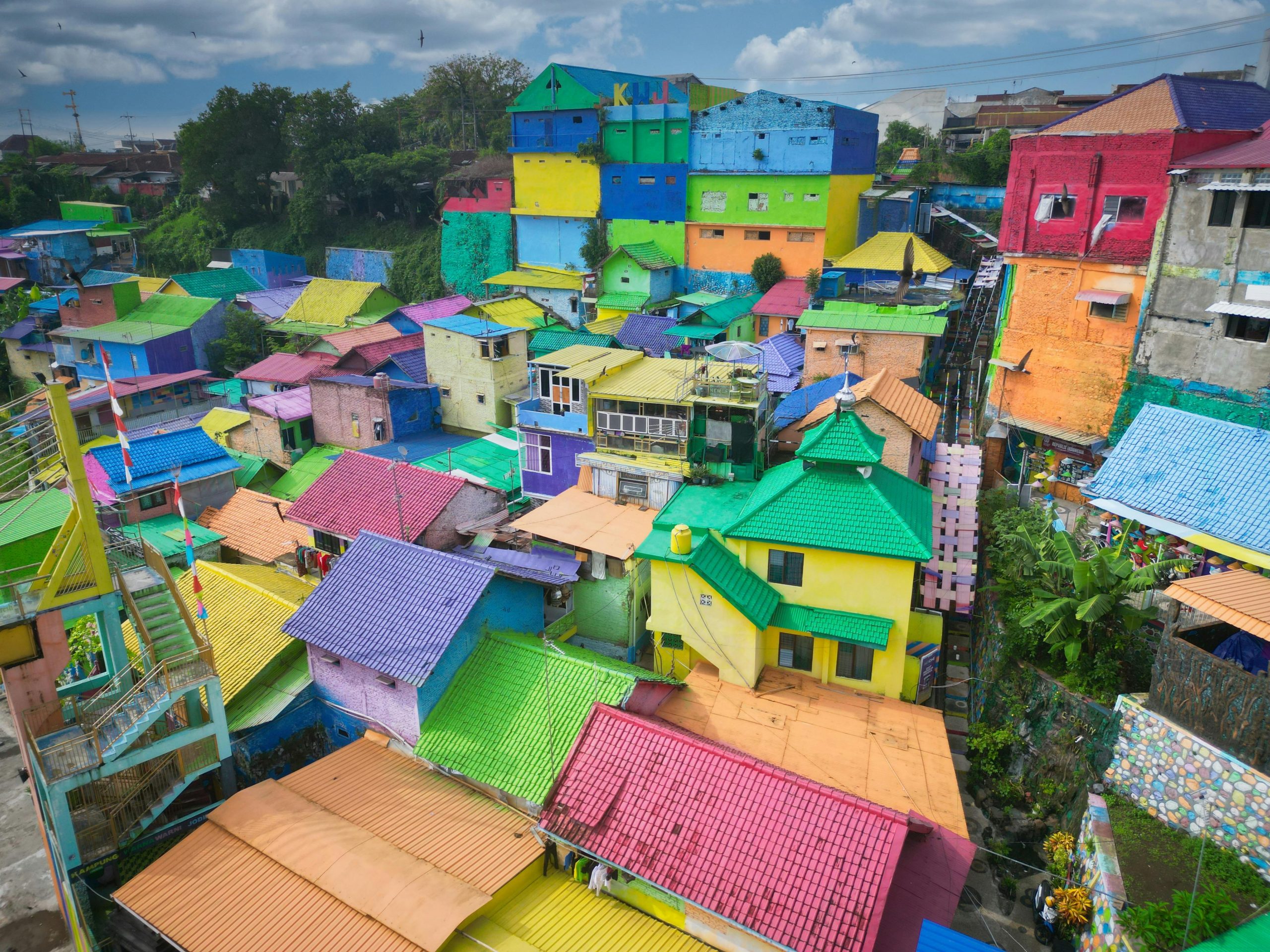
Jodipan Village, the Rainbow Village – Kampung Warna‑Warni
Once a neglected riverside settlement on the banks of the Brantas River, Jodipan Village—now famously known as Kampung Warna‑Warni or the Rainbow Village—has transformed into one of East Java’s most vibrant urban revitalisation success stories. The area was originally a rundown neighbourhood facing possible demolition due to poor living conditions, but everything changed in 2016, when communication students from a local university partnered with a paint company, local artists, and residents to reimagine the village through colour. Their initiative saw hundreds of houses painted in bright shades—pinks, blues, yellows, purples—and adorned with murals, turning the village into a giant open‑air gallery. This grassroots project not only beautified the environment but sparked community pride, improved sanitation awareness, and attracted a steady flow of visitors whose entrance fees and purchases help support the local economy.
Today, Jodipan is part of a colourful trio of adjacent creative communities that include Kampung Tridi (3D Arts Village)—known for its optical‑illusion murals—and Kampung Biru Arema, painted entirely in blue to honour of Malang’s beloved football club. A pedestrian bridge connects the villages, making it easy to explore all three. Wandering through Jodipan reveals a maze of narrow pastel‑painted stairways, recycled‑art installations, rainbow bridges, umbrella‑covered lanes, and uplifting street art at every turn. The village has become a symbol of how creativity, collaboration, and local spirit can transform an overlooked urban area into a thriving cultural destination and Malang’s most photogenic attraction.
Visiting Notes: Jodipan Village (Kampung Warna‑Warni)
Location: Jodipan sits in downtown Malang, along the Brantas River, just 10–15 minutes on foot from Malang Train Station, making it one of the city’s easiest attractions to reach. A pedestrian glass bridge links it directly with neighbouring Kampung Tridi.
What to expect: A formerly run‑down riverside settlement transformed into a bright, mural‑filled open‑air art district. Expect steep alleys, rainbow‑painted rooftops, 3D murals, and lively community spaces. The atmosphere is friendly and local, with small shops selling snacks and souvenirs. The area is compact and can be explored in 45–60 minutes.
Best time to visit: Morning offers the best lighting and fewer crowds; late afternoon gives warm golden tones for photos. Avoid rainy periods, as most paths are outdoors and become slippery. Weekdays are quieter than weekends.
Dress & behaviour: Wear comfortable shoes for uneven stairs and walkways. As this is a lived‑in neighbourhood, be respectful—avoid photographing residents without permission and keep noise low. Bring small cash for the entrance fee and local stalls.
Photography: Jodipan is designed for photography: top spots include the Glass Bridge viewpoint, Rainbow Stairs, and narrow mural-lined lanes. Every corner is colourful, but go early or late to avoid harsh overhead light and crowds.
Time needed: Expect 45 minutes to 2 hours, depending on how much time you spend taking photographs or exploring Kampung Tridi and Kampung Biru Arema across the bridge. Visitors typically spend around 3 hours if exploring all three areas.
Kajoetangan
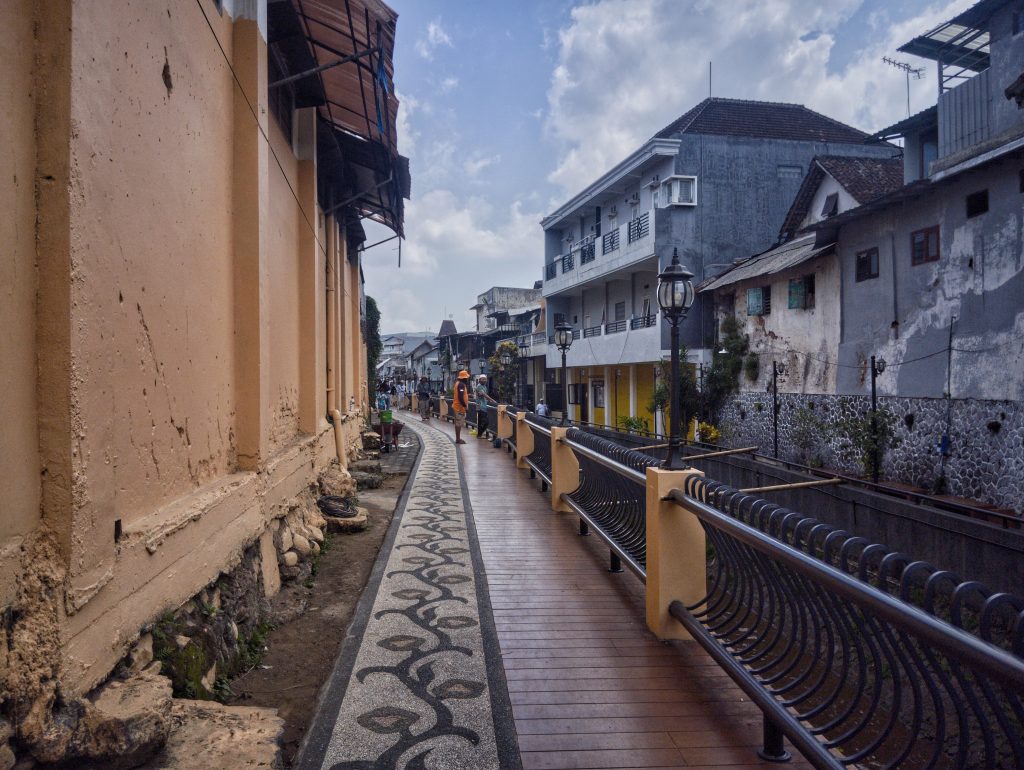
Kajoetangan sits quietly in the centre of Malang, a tangle of narrow lanes and century-old houses that still carry the softened edges of the Dutch colonial era. The name itself has stories layered beneath it. Some say it came from a wooden traffic sign shaped like a hand that once stood at a crossroads before 1914, its simple gesture guiding travellers towards the city square; others insist it came from a local patangtangan tree whose leaves resembled an outstretched palm. Still another explanation is geographical—this little neighbourhood held between the Sukun and Brantas rivers like a hand cupped around water.
Kajoetangan is no museum. People live here, cook here, sweep their front steps each morning. Yet the past hangs just overhead, visible in the high-ceilinged Dutch façades, in the thick walls, in the porch columns that still catch the light the way they did a hundred years ago. Many of the houses date back to the early 20th century and remain largely intact, even as the neighbourhood has become a designated heritage kampoeng, formally inaugurated as a cultural tourism area in 2018.
Walking through, you follow lanes that bend unexpectedly, pulling you into quieter pockets of the district. Some corners feel almost suspended in time; others show the layered creativity of the present day—bright murals, hand-painted signs, and the occasional café that has emerged gently from a restored living room. Visitors often pause at the murals, particularly the colourful Bank Indonesia wall, which has become an anchor point in the local visual landscape.
It is a neighbourhood best explored slowly. You notice the small things—an antique door handle, the way the afternoon sunlight slides across pastel walls, or a faded family photograph hung beside a window. People greet you as you pass, sometimes inviting a brief conversation about the house they live in and the one their grandparents lived in before that. This is still a working community, not a staged tableau, and that lived-in quality—its imperfection, its honesty—is what makes it compelling.
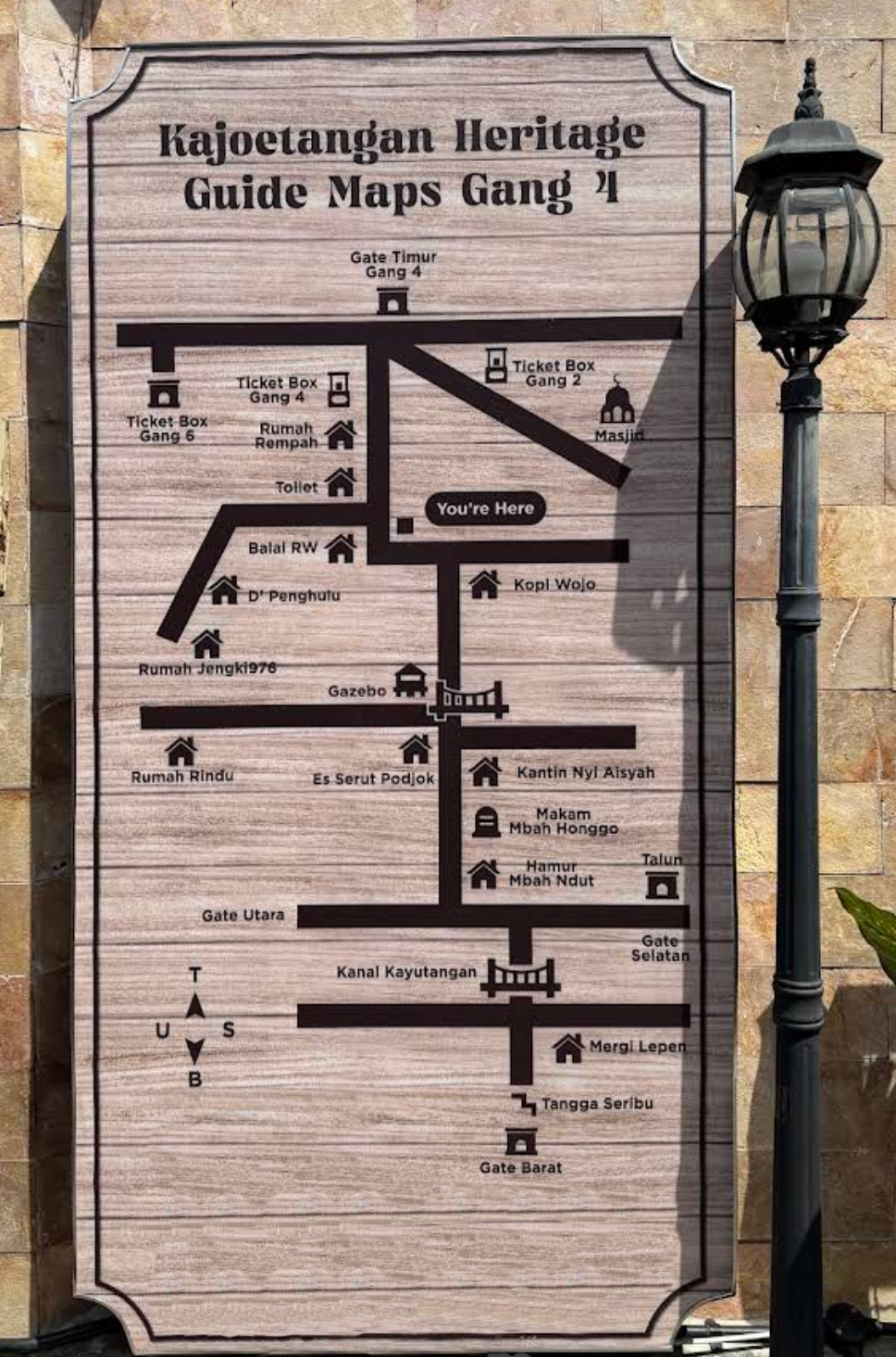
Cafés and street vendors settle into old verandas, offering traditional snacks like Es Podjok alongside newer, quieter spaces where you can watch life move along the corridor of Jalan Basuki Rahmat. Around sixty preserved houses are clustered throughout the village, each holding its own fragment of the city’s colonial past.
If you begin your walk at the main gate on Basuki Rahmat, the lanes lead you past heritage houses, then towards the riverside, where the atmosphere shifts. Less traffic, more murals, the colours deepening as you move outwards. It is an easy, absorbing circuit, something you can wander in an hour or stretch across an afternoon.
Kajoetangan isn’t spectacular in the loud sense. It is gentle, understated, a place built from texture rather than spectacle. A feeling more than a destination, and like many of Malang’s older quarters, it reveals itself not by instruction but simply by being walked.
Visiting Notes: Kajoetangan Heritage Village
Singosari Temple: Legacy of a Lost Kingdom
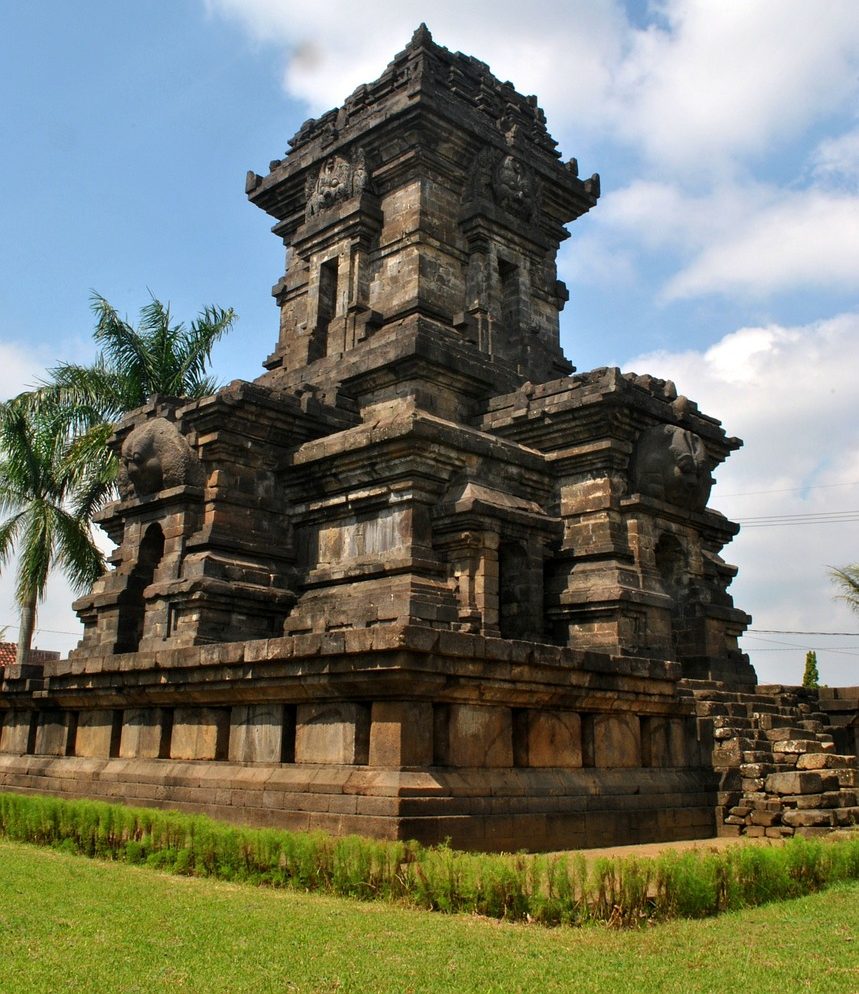
In the village of Candirenggo, about 12km north of Malang, Singosari Temple (Candi Singosari) stands as one of East Java’s most important remnants of the 13th‑century Singhasari Kingdom. Built as a syncretic Hindu‑Buddhist monument, the temple is widely believed to have served as the funerary shrine of King Kertanagara, the last ruler of Singhasari, whose assassination in 1292 triggered both the fall of the kingdom and the rise of Majapahit.
Architecturally, Singosari Temple is striking yet deliberately incomplete. Its lower levels reflect Shaivite Hindu traditions, while the upper chamber shows Buddhist dedication, symbolising the kingdom’s blended spiritual identity. You can still see its unfinished kala head above the entrance—evidence of the sudden political turmoil that halted its construction. Surrounding the temple once stood colossal Dvarapala guardian statues, and although much of the original statuary has been displaced over the centuries, the remaining carvings and reliefs display the artistic refinement of East Java’s classical era.
Today, the serene temple grounds offer a peaceful glimpse into the region’s ancient heritage. With its weathered stonework, towering structure, and links to legendary figures—from the powerful Kertanagara to early Majapahit rulers—Singosari Temple remains a compelling stop.
Visiting Notes: Singosari Temple
Location: Located in Candirenggo village, Singosari District, about 10 km north of Malang city and easily reached by car, angkot (shared taxi), or motorbike. The temple sits along the main road and is well signposted.
What to expect: A 13th‑century Hindu–Buddhist funerary temple dedicated to King Kertanegara, featuring tall stone architecture, intricate carvings, and remnants of guardian Dvarapala statues. The site is modest in scale, peaceful, and set amid quiet village surroundings—more atmospheric than extensive.
Best time to visit: Mornings between 8–10 am offer cooler temperatures and a calm atmosphere. The dry season (May–October) gives clearer skies and better photography conditions. Weekdays are generally quieter.
Dress & behaviour: Dress modestly out of respect for this sacred historical site. Move gently around the grounds, avoid climbing the temple structure, and go slowly around carvings and statues. Bringing sun protection and water is recommended.
Photography: Carvings, guardian figures, and temple silhouettes photograph beautifully, especially in softer morning or late‑afternoon light. Be mindful of other visitors and avoid stepping onto any restricted or fragile areas to frame shots.
Time needed: A visit typically takes 20–40 minutes—enough to walk the courtyards, appreciate the carvings, and enjoy the historical ambience. It pairs well with short cultural stops en route to other East Java sites.
No entrance fee, but donations are appreciated.
Tumpak Sewu Waterfall
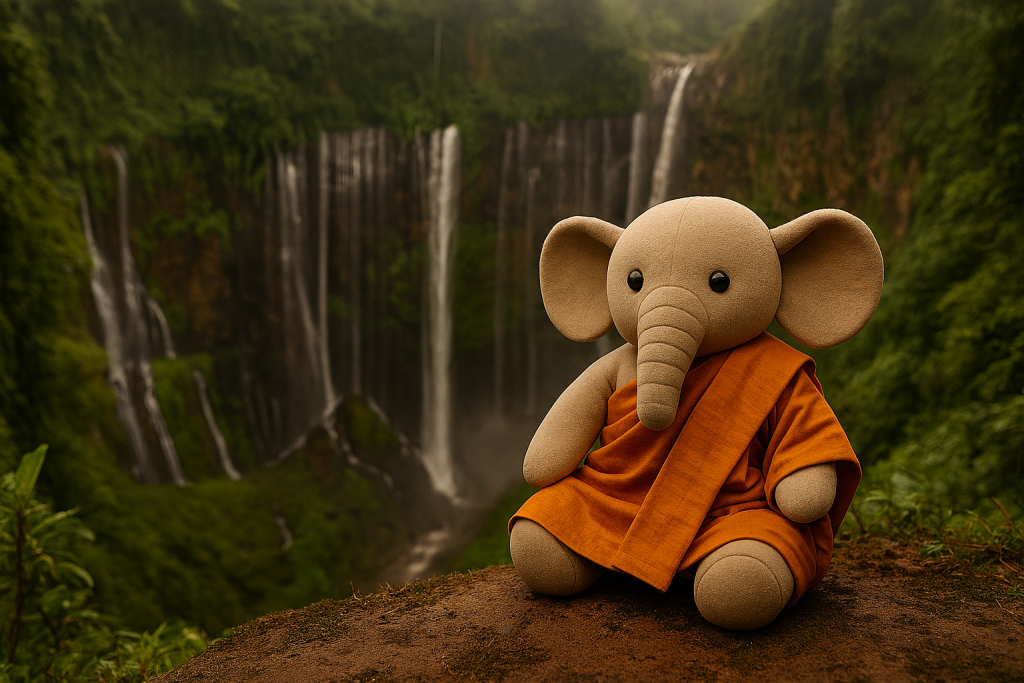
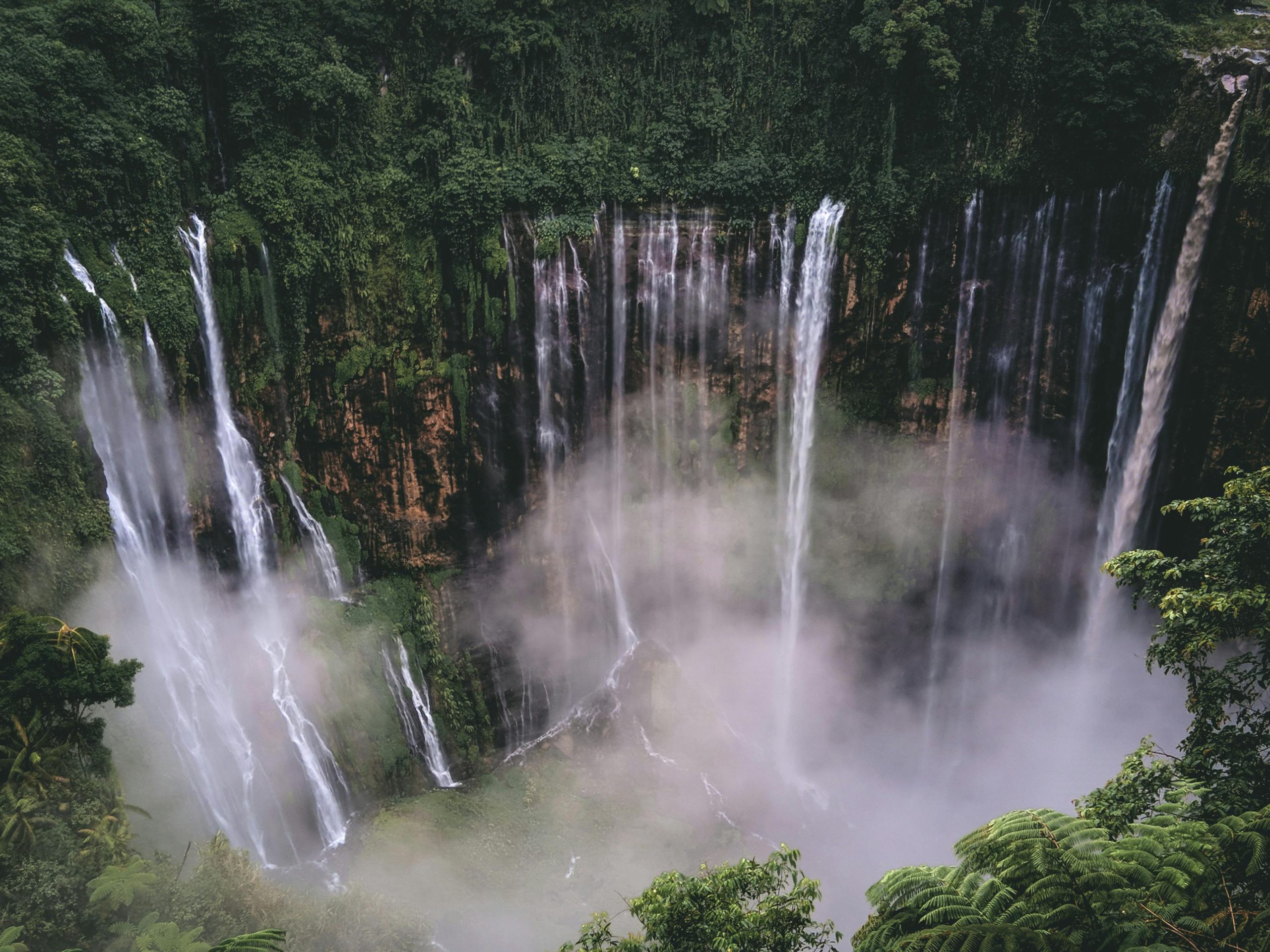
Known as “A Thousand Waterfalls,” Tumpak Sewu offers stunning views and adventurous treks. Straddling the border between Lumajang and Malang regencies, Tumpak Sewu Waterfall, iterally “Thousand Waterfalls” in Javanese, stands as one of Indonesia’s most dramatic natural wonders. Fed by the Glidik River, which flows from the slopes of Mount Semeru, the country’s highest volcano, the waterfall forms a vast, semi-circular amphitheatre where hundreds of thin streams plunge 120 meters into a lush, mist-filled ravine. Its multi-tiered flow and immense scale have earned it comparisons to a tropical Niagara.
It is possible to admire Tumpak Sewu from above at the panoramic viewpoint, reached by a short walk from the entrance, where sweeping views reveal the horseshoe‑shaped cliffs lined with countless water threads. It is also possible to take the steep descent through bamboo ladders, rocky trails, and river crossings into the canyon below—a challenging but unforgettable trek that places you directly at the base of the roaring falls.
Our plan is to spend a couple of nights close to Tumpak Sewu so we can arrive reasonably early in the morning to avoid crowds and capture the waterfall in its most atmospheric light.
Visiting Notes: Tumpak Sewu Waterfall
Location: Situated on the border between Lumajang and Malang regencies in East Java, near Sidomulyo Village (Pronojiwo District). Most visitors approach from Malang, roughly 2–3 hours by car.
What to expect: This is a raw, natural environment—not a landscaped attraction. Expect a dramatic horseshoe‑shaped cliff with hundreds of thin cascades dropping into a deep jungle ravine. Viewpoints from above require only a short walk; descending into the canyon involves steep, slippery trails, bamboo ladders, and river crossings, suitable only for confident hikers.
Best time to visit: Early morning is ideal for soft light, cooler temperatures, and fewer visitors. The dry season (April–October) offers safer trail conditions; the rainy season (November–April) makes the falls more powerful but may lead to trail closures. Arriving as close to opening time (7 a.m.) as possible is recommended.
Dress & behaviour: Wear sturdy footwear with good grip—expect water, mud, and slippery rocks. Clothing should be comfortable and moisture‑friendly. Move carefully and follow any instructions from local guides, especially on the descent. This is a natural site with real hazards; treat the terrain with respect.
Photography: The panoramic viewpoint offers excellent opportunities for wide shots, and drones are permitted in many areas. Be cautious with equipment on the canyon trek—mist, spray, and wet footing are constant. From the top or bottom, the falls are extremely photogenic, with Mount Semeru sometimes visible on clear days.
Time needed: A quick visit to the viewpoint can be completed in 30–45 minutes. If hiking to the base, allow 2–3 hours for the round trip, depending on conditions and your fitness level. Most travellers treat Tumpak Sewu as a half-day or full-day excursion.
Coban Rondo Waterfall
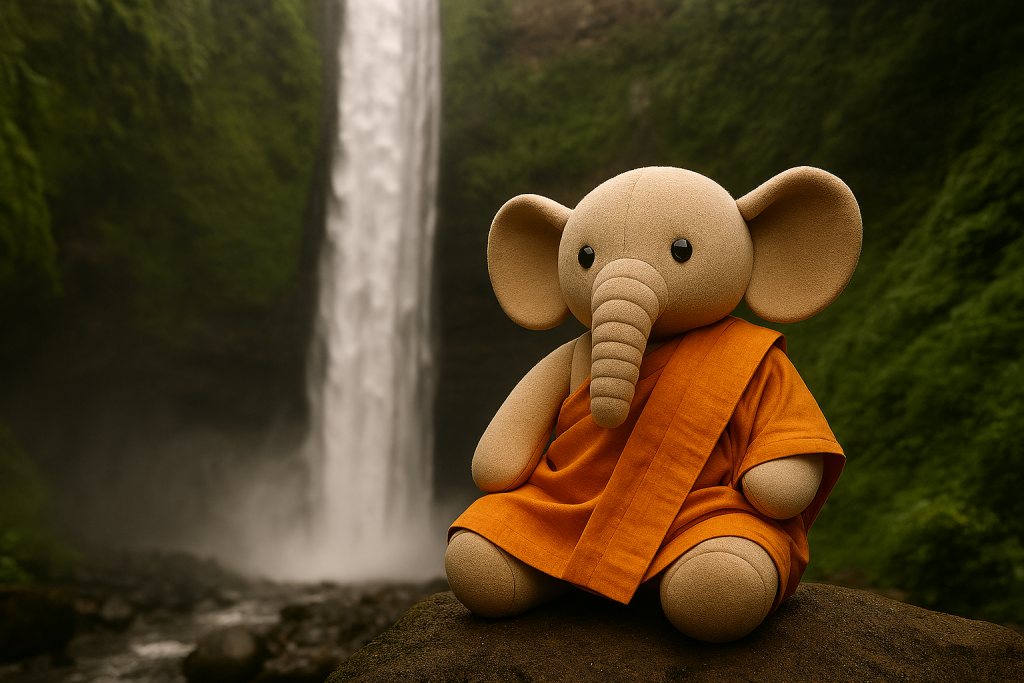
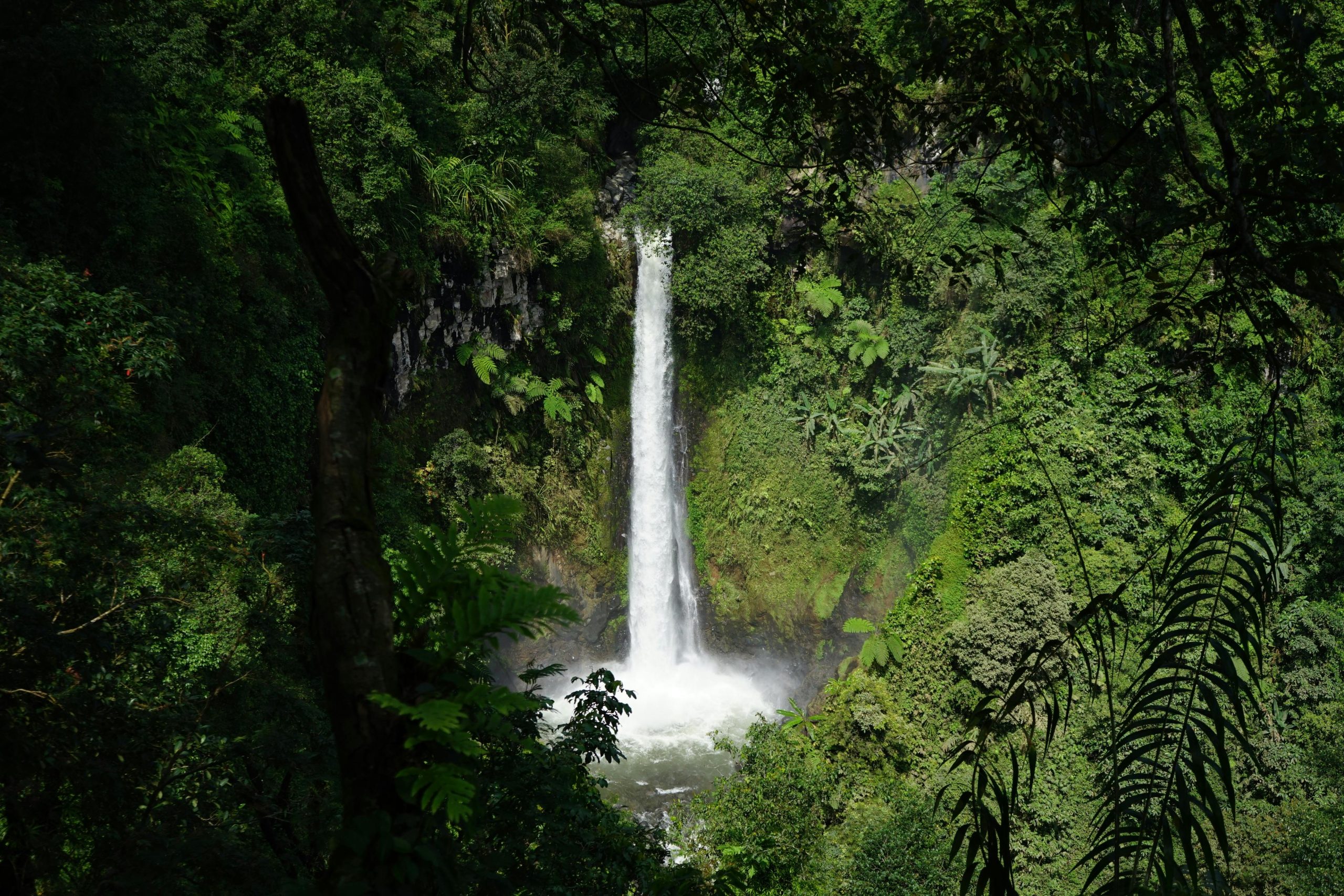
In the cool highland forests above Batu and Malang, Coban Rondo Waterfall offers a more accessible waterfall than many of East Java’s wilder cascades. The waterfall drops about 84 metres in a clean ribbon of water that settles into a shallow basin surrounded by tall pines and crisp mountain air—a setting that makes it especially appealing for families and casual travellers. The site’s name reflects a well-known Javanese folktale: “Coban”, meaning waterfall, and “Rondo”, meaning widow, drawn from the tragic story of Dewi Anjarwati, who is said to have hidden here after a fatal duel involving her husband.
One of Coban Rondo’s strengths is its accessibility. The approach is straightforward, with well-paved walkways leading from the parking area to the falls in just a few minutes—ideal for visitors who prefer scenic nature without technical hiking. The surrounding forest adds to the calm atmosphere, offering shaded spots, gentle trails, and several light-hearted attractions. Among them, the Labirin (maze) Garden, crafted from neatly trimmed hedges, has become a favourite stop. The waterfall’s flow shifts with the seasons—dramatic during the rains and softer in dry months—but thanks to maintained paths and visitor infrastructure, the site remains comfortable year-round.
Whether paired with a day exploring Batu’s orchards and hill scenery or enjoyed as a standalone nature break, Coban Rondo offers an easy going escape. Its blend of cultural legend, forest atmosphere, and laid-back recreation makes it a refreshing contrast to East Java’s more rugged waterfall treks.
Visiting Notes: Coban Rondo Waterfall
Location: Coban Rondo lies in Pujon District, Pandesari Village, at the edge of the Batu–Malang highlands. Travel times are about 30–60 minutes from either Batu or Malang—along clearly marked, well-maintained roads. Upon arrival, ample parking and a short, paved walk make access straightforward for visitors of all ages.
What to expect: The waterfall forms a tall, elegant drop framed by dense pine forest, creating a cool and shaded environment. Walkways are structured and easy to navigate, with plenty of space to pause for views. Around the main site, visitors will find recreational features such as the Labirin Garden, light outdoor activities, and comfortable paths suited to casual walking rather than strenuous trekking.
Best time to visit: Morning or late afternoon offers the most pleasant light and fewer crowds, particularly on weekends or holidays. Water volume increases noticeably during the rainy season, while the dry months bring clearer air for photos. Thanks to its highland setting, the area remains cool throughout the year.
Dress & behaviour: Comfortable walking shoes are recommended—the paths are paved but can be damp from mist. A light jacket can be useful, as temperatures tend toward the cooler side, especially during rainier months. Visitors should follow designated pathways and local instructions, although the environment is generally gentle and family-friendly.
Photography: The falls photograph beautifully from the main viewing platforms, especially when morning light filters through the surrounding pines. The forest setting also provides appealing opportunities for portrait shots, nature compositions, and wide-angle views. Seasonal changes in flow and mist add variety for returning visitors.
Time needed: Most travellers spend 1–2 hours here, enough to enjoy the falls, stroll through the forest, and explore nearby attractions like the maze garden. Those combining the visit with other Batu‑highland stops may extend their stay into a half-day outing.
Mount Bromo
Rising from the vast Tengger Caldera in East Java, Mount Bromo is one of Indonesia’s most recognisable volcanic landscapes—a place where dawn light, drifting volcanic smoke, and an endless sea of ash combine to create views that feel almost extraterrestrial. Standing at 2,329 metres, the volcano is active yet approachable, known for the constant plume of white sulphuric smoke that curls from its open crater. The name “Bromo” comes from the Javanese pronunciation of Brahma, the Hindu creator god, reflecting both the mountain’s spiritual significance and its deep roots in local Tenggerese culture.
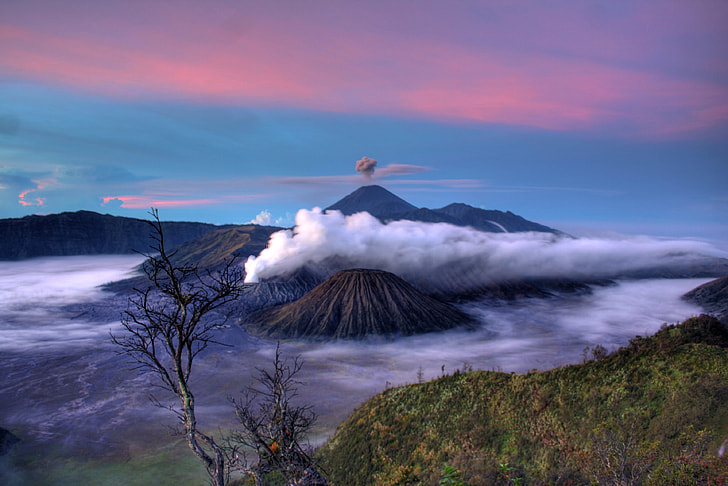
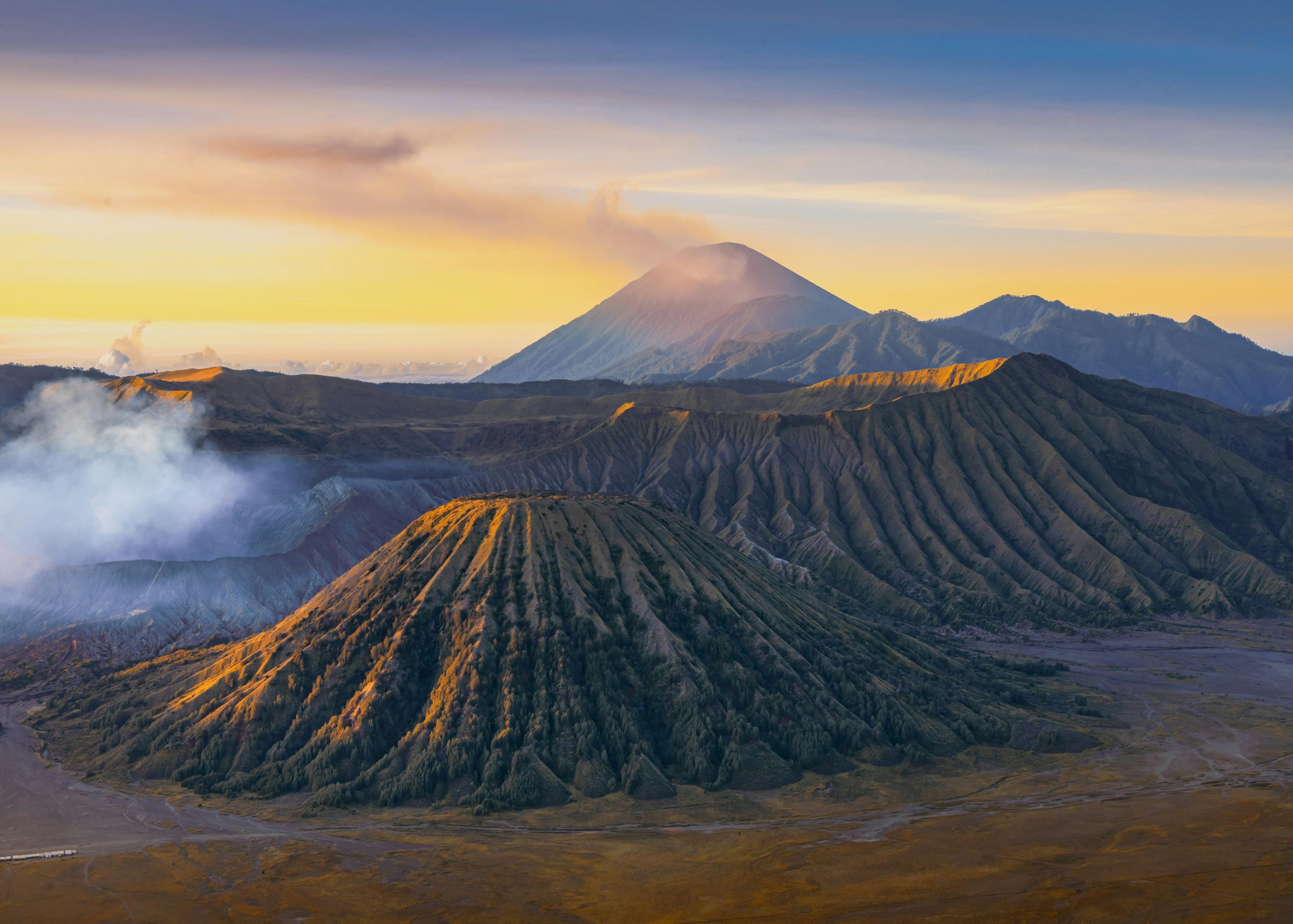
Set within the Bromo–Tengger–Semeru National Park, Bromo’s setting is as dramatic as the volcano itself. The surrounding Sea of Sand—a vast ash desert stretching across the caldera floor—creates an otherworldly stage that visitors cross by jeep, horseback, or on foot. Most travellers begin their experience well before dawn, climbing or driving to viewpoints like Penanjakan or King Kong Hill to witness sunrise illuminating Mount Bromo, Mount Batok, and distant Mount Semeru. From above, the volcanoes emerge from a blanket of mist as the sky shifts from indigo to gold—one of the defining sunrise scenes of Southeast Asia.
Beyond the panoramas, Bromo holds cultural meaning. Each year, the Tenggerese community conducts the Yadnya Kasada ceremony, offering food and harvest items into the crater to honour ancestral beliefs. This blending of natural spectacle and living tradition is part of what makes Bromo feel deeply alive—an active volcano surrounded by a society that treats it with reverence rather than fear.
The crater itself is accessible after sunrise: visitors traverse the Sea of Sand, then climb roughly 250 steps to reach the rim, where sulphurous smoke rises from the depths. The view into the crater is stark and elemental, a reminder of the volcanic forces that shaped the region.
Visiting Notes: Mount Bromo
Location: Mount Bromo sits in East Java’s Bromo–Tengger–Semeru National Park, spread across the regencies of Probolinggo, Pasuruan, Lumajang, and Malang. Common gateway towns include Probolinggo, Malang, Batu, and Cemoro Lawang, each providing different access routes and views.
What to expect: Expect a raw volcanic landscape—open ash plains, cold early-morning temperatures, and a horizon ringed by other volcanic peaks. Reaching sunrise viewpoints typically requires a pre-dawn departure, often around 3 a.m., whether via jeep tours or guided treks. After sunrise, visitors can walk or ride horses across the Sea of Sand to the crater’s base and climb to the rim. Be under no illusion, you will not be on your own!
Best time to visit: Sunrise is the signature experience, bringing the most dramatic colours and clearest views. Dry-season months generally offer the best conditions, though Bromo is visitable year-round. Temperatures at sunrise can fall to 2–5°C, rising rapidly later in the morning. Arriving early is essential to avoid heavy crowds at the main viewpoints.
Dress & behaviour: Warm layers, gloves, and wind protection are recommended for pre-dawn starts. Once inside the caldera, expect volcanic dust and ash—sturdy shoes, face coverings, and eye protection help with comfort. Follow local guidance, especially around the crater, as Bromo is an active volcano with shifting conditions.
Photography: Classic wide shots come from viewpoints such as Penanjakan, King Kong Hill, and Seruni Point, where the volcanoes rise from a sea of mist. At the crater rim, photographers can capture textures of the smoking vent and sweeping views across the caldera. Early morning light is ideal; mid-morning offers clearer skies.
Time needed: A full Bromo experience—from sunrise viewpoint to crater rim—typically takes half a day, though travellers often stay in Cemoro Lawang, Malang, or Batu for a night to ease the early start. Some extend the visit to explore nearby waterfalls, highland villages, or to combine Bromo with Ijen or other East Java highlights.
Mount Ijen (Kawah Ijen)
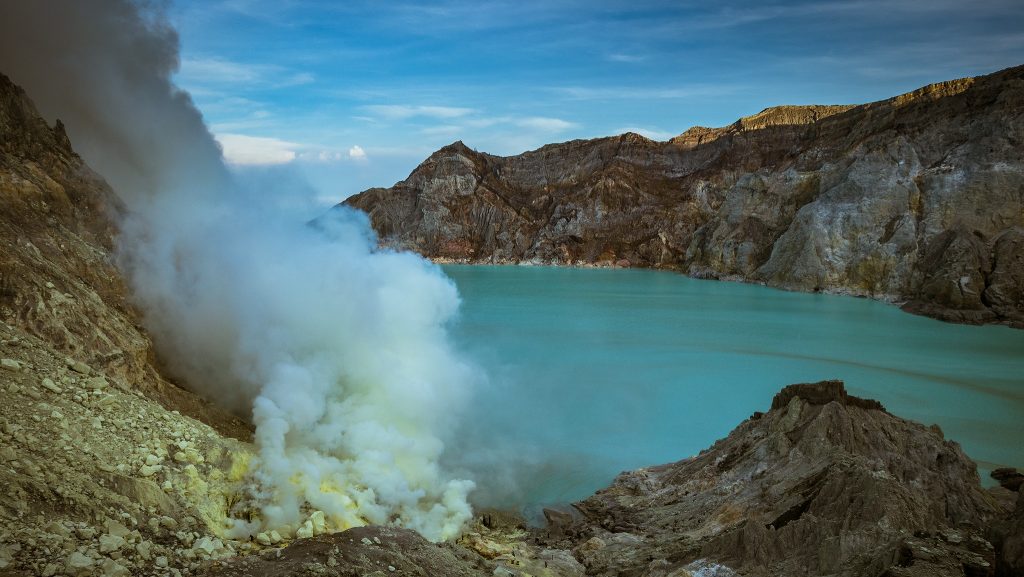
High on the Ijen Plateau of East Java, Mount Ijen offers one of the most surreal volcanic landscapes in Indonesia—a place where darkness reveals electric‑blue flames and dawn unveils a vast turquoise lake steeped in sulphur. Known for its otherworldly blue fire, its acidic crater lake, and the presence of traditional sulphur miners, Ijen is both visually astonishing and culturally significant. The volcano sits near Banyuwangi and forms part of the Java–Bali volcanic arc, making it accessible from both Java and Bali.
Hiking Ijen typically begins around midnight, when trekkers ascend the crater trail under moonlight and mist to witness the rare blue flames, a natural spectacle caused by ignited sulphuric gases escaping through volcanic fissures. Visible only before dawn, the blue fire can rise several meters, glowing eerily against the darkness. After this pre-sunrise encounter, hikers continue upward to the rim, where sunrise breaks over the largest acidic lake in the world, a 200‑metre deep pool of milky turquoise coloured by dissolved minerals and sulphur. From the rim, shifting sulphur clouds drift across the crater, giving the scene a dramatic, almost unearthly atmosphere.
Ijen is also home to the region’s famous sulphur miners, who carry 60–70 kg baskets of solid sulphur up steep paths in one of Indonesia’s most physically demanding traditional professions. Their presence adds a profound human dimension to the volcanic landscape—an ongoing reminder of the intersection between natural wonder and human resilience.
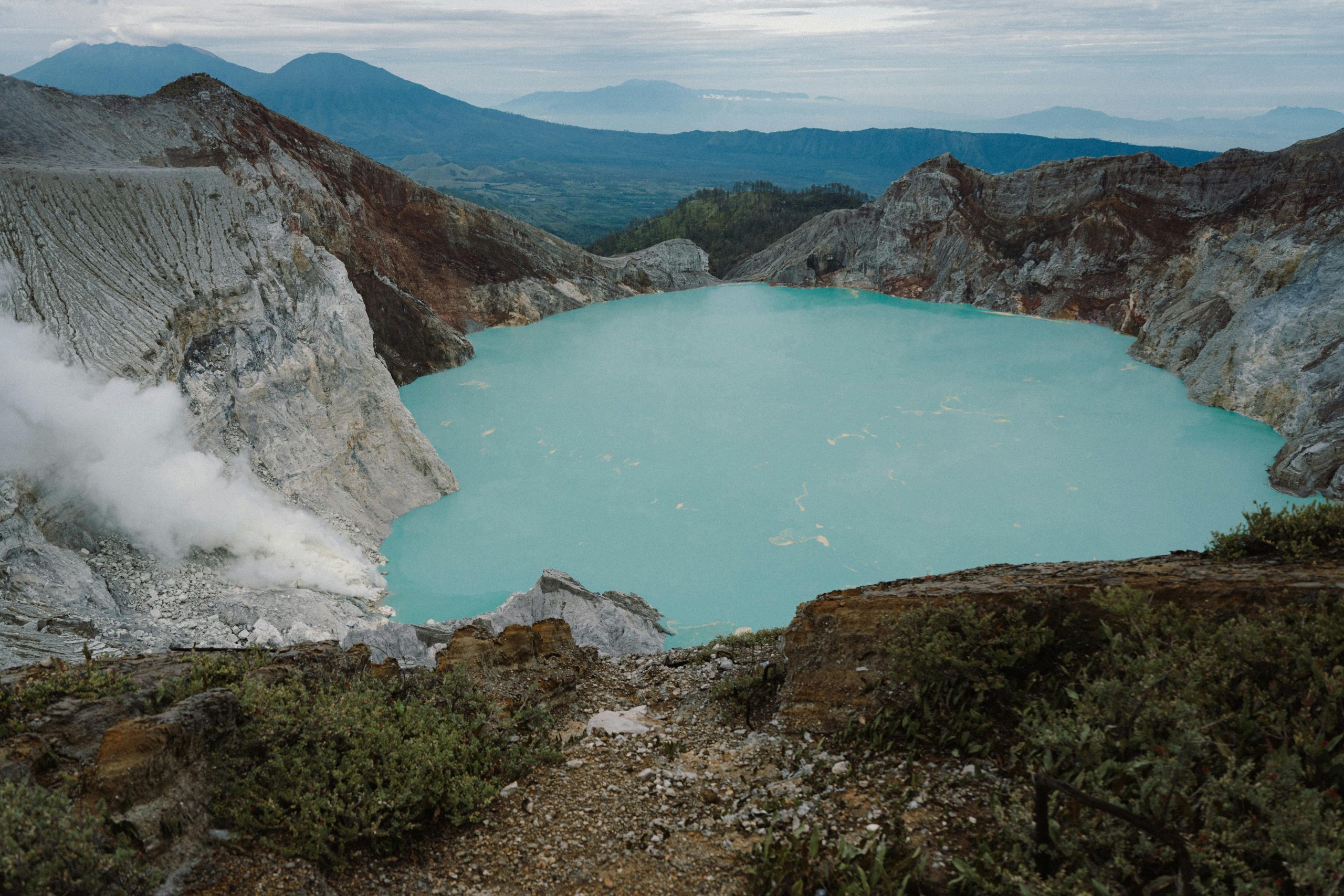
Visiting Notes: Mount Ijen
Location: Mount Ijen lies in East Java’s Ijen Plateau, accessible from Banyuwangi (about 1.5 hours from the base) or via long-distance routes from Surabaya or Bali (ferry + overland transfer). These approaches make Ijen popular as both an independent trip or as part of a combined Bromo–Ijen itinerary.
What to expect: Expect a moderate to challenging nighttime trek of roughly 9.3 km round‑trip, with steep ascents, cold winds, and sulphur fumes requiring gas masks. The pre‑dawn portion focuses on viewing the blue fire; after sunrise, the experience shifts toward panoramas of the crater lake, smoking vents, and the rugged volcanic terrain. The environment is raw, active, and highly atmospheric—this is not a landscaped attraction but a living volcano.
Best time to visit: The dry season (April–October) provides clearer skies, safer trails, and better visibility for the blue fire. Peak months are June–August, while April–May and September–October offer fewer crowds. Wet‑season months bring slippery trails and reduced blue fire visibility. Weekday hikes are preferable for avoiding crowds at the rim.
Dress & behaviour: A gas mask is mandatory, and since 2024, visitors must carry a medical certificate and be accompanied by a local guide. Bring warm layers, sturdy boots, a flashlight or headlamp, and avoid approaching the lake shore due to toxic gases. The volcanic environment can be unpredictable—exercise caution, heed guide instructions, and stay within designated viewing zones.
Photography: Blue fire is best photographed between 2 a.m. and 4 a.m., using long exposures for clearer flame capture. Sunrise brings ideal lighting for the crater lake, with soft golden light revealing mineral colours and mist. Telephoto lenses help frame the lake from safe distances, while wide angles capture the vast crater environment.
Time needed: A typical Ijen trek takes 3–4 hours of hiking, but the full experience—from midnight departure to descending after sunrise—usually spans 6–7 hours. Most visitors stay overnight in Banyuwangi or nearby villages to manage the early start.
Yogyakarta: The Cultural Capital of Java
Yogyakarta is the capital of the Special Region of Yogyakarta and one of Indonesia’s most culturally significant cities. Located near Mount Merapi and 29 km from Java’s southern coast, the city has long been a centre of Javanese civilisation. Originally part of the Buddhist Sailendra kingdom and later the Hindu‑Javanese Mataram Kingdom, Yogyakarta became the seat of the Yogyakarta Sultanate in 1755. Its rich cultural traditions, spanning classical dance, music, batik, puppetry, and literature, remain actively practised today.
The city is also a major academic centre, home to Gadjah Mada University, Indonesia’s oldest and one of its most prestigious universities, and numerous other institutions that contribute to its youthful, intellectual atmosphere. Yogyakarta was a crucial site during Indonesia’s independence movement, temporarily serving as the national capital from 1946 to 1950.
Cultural & Historical Highlights
- Kraton (Sultan’s Palace): A living palace complex and cultural museum that embodies Javanese royal traditions, serving as both the symbolic and administrative heart of the Sultanate.
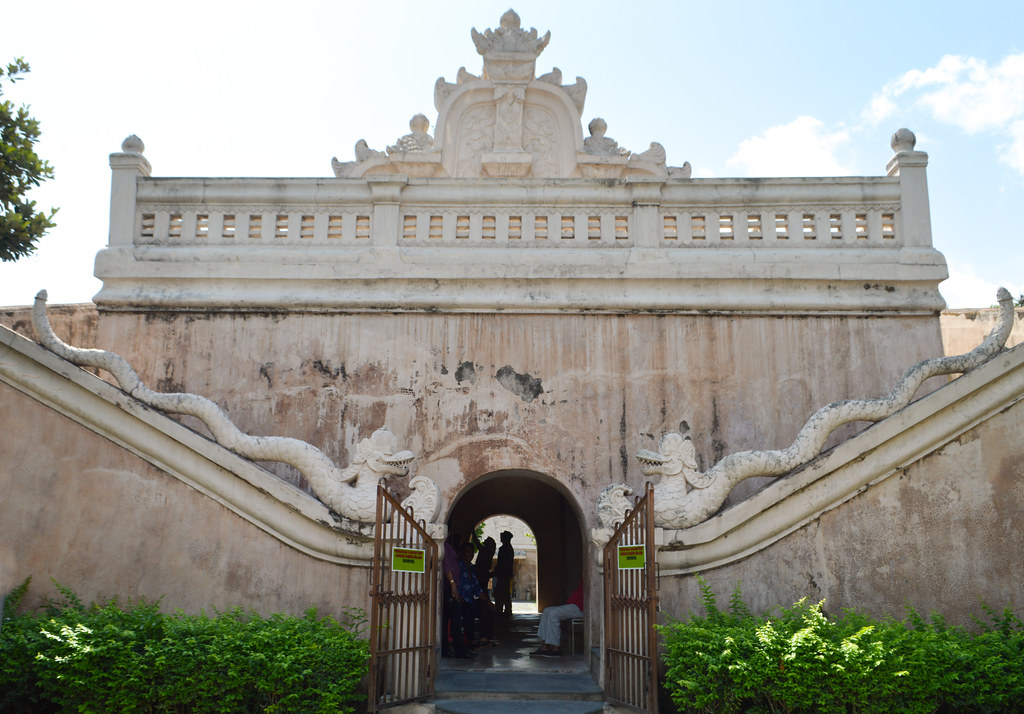
- Taman Sari Water Castle: Once the royal leisure garden, this architectural complex features bathing pools, tunnels, and historical structures that illustrate the sophistication of Javanese palace life.
Yogyakarta is widely regarded as the cultural soul of Java. With its artistic heritage, historical depth, vibrant urban life, and proximity to the monumental Borobudur and Prambanan temples, it remains one of Indonesia’s most influential and captivating destinations.
Getting there: From Malang to Yogyakarta
The journey from Malang to Yogyakarta is straightforward, with several reliable transport options depending on comfort, timing, and budget.
By train: Direct trains run several times a day from Malang to Yogyakarta Tugu Station, with journey times of around 6 hours. Services include economy and executive classes, with tickets starting from around IDR 220,000–340,000 (£11–£17) on Indonesian Railways (KAI). Trains depart from Malang Station and arrive in central Yogyakarta, making this the most convenient option for most travellers.
Executive services such as the Kertanegara and Malabar trains are well‑reviewed for comfort.
By bus: Direct buses connect Malang and Yogyakarta daily. Executive-class coaches take approximately 5–6 hours, depending on traffic, with fares typically around IDR 200,00-225,000 (£9–£10). Buses depart from Malang city and arrive at Yogyakarta’s main stations, with operators such as Tividi and Cititrans offering comfortable services.
Sites that might be worth Exploring
Yogyakarta, known locally as Jogja, sits at the cultural and spiritual heart of Java, a city where tradition is not preserved for display but woven seamlessly into everyday life. The city is unique in Indonesia for still being governed by a Sultan, and guided by centuries‑old customs. Yogyakarta moves to a rhythm all its own: gamelan music drifts from palace courtyards, batik artisans work in quiet backstreets, and rituals unfold with an unhurried confidence that feels refreshingly untouched by modern urgency. It is a destination that rewards those who linger, offering insight into a way of life shaped as much by philosophy and ritual as by history.
Beyond the city, Yogyakarta provides access to some of Indonesia’s most extraordinary sights. The monumental temples of Borobudur and Prambanan rise from the surrounding plains as enduring symbols of Java’s Buddhist and Hindu past, while royal water palaces, volcanic landscapes and vibrant markets add further depth to the journey. Together, these experiences form a destination of rare balance: culturally rich, visually arresting and quietly profound, a place not simply to visit, but to absorb and as such suits our slow pace.
Borobudur
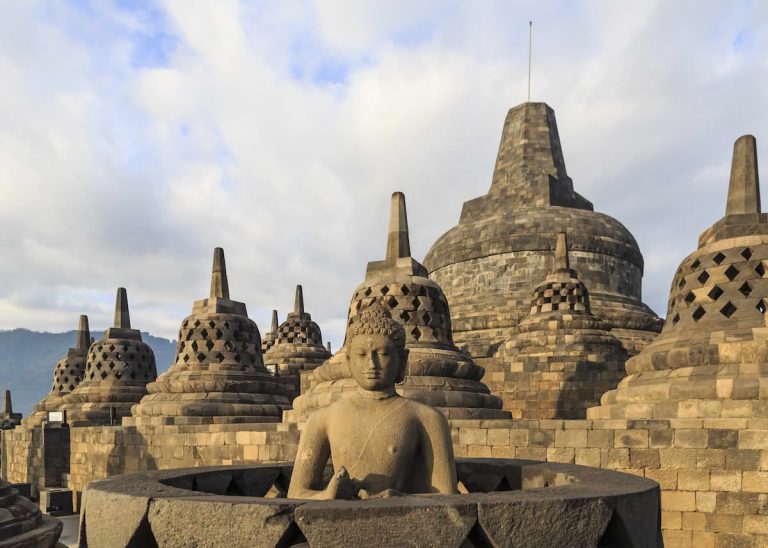
Rising from the fertile Kedu Plain of Central Java, Borobudur is the world’s largest Buddhist monument and one of Southeast Asia’s most profound spiritual sites. Constructed during the 8th and 9th centuries under the Sailendra dynasty, the temple was conceived not simply as a place of worship, but as a three‑dimensional guide to enlightenment. Its design combines the symbolic forms of the stupa, the sacred mountain and the mandala, leading pilgrims on a clockwise ascent through nine terraces that represent successive stages of Buddhist cosmology — from the world of earthly desire to ultimate spiritual release.
For centuries, Borobudur was lost to the world. Following the decline of Buddhist kingdoms in Java and repeated volcanic eruptions, the monument was gradually buried beneath ash and jungle growth. Its rediscovery in 1814 by Sir Thomas Stamford Raffles, then British governor of Java, marked a turning point. Acting on local knowledge, Raffles ordered the site to be cleared, revealing a structure of astonishing scale and sophistication. Subsequent Dutch and UNESCO‑led restorations culminated in Borobudur’s designation as a UNESCO World Heritage Site in 1991, securing its place among the great archaeological monuments of the world. Today, Borobudur remains a place of pilgrimage as well as quiet contemplation. More than 2,600 carved relief panels depict Buddhist teachings, moral lessons and scenes from daily life, while hundreds of serene Buddha statues sit within perforated stupas, seemingly suspended between earth and sky. To visit Borobudur is not merely to admire an ancient structure, but to experience a journey, physical, visual and philosophical, that has remained largely unchanged for over a millennium.
In recent years, access to the monument has been carefully managed to ensure its preservation for future generations. Visitor numbers allowed onto the temple structure are now strictly limited, with advance online booking required and guided entry enforced. Those permitted to ascend must wear specially designed upanat sandals, introduced in late 2023 to protect the ancient stone from erosion caused by modern footwear. These measures have transformed a visit to Borobudur into a more considered and intimate experience, reinforcing the sense that this is not a site to be consumed, but one to be respected.
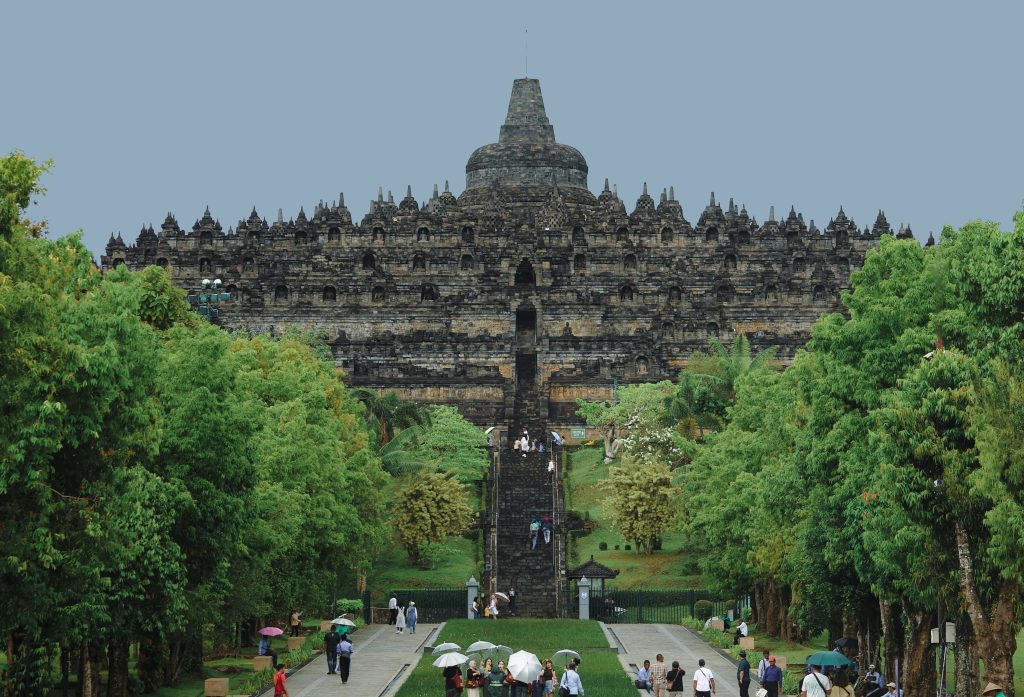
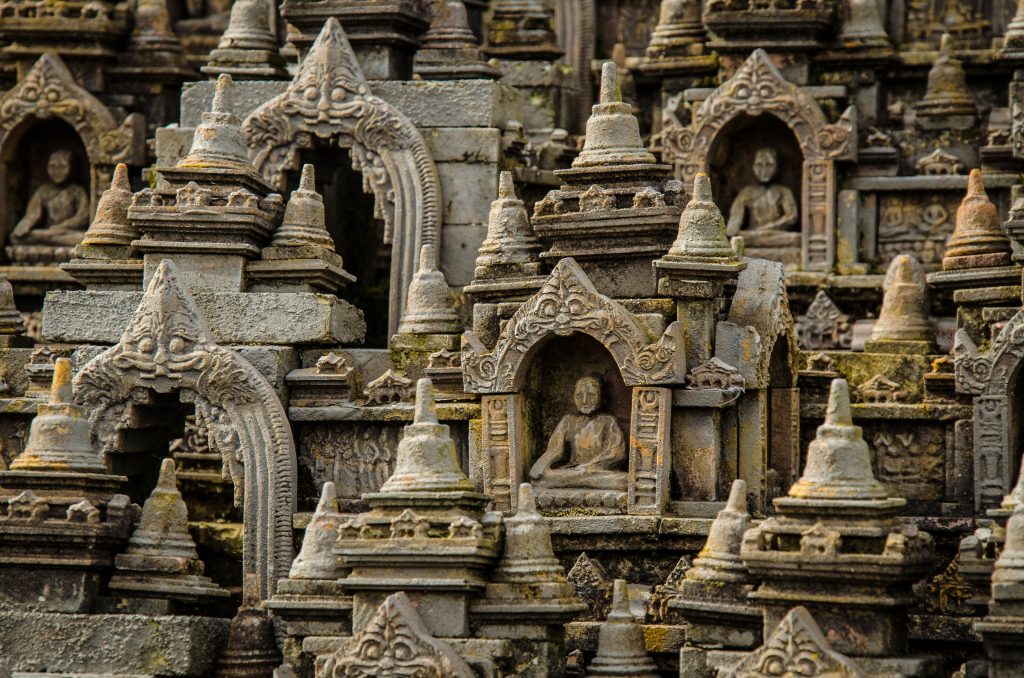
Visiting Notes:
Location: Borobudur lies in Central Java, approximately 40 km north-west of Yogyakarta, set amid volcanic plains between Mount Merapi and Mount Merbabu. Most visitors reach the site by private car or organised transfer from the city.
Access and Tickets: Entry to the temple structure is now strictly regulated. Tickets must be booked online in advance and are released only a few days ahead of the visit. Daily access to the monument itself is limited to a fixed number of visitors, admitted in small, timed groups and accompanied by an official guide. Mondays are reserved for maintenance, when access is restricted to the surrounding grounds. https://ticket.borobudurpark.com/en/
This is the most reliable source for tickets, and it is strongly recommended, as access to the temple structure is strictly limited and often sells out. Third-party platforms also sell tickets, but availability for climbing the monument is not guaranteed.
Ticket Types and Prices (International Visitors)
- Temple Grounds Ticket: Allows access to the park and views of Borobudur from ground level only. Approx. IDR 455,000 (£20) per adult. (Does not permit climbing the monument)
- Temple Structure (Climb‑Up) Ticket: Required to ascend the monument itself. Includes timed entry, an official guide and mandatory upanat sandals. Approx. IDR 455,000 per adult. (Strict daily quota; advance booking essential)
- Sunrise or Sunset Tickets: Premium access outside standard opening hours with very limited numbers. Approx. IDR 1,000,000 per person. (Extremely limited availability; often sells out days ahead)
Important Notes
- Tickets are released only a short time in advance (We are going in June, I booked our tickets in April) and are date, and time, specific.
- Climbing the temple is only permitted with a structure ticket and a guide.
- Prices are set in Indonesian rupiah and may vary slightly depending on season and availability.
Footwear & Conservation: To protect the ancient stone, visitors permitted onto the temple must wear specially designed upanat sandals, provided on arrival. These lightweight sandals, introduced as part of conservation efforts in late 2023, reduce friction on the worn steps and terraces and are compulsory for all ascents. Personal footwear is stored during the visit. And the best bit, you get to keep the sandals!
Etiquette: Borobudur remains an active place of worship. Touching reliefs or Buddha statues is prohibited, as are selfie sticks, drones and large bags. A calm, respectful approach is expected throughout, reinforcing the sense that this is a sacred monument rather than a conventional tourist attraction.
When to Visit: Early morning and late‑afternoon sessions offer softer light and a quieter atmosphere. While sunrise access to the upper levels is now restricted, the surrounding park still provides impressive views across the Kedu Plain, particularly in misty conditions.
Prambanan
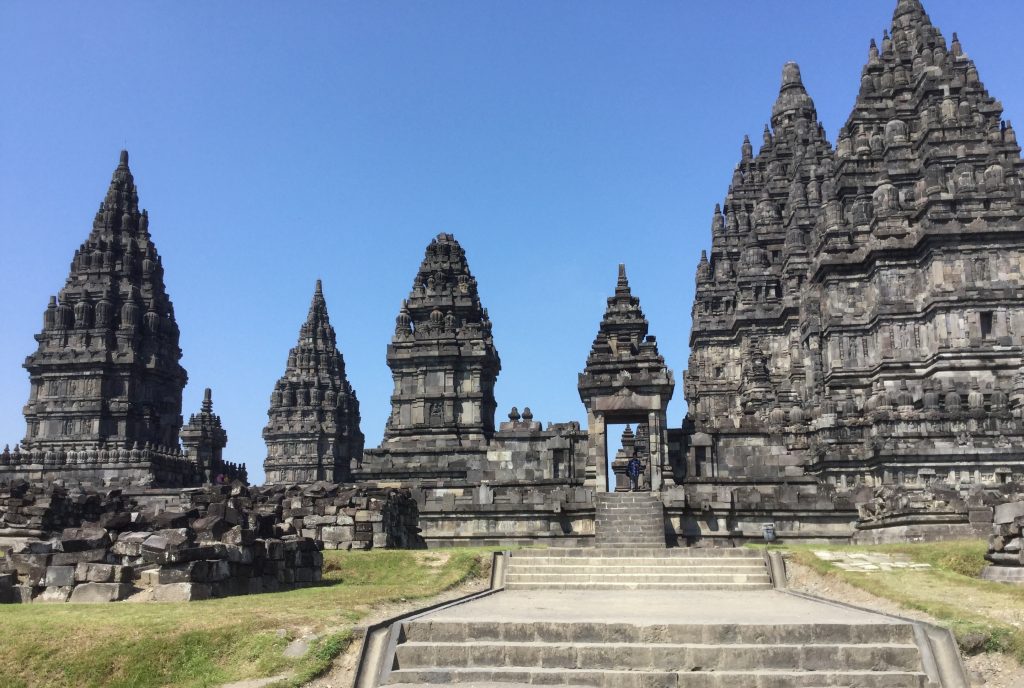
According to Javanese legend, Prambanan was built in a single night by supernatural forces, a temple complex conjured through ambition, betrayal and divine intervention. While the myth belongs to folklore, the reality is no less astonishing. Rising from the plains east of Yogyakarta, Prambanan is Indonesia’s largest Hindu temple complex, a dramatic ensemble of soaring stone towers dedicated to the gods of the Hindu Trimurti, and a monument whose scale and symbolism still command awe more than a thousand years after its construction.
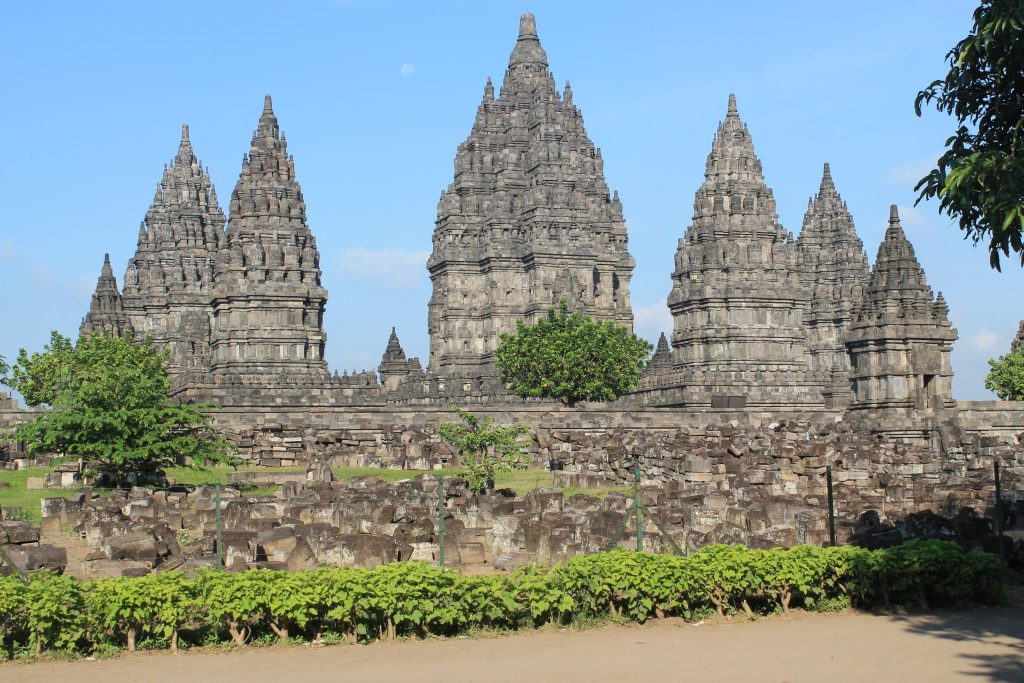
Where Borobudur draws the eye inward and upward in quiet contemplation, Prambanan announces itself through height, symmetry and spectacle. A forest of slender stone spires rises sharply from the plain, their pointed silhouettes forming one of Java’s most striking horizons. The experience is especially evocative in the late afternoon, when the sharp silhouettes of the temples glow in the lowering sun, and again after dark, when traditional Ramayana ballet performances bring the epic carvings to life against an illuminated backdrop of ancient stone.
Prambanan’s purpose was both devotional and symbolic. Designed as a temple‑mountain, the complex represents Mount Meru, the centre of the Hindu universe, with devotees once moving through a ritual landscape of shrines, courtyards and processional routes. Intricate bas‑reliefs carved into the temple walls recount scenes from the Ramayana, their narratives unfolding as visitors walk clockwise around the inner sanctuaries. At its peak, Prambanan would have been both a centre of worship and a powerful statement of royal legitimacy, proclaiming the authority of Java’s Hindu rulers in stone.
Like Borobudur, Prambanan was eventually abandoned. Shifts in political power, religious change and seismic activity led to the complex falling into ruin, its temples partially collapsed and scattered by earthquakes. Though known locally for centuries, serious restoration began under Dutch colonial administration in the early 20th century, with painstaking work continuing into the modern era. Today, Prambanan is recognised as a UNESCO World Heritage Site, admired not only for its scale and craftsmanship but also for the drama of its partially restored towers rising from a field of fallen stone.
Visiting Notes:
Location: Prambanan lies approximately 17 km east of Yogyakarta, close to the border between Central Java and the Special Region of Yogyakarta. It is easily reached by private car, taxi or local transport, and is often combined with Borobudur in a single day.
Getting to Prambanan from Yogyakarta (Public Transport)
Reaching Prambanan from central Yogyakarta is straightforward and inexpensive using public transport, making it one of the easiest major sites to visit independently.
By Trans Jogja Bus (Most Practical Option)
The Trans Jogja bus network provides a direct, low‑cost route from the city to Prambanan.
- Take Trans Jogja Route 1A in the direction of Terminal Prambanan.
- Buses depart frequently from stops along Malioboro Street, near Tugu Station, and from several points across the city.
- Alight at Prambanan Terminal, from where the temple entrance is a short walk of approximately 5–10 minutes.
- Fare: IDR 3,600 per person, payable by contactless card or supported e‑wallets.
- Journey time: approximately 40–45 minutes, depending on traffic.
This is the most reliable option for visitors staying in central Yogyakarta and is well signposted and easy to navigate.
By Commuter Train (KRL Yogyakarta–Solo Line)
The electric commuter train offers a quicker alternative during busy periods.
- Trains depart from Lempuyangan Station in Yogyakarta towards Solo.
- Alight at Brambanan Station.
- From the station, Prambanan Temple is around 1.5 km away, reachable on foot or by short local taxi ride.
- Journey time: approximately 20–25 minutes by train.
Access & Tickets: Prambanan is managed by the same authority as Borobudur, and tickets can be booked via the official site: https://ticket.borobudurpark.com/en/
Unlike Borobudur, access to Prambanan’s main courtyards is less restricted, and visitors are free to explore the complex independently during opening hours. Some inner areas may be closed temporarily for conservation work.
Ticket Types & Prices (International Visitors)
- Standard Entrance Ticket: Allows full access to the Prambanan temple complex and surrounding grounds. Approx. IDR 400,000–455,000 per adult. There are no time slots onteh ticket, only the day. There is restricted access on Mondays for maintenance.
- Ramayana Ballet Tickets: Evening performances held on select nights, staged against the illuminated temples. Prices vary by seating and season and should be booked in advance.
Etiquette: Prambanan remains a sacred Hindu site. Visitors should dress respectfully, avoid climbing on ruins, and refrain from touching reliefs or statues. Some temples may be closed for worship or restoration at short notice.
When to Visit: Early morning offers quieter exploration and softer light, while late afternoon is ideal for photography. Sunset transforms the complex into a striking silhouette, and evening performances provide one of the most atmospheric ways to experience the site.
A little more detail on Prambanan
Prambanan is a rigorously ordered sacred landscape rather than a single monumental building. The complex is laid out on a rectangular, axial plan, organised through a series of concentric courtyards that rise gradually toward the centre, mirroring Hindu cosmological ideas of ascension from the earthly realm toward the domain of the gods. Originally, the compound contained hundreds of structures arranged with strict symmetry, creating a dense stone city oriented along cardinal directions.
At the core of the complex stands the central terrace, an elevated square platform that carries the six primary temples. The dominant structure is the Shiva temple, which acts as the architectural and symbolic focus of the entire site. Rising to approximately forty‑seven metres, it is built as a tiered tower crowned with a tall, stepped roof that draws the eye upward, emphasising the vertical and divine hierarchy. The temple’s massing is complex: projecting porches, sharply articulated cornices, and deep shadowed niches create a sense of rhythm and depth across the façades.
Inside, the Shiva temple is divided into four interior chambers, aligned to the cardinal points. The central cella contains a large statue of Shiva Mahadeva, while the subsidiary chambers house figures including Durga and Ganesh. Internally, the architecture remains austere and vertical, with thick stone walls and limited light, reinforcing the sense of enclosure and ritual gravity.
Flanking the Shiva temple are the Brahma and Vishnu temples, slightly smaller but architecturally parallel in form. Their façades repeat the same vertical emphasis, stepped roofs, and profusion of carved ornament, creating visual coherence while maintaining a clear hierarchy. The exteriors of these three main shrines are encircled by bas‑relief panels, famously depicting episodes from the Ramayana. These reliefs are integrated architecturally rather than treated as surface decoration, forming a continuous narrative band that guides circumambulation around the temples.
Directly facing each of the three deity temples across a central processional axis are the vehicle temples, each dedicated to the divine mount associated with the god it mirrors. The Nandi temple, opposite Shiva’s shrine, forms a strong axial counterpoint and reinforces the ritual dialogue between deity and devotee. Architecturally, these temples are more compact but replicate the same pointed silhouette and decorative vocabulary, maintaining overall unity while marking their secondary status.
- Nandi Temple (bull) faces the Shiva temple
- Garuda Temple (eagle) faces Vishnu
- Hamsa Temple (mythical goose/swan) faces Brahma
Around the central platform are smaller functional shrines:
- Candi Apit: flanking temples near stairways
- Candi Kelir: placed at the four corners
- Candi Patok: likely boundary or directional markers
These structures reinforce cosmological order and transition between sacred zones rather than serving as primary worship spaces.
Beyond the central terrace, Prambanan’s architecture becomes increasingly expansive and fragmentary. Lower terraces once held rows of pervara temples, small subsidiary shrines arranged in precise concentric rings around the core. Although few remain standing today, their foundations reveal an overwhelmingly dense configuration intended to surround the main sanctuary with repeated sacred forms, amplifying its spiritual authority through repetition and scale.
The entire complex is constructed from andesite stone, quarried from volcanic sources nearby, and assembled with high precision. Decorative elements—floral motifs, guardian figures, kala heads, and geometric mouldings—are deeply carved, producing strong contrasts of light and shadow that animate the structures throughout the day. The tall, tapering silhouettes and pointed finials distinguish Prambanan from the more horizontal massing of nearby Buddhist monuments, underscoring its distinct architectural identity. Prambanan does not exist in isolation but as part of a broader sacred zone, which includes nearby Buddhist temple complexes such as Sewu and Lumbung. Although differing in religious affiliation and form, these structures share similar orientations and construction techniques, suggesting coordinated planning across the landscape. Together, they reinforce the impression of central Java as a carefully structured ritual environment shaped as much by architecture as by belief.
Kraton: A Grand Complex that Reflects the Javanese Cosmos.
The Kraton was born out of fracture. In the middle of the eighteenth century, the once-powerful Mataram Sultanate was divided, its authority weakened by internal conflict and foreign interference. From that division emerged Yogyakarta. It emerged as a new royal centre under Sultan Hamengku Buwono I, who ordered the construction of the Kraton in 1755–56. What was created was not simply a residence, but a statement of continuity at a moment when continuity could no longer be taken for granted. The site was chosen deliberately. The palace was laid out along a strict north–south axis, aligned with Mount Merapi and the Indian Ocean, embedding the new sultanate within an older cosmological order that long pre-dated political boundary. Even as kingdoms were divided and power recalculated, the deeper structure of the world remained intact.
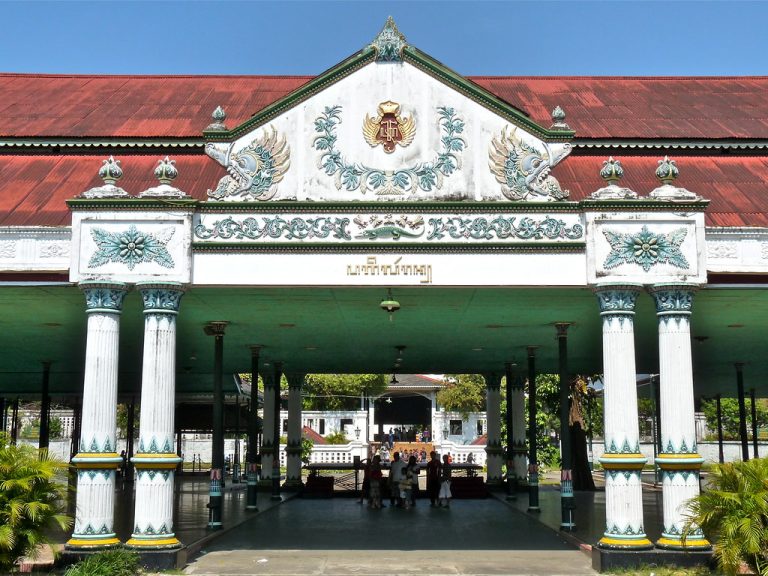
Unlike Borobudur or Prambanan, the Kraton was never abandoned. There was no period of burial or rediscovery. Its history is not one of interruption, but of persistence. The palace continued to function as the heart of court life, sustaining rituals, arts, and social codes that shaped Javanese identity long after royal power had been curtailed. Over time, the Kraton expanded, pavilion by pavilion, under successive sultans. Each addition respected the original layout, preserving the palace’s symbolic geometry even as circumstances changed. Colonial rule reduced the Sultan’s political autonomy, but the palace endured as a cultural and ceremonial centre. It adapted without surrendering its core logic. Architecturally, the palace reflects this intent. It does not rise above its surroundings, nor does it seal itself off from them. Pavilions are open-sided, roofs are low, and courtyards follow one another in measured sequence. The effect is not defensive, nor ostentatious, but composed. Authority here is expressed through order and alignment rather than mass.
In this way, the palace differs fundamentally from the great temples nearby. Borobudur and Prambanan speak of belief through stone, fixed at the moment of their creation. The Kraton speaks through behaviour. Its history is not confined to its founding or its buildings, but extends into the present through custom, etiquette, and rhythm. The northern and southern squares, Alun‑alun Lor and Alun‑alun Kidul, still define the palace’s relationship with the city. The northern square once hosted royal ceremonies and public audiences, framed by ancient banyan trees that still mark its centre. The southern axis leads symbolically towards the ocean, believed to be the realm of the Queen of the South Seas, the Sultan’s spiritual counterpart. Even death follows this logic: royal funeral processions move southwards, along the same invisible line.
To walk through the Kraton after visiting the temples is to understand what followed them. The temples represent Java’s engagement with imported cosmologies, monumental and absolute. The palace represents their translation into order, into governance, ceremony, and daily discipline. It shows how belief survived not as architecture alone, but as practice.
The Kraton does not dominate the skyline, it never needed to. Its authority lies in having endured through division, colonial constraint, and modern change without losing its centre. Between mountain and sea, between past and present, it continues to hold its ground, quietly asserting that balance, once established, can still be maintained.
Visiting Notes:
Opening hours: The Kraton is generally open Tuesday to Sunday, from around 08:00–14:00. It is closed on Mondays and may also close during royal ceremonies or special events.
Tickets: Visitors enter via designated public gates and pay a modest entrance fee. Foreign visitors typically pay IDR 15,000 (£0.70), with a small additional charge if you wish to take photographs inside the palace complex.
What you see: The Kraton is not a single building, but a working palace complex made up of courtyards, open pavilions, and small museum spaces. Only certain areas are open to the public; others remain private as the Sultan’s residence and administrative centre. Expect royal heirlooms, batik, weapons, photographs, and ceremonial objects displayed simply rather than dramatically.
Context: Unlike Borobudur or Prambanan, the Kraton is a living institution. The Sultan still resides here and serves as the hereditary governor of the region. Visitors are guests within an active cultural and political centre, not simply tourists at a historical site.
Performances: Traditional gamelan music and classical dance performances are often held in the mornings and are usually included in the entry ticket, particularly between 09:00 and 11:00. These are working rehearsals or court performances, not theatrical shows.
Dress and behaviour: There is no formal dress code, but modest clothing is expected. Shoulders and knees should be covered. Behaviour is important: move slowly, avoid loud conversation, and follow instructions from palace attendants (abdi dalem), who still serve the court in traditional dress.
Time needed: Allow 1.5–2 hours for a visit. The experience is more about atmosphere than volume of exhibits, and it rewards patience rather than speed.
Photography: Photography is permitted in most public areas but requires purchasing a separate permit at the entrance. Some spaces may still be restricted.
Best time to visit: Arrive early in the morning for cooler temperatures, fewer crowds, and the best chance of seeing performances and daily palace routines.
Taman Sari Water Castle
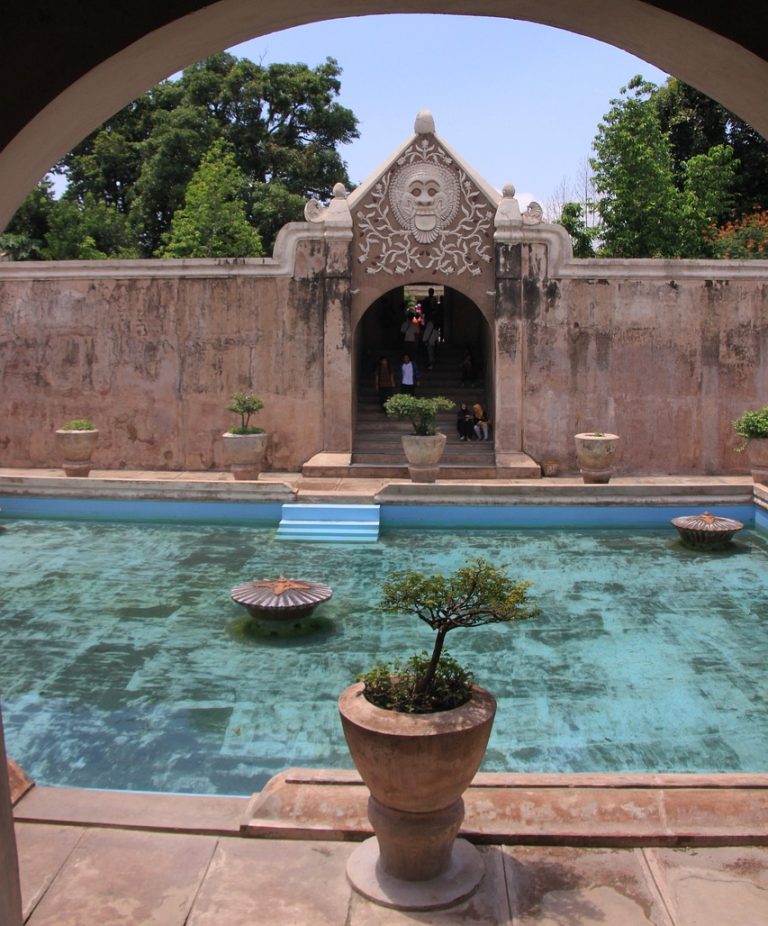
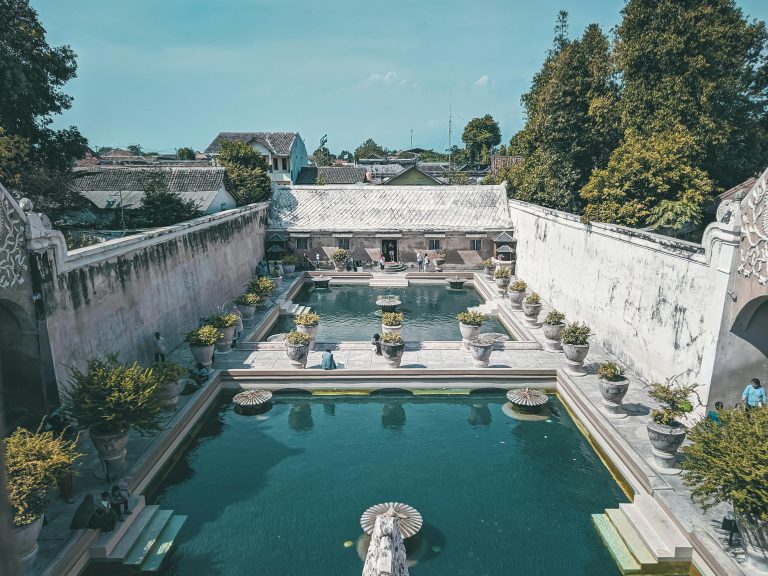
Hidden behind narrow lanes and unassuming walls, Taman Sari is less a single monument than the surviving core of an elaborate royal landscape shaped by water. Constructed in the mid‑18th century during the reign of Sultan Hamengkubuwono I, the complex originally extended far beyond its present footprint, combining artificial lakes, islands, canals, bathing courts, pavilions, and underground passages into a secluded pleasure garden for the Yogyakarta court. Water was both a practical and symbolic element here: it cooled the air, structured movement through the site, and reinforced ideas of purity, hierarchy, and controlled retreat within a fortified urban setting.
At the heart of the surviving complex is the bathing area, where pale stone pools are arranged within enclosed courtyards, once fed by springs and channels that connected to larger surrounding reservoirs. These pools formed part of a carefully orchestrated environment, designed for leisure and observation as much as for ritual cleansing. Elevated towers allowed the sultan to overlook the water courts, while surrounding chambers provided shaded spaces for rest and preparation. Beyond this inner core, now largely absorbed into the surrounding neighbourhood, lay expansive water gardens dotted with pavilions that could be partially submerged by controlling sluice gates, transforming Taman Sari into a literal “water castle” in times of ceremony or threat.
The complex also functioned as a place of withdrawal and reflection. Underground tunnels linked the pools to hidden prayer spaces and a circular subterranean mosque, where light enters only from above, creating an atmosphere of enclosed calm distinct from the openness of the water gardens. Over time, earthquakes, changing court priorities, and urban growth reduced Taman Sari to fragments, yet its design still reveals a sophisticated blending of Javanese spatial principles with strong foreign influences absorbed through trade and diplomacy. Today, walking through the remains, water, architecture, and history feel tightly interwoven, less monumental than Java’s great temples, but quietly expressive of courtly power, intimacy, and control in an island shaped as much by palaces as by volcanoes.
Visiting Notes:
Location: Taman Sari lies just south‑west of the Kraton in central Yogyakarta, hidden behind residential streets that were once part of the wider royal gardens. The final approach is on foot through Kampung Taman, which now occupies much of the former complex.
What remains: Only the central bathing complex, underground mosque, and some tunnels are preserved in full. Large sections of the original lakes, canals, and pavilions have been lost or absorbed into the surrounding neighbourhood, giving the site a fragmented but atmospheric character.
Best time to visit: Early morning is quieter and allows time to explore the bathing pools and underground spaces before the heat builds. The enclosed courtyards can feel exposed later in the day.
What to look for: Focus on the relationship between water, elevation, and enclosure—raised viewing platforms above the pools, sunken bathing courts, and the sudden transition into subterranean spaces that once offered privacy and security for the royal household.
Atmosphere: Unlike Java’s major temples, Taman Sari is intimate and inward looking. Its appeal lies less in monumentality than in its layered spaces and the contrast between calm interiors and the busy city surrounding them.
A Walking Route Through Yogyakarta
Yogyakarta reveals itself best at walking pace, where palace walls, market streets, mosques, and quiet kampungs sit close together. The city’s historic core is organised along a symbolic north–south axis, linking court, market, and water gardens in a sequence that reflects both royal power and everyday life.
Begin around Malioboro, the city’s main thoroughfare and long‑standing commercial spine. This is Yogyakarta at its most animated: street vendors, bookstalls, batik shops, and cafés line the pavements, while the rhythm of daily trade gives a sense of the city’s role as Java’s cultural crossroads. Walking south, the bustle gradually thins, and the architecture becomes more formal, signalling your approach to the royal precinct.
Beyond Malioboro lies the Kraton, the living palace of the sultan and the symbolic heart of Yogyakarta. Even from its outer courtyards, the atmosphere shifts—slower, quieter, more ceremonial. The surrounding neighbourhoods retain a sense of order shaped by centuries of court life, and traditional houses sit behind high walls along shaded streets.
From here, continue west on foot toward Taman Sari, slipping through narrow residential lanes that once lay inside the palace grounds. This walk offers one of the most revealing contrasts in the city: domestic life unfolding amid fragments of royal architecture. The water castle itself, with its bathing pools and tunnels, marks a sudden retreat from urban space into a former world of enclosure and leisure, where water and walls shaped privacy and power.
Leaving Taman Sari, walk south‑east toward Alun‑Alun Kidul, the southern square. This open space once formed part of the cosmological order of the city, balancing the palace to the north. Today it remains an unpretentious gathering place, particularly lively in the evenings, where the formal geometry of Javanese planning meets contemporary life.
If time allows, the route can be extended eastward toward Kotagede, the old nucleus of the Mataram Sultanate. The pace slows noticeably here: narrow streets, silver workshops, mosques, and traditional houses create a sense of continuity with Java’s pre‑colonial past. Alternatively, turn back north as dusk approaches, when Malioboro reasserts itself with street food, lights, and informal commerce.
Taken together, this walk forms a layered portrait of Yogyakarta—royal and domestic, ceremonial and lived‑in—where history is not confined to monuments but embedded in the city’s everyday fabric.
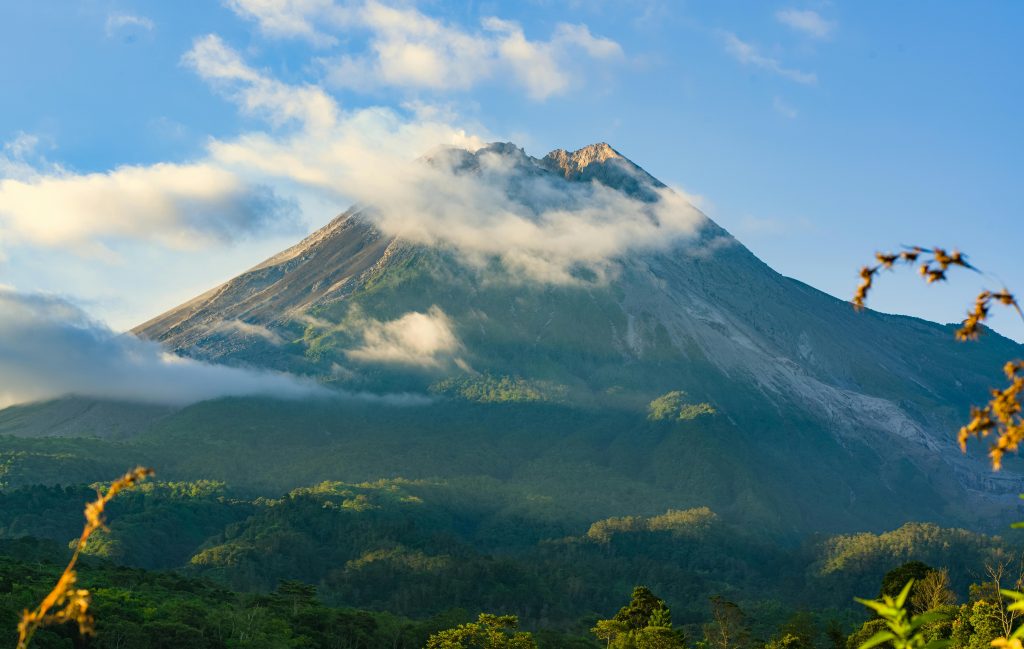
Mount Merapi
Rising sharply to the north of Yogyakarta, Mount Merapi dominates both the landscape and the imagination of central Java. Known locally as the “Mountain of Fire,” it is one of the most active volcanoes in the world, its steep cone regularly reshaped by eruptions that have occurred for centuries. From the city on clear mornings, the summit often appears deceptively calm, a backdrop to daily life that conceals extraordinary power beneath its surface. Merapi sits uncomfortably close to densely populated plains, yet its slopes remain heavily cultivated, the volcanic soils prized for their fertility despite the risks they carry.
Beyond its geology, Merapi holds deep cultural significance. The volcano is considered sacred, bound into Javanese cosmology as a living presence rather than a distant natural feature. Rituals and offerings have long formed part of an effort to maintain balance between the mountain and the communities below it, reflecting a worldview in which eruption and renewal are inseparable. Today, Merapi is closely monitored, its activity shaping patterns of evacuation and return, yet it remains a constant—unavoidable, awe‑inspiring, and integral to the identity of the region. Seen from afar or approached cautiously on its lower slopes, it offers one of the clearest expressions of Java’s volatile relationship between nature, belief, and settlement.