Sumatra: Chaos, Colour, Lakes and Jungle
Sumatra doesn’t ease you in gently; it sweeps you up the moment you step off the plane. One minute you’re gliding through immigration feeling smug about your paperwork, and the next you’re standing in an arrival hall exploding with colour, chaos and celebratory outfits bright enough to guide ships at sea. Before you’ve even reached the jungle, the island has already made its intentions clear: this is a place where nothing happens quietly, where the roads have personalities, and where adventure begins long before you realise you’re in the middle of one.
Arrival, Colour, Chaos and the Road to Bukit Lawang
Airports can be wonderful places to pass through when all the paperwork is in order. We were flying back to Indonesia, Sumatra, to be exact, and with the visa sorted and immigration cards completed, it was a simple matter of tap‑and‑go through the automated gate. Within minutes we were standing at the baggage carousel, watching our fellow passengers, the ones who had battled heroically to be first off the plane, now standing in long, resigned queues, scanning QR codes and filling out forms they could have completed before the flight. Our euphoria, however, was short‑lived.
We stepped into the arrival lounge expecting to see the man who was supposed to take us to the jungle. Instead, we found an empty space where he should have been. Well, not exactly empty, the place was full of Indonesians dressed in spectacularly colourful clothing, each group wearing coordinated scarves and fabrics showing where they were from. Even their luggage matched their outfits. The airport was a riot of colour: reds, greens, yellows, blues, all of them bright enough to be seen from space. Subtlety is not a regional pastime; if a colour exists, someone was wearing it, in fluorescent.
When our driver finally arrived, I asked him what was going on, expecting some kind of tournament, festival, or perhaps an Indonesian version of It’s a Knockout. But no, they had all just returned from a pilgrimage to Mecca. I didn’t realise fancy dress was part of the requirement, but apparently the tradition is to return home in celebratory clothing, and Sumatra clearly does celebration with enthusiasm.
The roads in Sumatra leave a lot to be desired. Potholes so large they appear to have their own ecosystems, stretches where the tarmac has given up entirely, and sections where the road surface resembles geological research rather than infrastructure. Talking to various people about the state of the roads, the answer was always the same: too much corruption to get them repaired, and the president, elected with jubilation when we were in Bali in 2024, has done little to change things. As you might expect, his popularity has declined.


The Leuser Ecosystem
For wildlife, it’s irreplaceable. For humans, it’s essential. For both, it’s increasingly fragile.
The Leuser Ecosystem is a vast, mountainous rainforest system in northern Sumatra, covering around 2.6 million hectares, an area roughly the size of Wales. It’s the last place on Earth where orangutans, tigers, elephants and rhinos still coexist in the wild, sharing the same forest in a way that feels almost mythical. The landscape is a mix of steep valleys, cloud forests, peat swamps, fast‑flowing rivers and dense jungle, stretching across the provinces of Aceh and North Sumatra.
When the hillsides are intact, the forest acts like a giant sponge, absorbing rainfall, releasing it slowly, and preventing floods. When the forest is cut, the sponge disappears, and the water comes down all at once.
To prevent this, the Leuser Ecosystem is legally protected, but enforcement is inconsistent. Illegal logging, palm‑oil expansion, mining and road‑building have carved into the forest for decades, weakening slopes and destabilising river systems. Conservationists often describe Leuser as “the lungs of Sumatra,” but it’s also the island’s circulatory system, regulating water, climate, biodiversity and the livelihoods of the people who live around it.
It’s one of the most important water‑catchment areas in Indonesia. The rivers that begin in the Leuser highlands feed millions of people downstream, including the communities around Bukit Lawang. The village of Bukit Lawang sits right on the edge of this ecosystem, which is why the jungle feels so alive the moment you step into it, and why the consequences of mismanagement upstream can be devastating.

Bukit Lawang: A Village With a Hidden Scar
Our driver was almost asleep when we arrived on the outskirts of Bukit Lawang, but to reach the village proper, and the river, you climb onto the back of a motorbike and are whisked along a narrow concrete path that follows the line of river at speed, as though the bike will explode if he drops below 50.
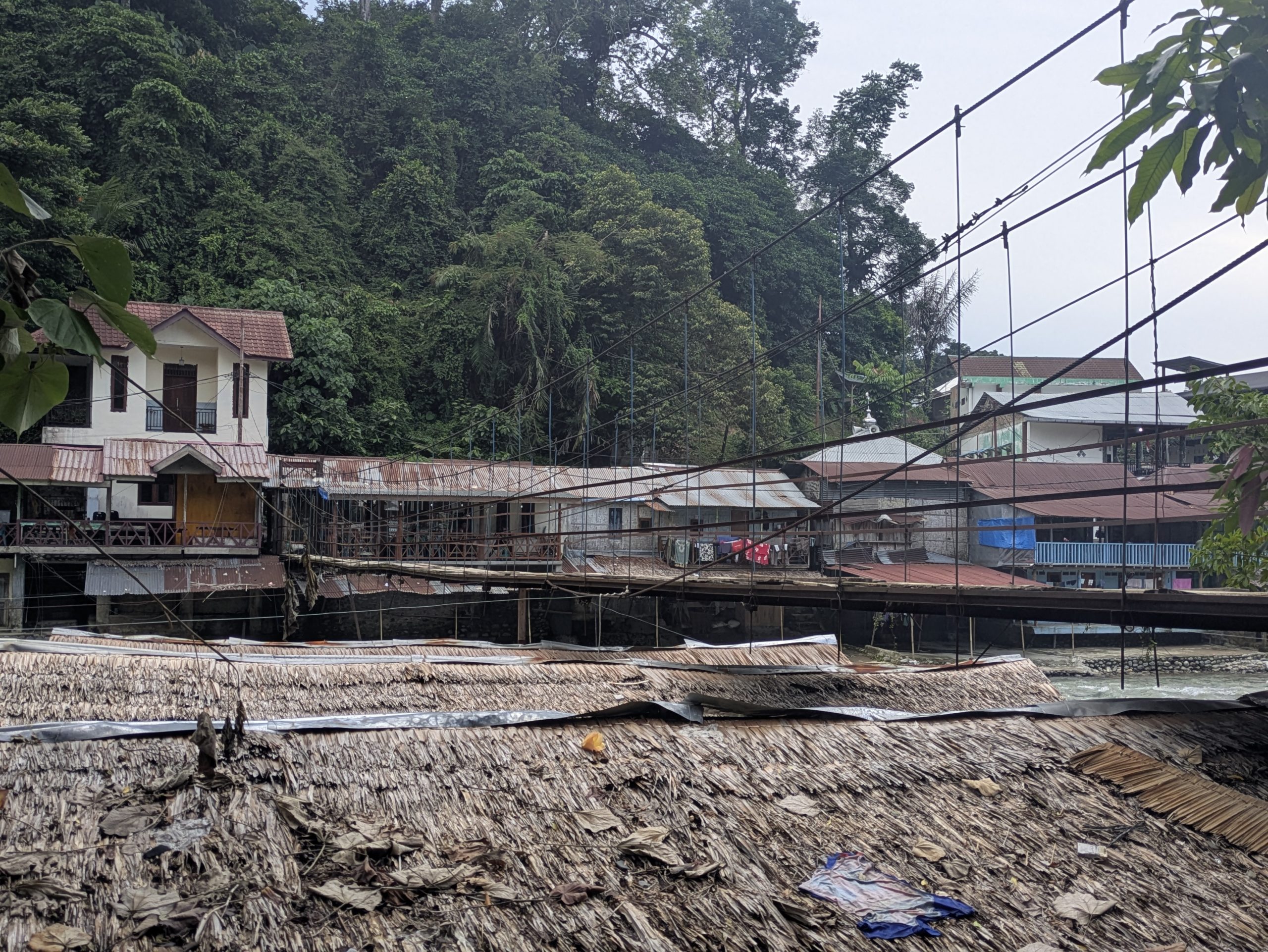
The village is a long, thin riverside settlement that stretches along the banks of the Bahorok River, a fast‑flowing, jade‑green torrent that cuts through the jungle. Guesthouses cling to the slopes, rickety bridges sway over the water, and cafés perch on stilts above the rocks. Everything is connected by a maze of footpaths, steps and wooden walkways that feel one monsoon away from needing a complete rebuild.
It looks idyllic now, but the village carries a scar that isn’t immediately visible.
In November 2003, a catastrophic flash flood tore through the valley and destroyed almost everything. Locals still talk about it in quiet voices, and if you look closely, you can see where the riverbanks have been rebuilt, where guesthouses stand on newer foundations, and where the jungle has reclaimed what was lost.
The disaster wasn’t a freak act of nature. It was man‑made.
Illegal logging upstream had stripped the hillsides bare, leaving the soil loose and unstable. When days of heavy rain hit the Leuser highlands, the saturated slopes finally gave way. A massive landslide crashed into the Bahorok River, creating a surge of water, mud, trees and debris that accelerated down the valley like a freight train.
The wave hit Bukit Lawang in the middle of the night.
Entire sections of the village were swept away. Guesthouses collapsed, bridges snapped, and the river, normally a jade‑green ribbon winding through the jungle, became a roaring brown torrent carrying timber, boulders and pieces of buildings. More than 200 houses and 400 guest rooms were destroyed. 239 people died, including locals and tourists, and thousands were displaced. The orangutan rehabilitation centre was heavily damaged, and several animals were lost.
For a long time afterwards, Bukit Lawang was simply gone, but with government support, NGO assistance and a huge amount of local determination, the village was reconstructed with stricter regulations on logging and land use. The orangutan centre reopened, guesthouses were rebuilt on higher ground, and the riverbanks were reinforced. Today, Bukit Lawang feels lively and welcoming, but the memory of the flood lingers, in the stories guides tell, in the caution with which people watch the river during heavy rain, and in the quiet pride locals have in the village they brought back from nothing. It’s one of those places where the beauty of the jungle sits right alongside the fragility of the landscape, and where the consequences of environmental mismanagement are not theoretical, they’re lived. The village has the atmosphere of a place that exists entirely for jungle trekking, half adventure base camp, half backpacker outpost, with a soundtrack of cicadas, rushing water,
Morning on the Bahorok: From Whispered Trepidation to the Wall of Green
The following morning, we were up early and, after a cold shower, walked to the meeting point for our two‑day trek into the jungle, hoping to see orangutans and whatever else the forest felt inclined to reveal. We sat on the veranda overlooking the Bahorok River, watching the water churn over boulders and coil into deep jade pools. Two girls were playing in the current, walking upstream and launching themselves into the flow. The river swept them past our viewpoint in seconds before they scrambled out, ran back up the bank, and did it all again, laughing and screaming in the way only people unfazed by cold water can. The river is the village’s lifeline, a place for swimming, washing, tubing, and cooling off after long hikes (and trust me, cooling off is immediate!), its colour shifting from pale jade to deep green depending on the light.
There was a mood of trepidation among the trekkers gathering on the veranda, each of us quietly wondering whether we were tough enough to survive the adventure. Conversations were whispered, glances flicked toward the entrance every time a noise sounded outside, and everyone waited to see who their guides would be and, more importantly, who they would be walking with. We were quietly relieved when the large French family was assigned their own group. The two Germans we’d travelled with from the airport were doing a two‑night trek and joined a small team heading deeper into the forest. We were paired with a couple from Portsmouth and two young women from France who are currently living in Perth, Australia.
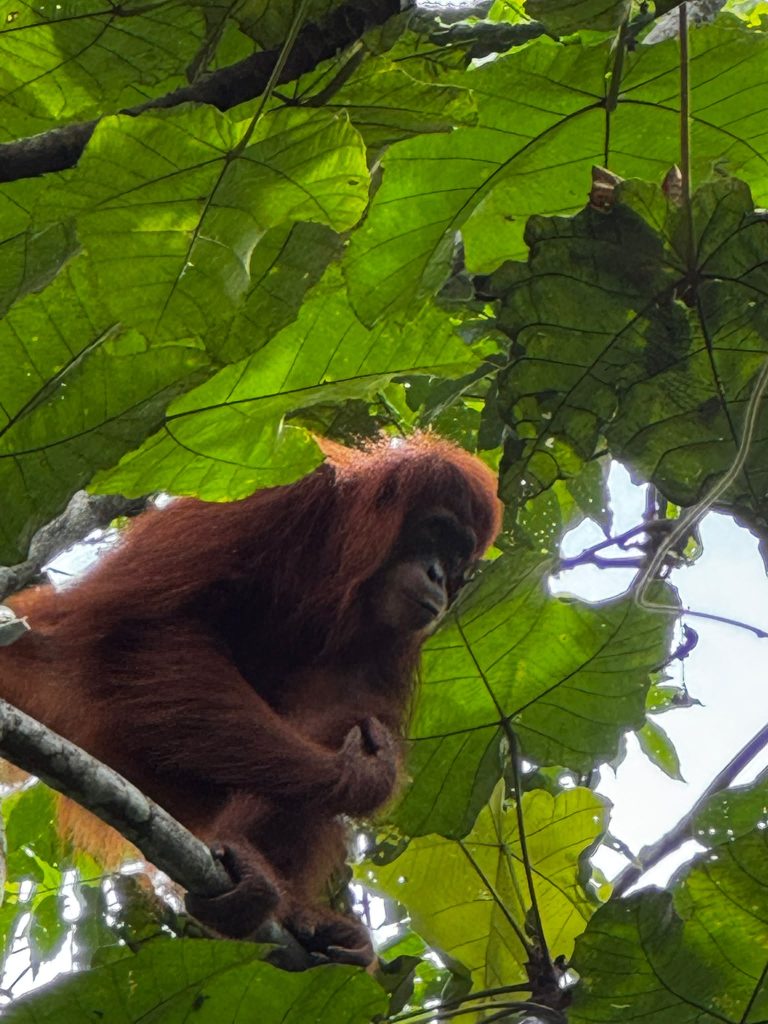
With Ricki and Jaka, our guides, we set off through the village toward the less rickety of the two bridges and made our way toward the jungle. Before even reaching the national park boundary, we came across a group of orangutans, two mothers and three youngsters. Orangutans are usually solitary, so it was unusual to see so many together, but these two mothers were semi‑wild: hand‑reared, rehabilitated, and released back into the forest. They lounged in the trees with the confidence of animals who know exactly how photogenic they are, unless I am taking the photographs, in which case it might have been better if they’d been stuffed. Fortunately, someone in our group had both a better camera and greater competence, and kindly sent us copies of their pictures. Thank you for them, and for giving permission to add them to this page.
We passed through a rubber plantation, the trees lined in neat rows with small coconut half‑shells fixed at their bases to collect latex, and then walked through an archway, the sort of mysterious second door Mr Benn might step through, and into the jungle proper: a wall of green that swallowed the path, the noise, and, for the next two days, any sense of the outside world. Much of the trek was spent going up and down hills. The tracks were rough, carved out by decades of visitors, but unlike the hills of Snowdonia or the Peak District, the mass of tree roots here holds the soil together. They prevent the worst of the erosion but create a slip hazard of their own if you’re not concentrating. Every step is a negotiation: roots, mud, leaves, and the occasional patch of ground that looks solid but behaves like custard. When you slip and almost fall, you quickly learn to give a look that suggests you meant to do that.
We reached the top of the first hill having already ticked both long‑tailed and pig‑tailed macaques off the list, along with a snake that might have been a green twig or a twig that might have been a green snake, neither option encouraged further investigation. We stopped for a break where our guides produced a display of fruit that would have been a credit to many hotels: bananas, pineapple, dragon fruit, watermelon, passion fruit, and snake fruit, beside a tree marked with old claw scars from a sun bear, not recent, but recent enough to remind you they were around.
We’d seen snake fruit growing in Bali and Java, and it looks exactly like something a jungle would produce if it wanted to keep you guessing. Each fruit is about the size of a small fig, a squat teardrop wrapped in a skin that resembles snakeskin, glossy, reddish‑brown, and covered in tiny overlapping scales that catch the light like polished armour. When you run your thumb over it, the scales shift just enough to make you wonder whether it might slither away. Inside are three polished brown seeds covered in pale, plump flesh that is firm, almost crunchy, like an apple carved into segments. Within our group there was no consensus on what it tasted like. There was something familiar, but what? Personally, I wasn’t a fan, but I ate it on three separate occasions in a quest to work out what it tasted like. I still don’t know, and Google has let me down again.
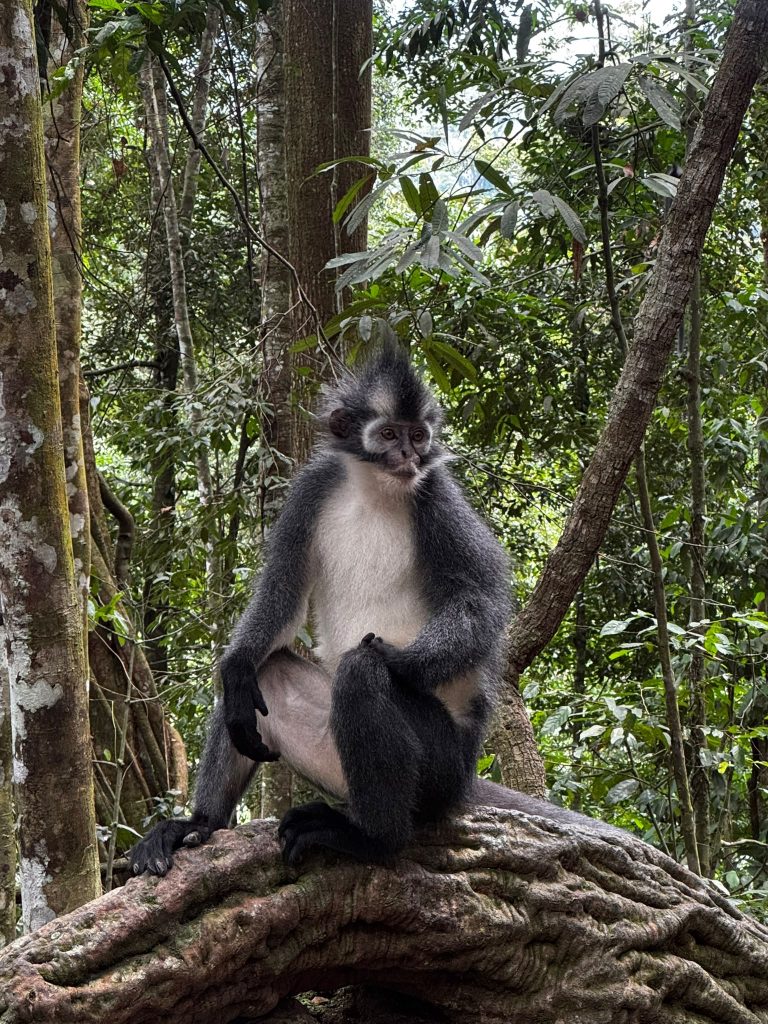
Having eaten more fruit than Ipoh has seen in months, we continued along the ridge, stopping to watch an eagle perched on the branch of a dead tree, surveying the valley like a disapproving headmaster. A group of Thomas’ leaf monkeys posed obligingly for photos, sitting upright with their white moustaches and punk‑rock crests, as though they craved the attention.
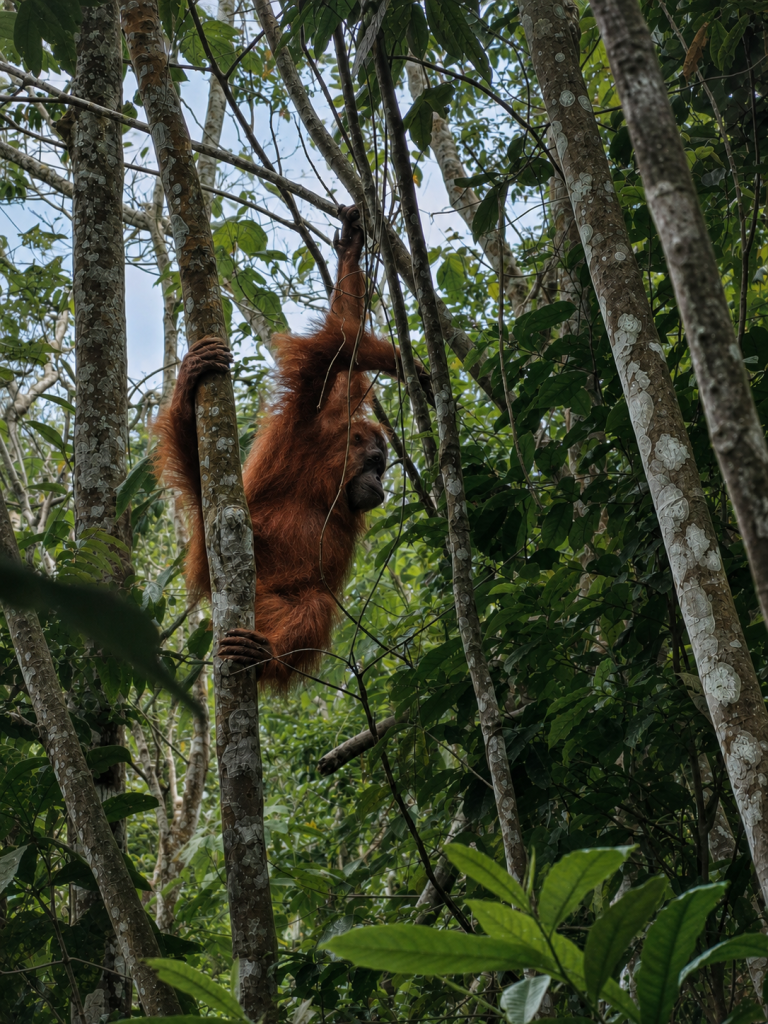
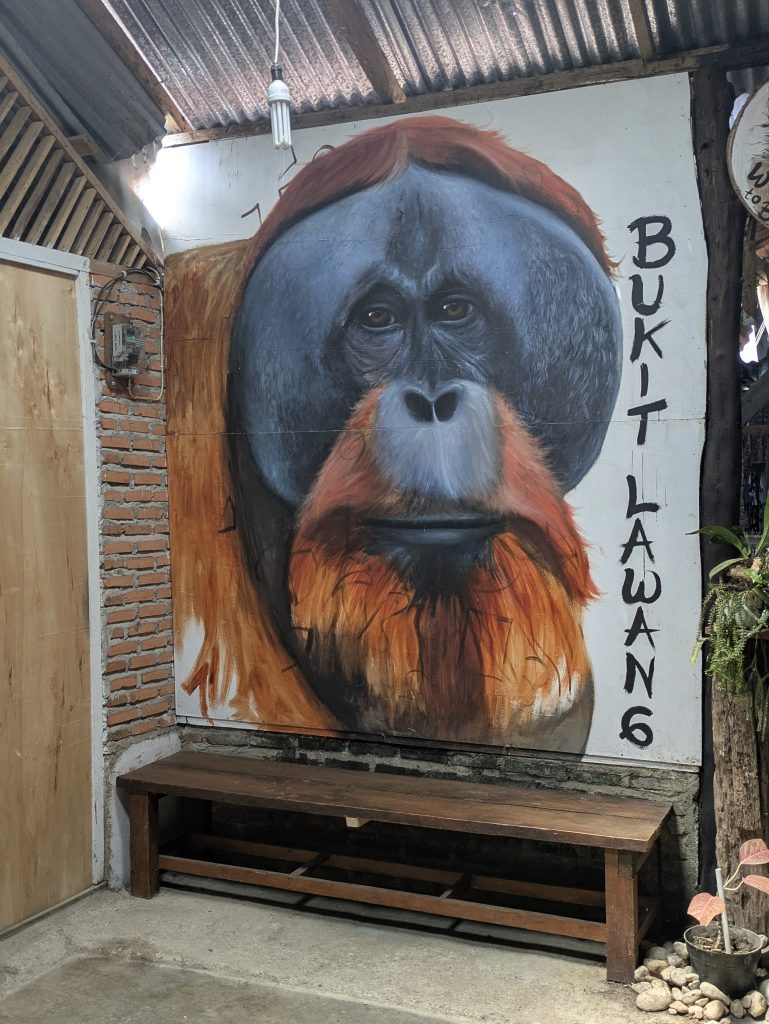
Then came a steady descent. After a short while, we stacked our bags at the side of the path and scrambled down to see a large wild male orangutan. He was magnificent: broad‑shouldered, heavy‑jawed, with cheek pads like leather shields and long arms that looked capable of bending steel. He sat in the crook of a tree, finishing off a late lunch with slow, deliberate movements, occasionally glancing at us with the expression of someone who has seen many tourists and remains unimpressed by all of them.
For much of the walk we had been following the Bahorok River from the other side of the ridge, determined using key features along the skyline. Eventually we dropped off the ridge entirely and descended to a tributary of the Bahorok River. We waded downstream over polished stones and slime‑covered rocks, slipping, swearing quietly, and pretending we were far more agile than we actually were. Each step was a lottery. Everyone worked hard to stay upright, but the truth was that everything we were wearing was already saturated with sweat. The humidity wrapped around us like a warm, wet blanket. The walking wasn’t difficult, unless you are five feet tall with an artificial knee and a bad heart, but the combination of heat, moisture and terrain kept the distance covered shorter than we would have expected before entering the jungle.




The Jungle Camp, the Night, and the Long Float Home
Eventually signs of habitation became apparent as the campsites started to come into view. The sites were a clearing beside the water with a bamboo shelter, a cooking area, and a scattering of mats laid out on stony platforms. It wasn’t luxury, three mosquito nets each with thin mattress, blankets and pillows, and only the thickness of the netting between you and the people you only met that morning, but after hours of climbing, sliding and sweating, it looked like the Ritz.
We dropped our bags, peeled off our trainers, and sat on the riverbank with our feet in the water, watching it swirl past in shades of jade and silver. The others went one step further and went swimming, a chance to bathe and refresh after the day’s hike. After a welcome cup of tea, we sat on our mats trying to find the most comfortable patch on the stony ground and saw a pair of hornbills fly overhead. Dinner was a feast. The camp chef produced dishes you would not have thought possible in the surroundings. We ate until we couldn’t move, then sat back and drank ginger tea whilst Jaka performed several card tricks, I have no idea how he did any of them and gave us puzzles to solve (we were terrible at them, but the phrase two mountains to four mountains haunted the rest of the trek). It was a fantastic end to the day. We settled down for the night, cicadas started their electric buzz, frogs croaked from somewhere deep in the undergrowth, and the river kept up its constant, reassuring roar. The jungle around us felt alive in a way that cities never do, not threatening, just busy, as though every creature had somewhere important to be.
Morning arrived suddenly. The jungle doesn’t do gentle transitions. One moment it was dark; the next, sunlight was filtering through the canopy and we sat once again on our uncomfortable mats waiting for a cup of coffee. Breakfast was a toasted egg sandwich, and more fruit. We ate with our guides, overlooking the river, all quiet except for Ricki and occasional “four mountains” to lighten the mood.
The second day’s walk was shorter but steeper, with more scrambling and more opportunities to test the limits of our balance. The weather was a little overcast and it did get very dark at one point and we expected to get wet, oh hang on we already were wet. It was not much fun putting the wet trousers on first thing in the morning, but by the time we got going my clean t-shirt was equally wet. We saw a tortoise, an unexpected addition to the list, the obligatory load of macaques, and as if on cue a hornbill flew past the gap, close enough to see his yellow bill. We have seen many of them during our time in the jungle both in Sumatra and in Borneo, but none as close as this.
Eventually we descended to the riverbank and followed it to a stack of inner tubes waiting to transport us back to the village, the jungle’s version of a taxi ride: fast, noisy, slightly chaotic, and far more fun than it has any right to be. The tubes were lashed together and they told us to get in and sit tight, as we were pushed into the current. The river took over immediately. We shot downstream, our captain keeping us in the centre of the channel (most of the time). I expected the water to be refreshing but it was freezing cold adding to the reasons for the laughter which was in that slightly hysterical way people do when they realise they are no longer in control of anything. The jungle blurred past, green walls, hanging vines, flashes of sunlight, and every so often the guides shouted “four mountains”, “alright mate” and for some reason started singing Jingle Bells in Indonesian. It was exhilarating, ridiculous, and utterly unforgettable.
As we approached Bukit Lawang, the river widened and slowed. A troop of long-tailed macaques welcomed us back home before we saw the Jungle Inn, where we had dinner on our first night in the area, and then the bridges came into view. We drifted to the shore, climbed out of the tubes, and stood dripping on the stones, grinning like fools.
Two days in the jungle had left us filthy, exhausted, and smelling faintly of river water. But it also left us with the sense of having stepped into a world that is both fragile and fierce, ancient and alive, and absolutely worth every slip, sweat patch and questionable tube‑related decision. It was also great to meet six other people, briefly get to know them before we all went our separate ways. Okay we did bump into Jaka and Ricki a couple of times in the days that followed, but that kind of ruins the narrative.
How Bukit Lawang Stretched Our Patience and Squashed Our Personal Space
The problem with this type of tourism is that there’s very little encouragement to stay and explore the region after your jungle trek. Most hotels that organise trips don’t want you hanging around; they want the beds freed up for the next batch of trekkers. It means a lot of local businesses see almost none of the tourism money that passes through Bukit Lawang.
We, however, had found a homestay that scored highly on Agoda, and once out of the jungle we crossed the very rickety bridge to reach it. As we had clearly just come out of the jungle, we were not welcome at all. Despite the fact they obviously had empty rooms, they told us they no longer worked with Agoda and we should leave. I stood my ground while trying to find somewhere else to stay (there wasn’t anywhere), and eventually the owner showed us to a chalet. I may have mentioned before that we like the feel of a homestay, but this one… you couldn’t help feeling the rest of the family did not want people on their land.
Still, we were glad for a bed for the night and the sound of the river close by. The noise was uncannily similar to the television when programmes had finished for the evening, that static white hiss that usually meant you’d fallen asleep watching the Open University, because it was the only thing on when you got in from the pub. I am sure this is why I don’t know what the Jacobian rule is.
Despite the accommodation woes and the constant arguing between the owners, we had a few relaxing days in the area, wandering around the village and putting some tourist money into other local businesses. Our only regret was leaving the door open while sitting on the veranda. The cat got in, curled up on the bed, and went to sleep. Earlier that day we’d been congratulating ourselves on how few mosquito bites we’d had throughout the trip. In fact, our worst experience had been the sand fleas that attacked Jay on Pulau Mamutik. The following morning, we woke up covered in flea bites, a final gift from the people who did not want us.
On the last morning at Bukit Luwang we were up before anyone else, as usual, so left the key in the door, and walked away to catch the tourist bus to Lake Toba. At the pick‑up point there were no minivans or anything similar waiting. From the crowd gathering, it was clear most of us were heading to Lake Toba, and after the standard half‑hour delay a few men emerged from a local coffee shop and pointed to a row of cars. That was all fine until seven passengers, us included, were directed to the same six‑person car. We let the Essex couple (“alright babe”) express everyone’s grievance. It was uncomfortably tight, and for an eight‑hour journey on Sumatran roads, not a pleasant experience.




Parapat: The Town Before the Island Inside the Lake Inside the Volcano
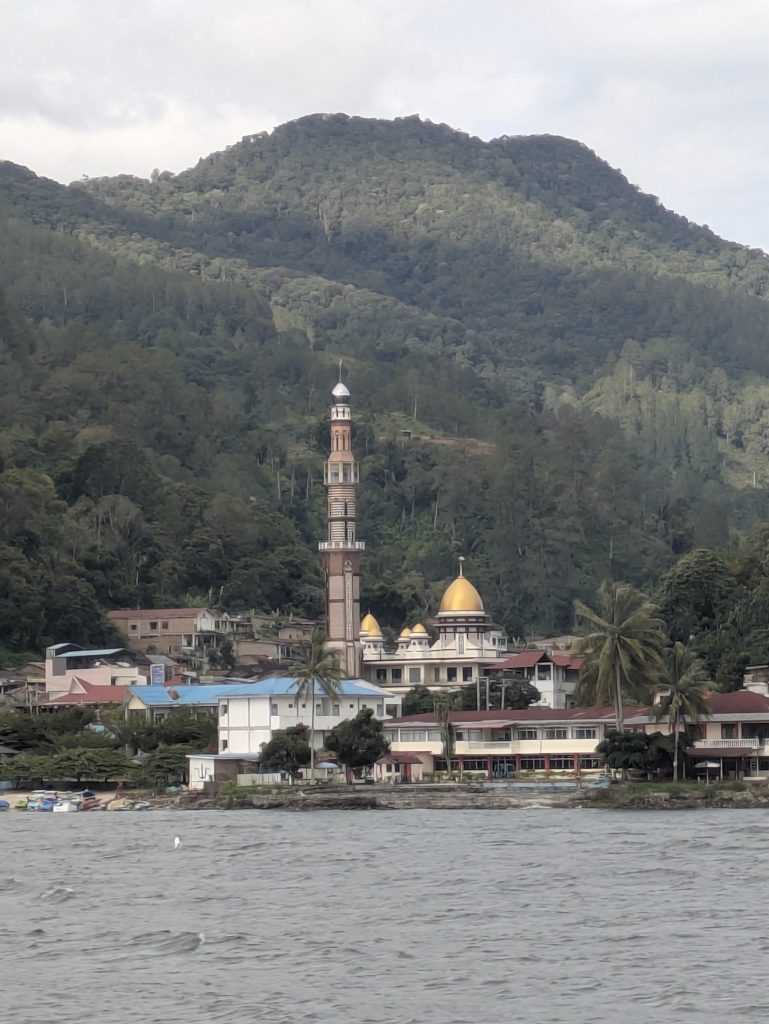
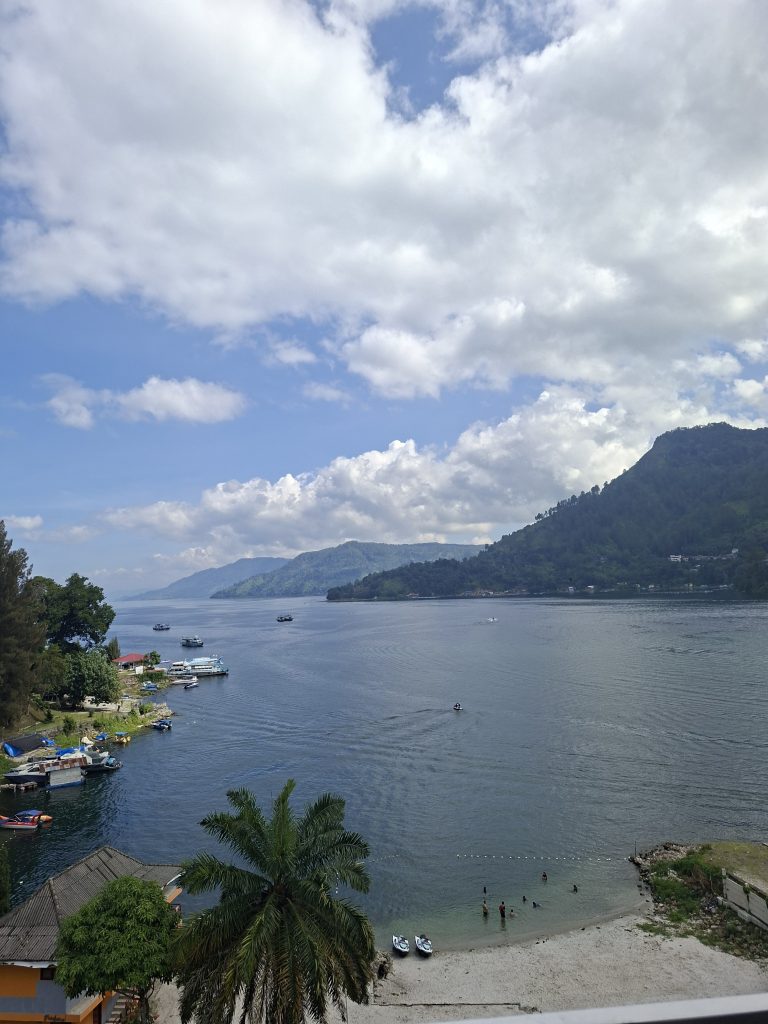
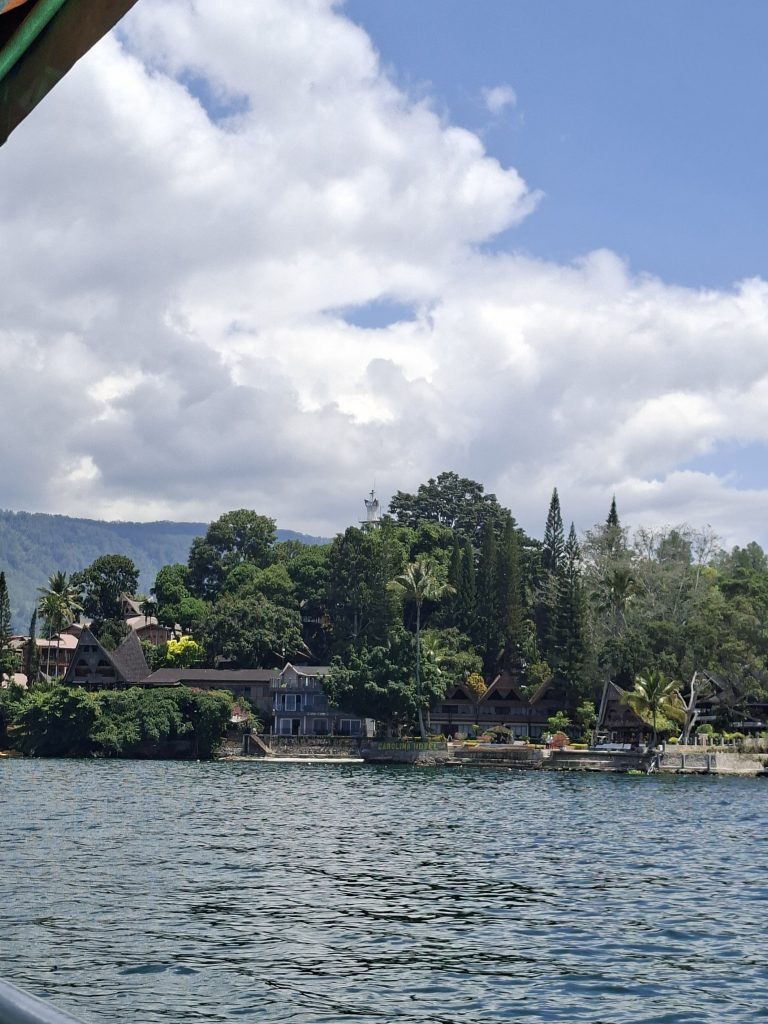
We arrived in Parapat and, rather than risk missing the last ferry because of delays on the road, we had booked a room in a hotel boasting great views over the lake. Lake Toba is the largest volcanic lake in the world, formed by a super volcanic eruption around 74,000 years ago that nearly wiped out humanity. Today it is serene, vast, and impossibly blue. Looking forward to our view, and anticipating a good sunset, we rushed across the room to open the curtains… and saw a concrete wall less than two metres in front of us. With the previous homestay and the cramped transfer, we hoped this was the third and final piece of bad luck.
Parapat itself is a curious place. It’s clear they see few Western tourists beyond the port where you catch the ferry to Samosir Island. It’s a shame, because the town has plenty of infrastructure to support visitors: lakeside cafés, markets, hotels, and a promenade that feels like it was built with holidaymakers in mind. It does seem to be a popular destination for Indonesians and Malaysians, offering jet‑skiing, boat trips, lakeside swimming, and the sort of relaxed atmosphere that comes with being next to a body of water with an area of 1,130 km², about the size of Greater London, or one and a half Singapores. It’s a stretch of water so wide it feels like a small sea.
In the morning we sat by the infinity pool looking out across the lake, watching the jet‑skiers, apparently a popular mode of transport here, and the obligatory drones capturing dynamic footage as they zoomed around. People swam in the lake, some with soap and shampoo, taking advantage of the free (cold) bath. They sat on the rocks along the shoreline like a row of male sirens waiting to sing their entrancing song to passing ferries. We watched the pink duck boat ferry people along the shore; the captain clearly had wax in his ears, much like Odysseus, though for entirely different reasons.
Leaving the hotel, a steady wander took us through town. The plan had been to follow the shoreline like sensible people, but the road had other ideas and dragged us inland through the market, now calm and orderly, a stark contrast to the full‑scale pandemonium we’d witnessed on arrival, when it looked as though someone had shouted “Everything half price!” and then set off a firework.
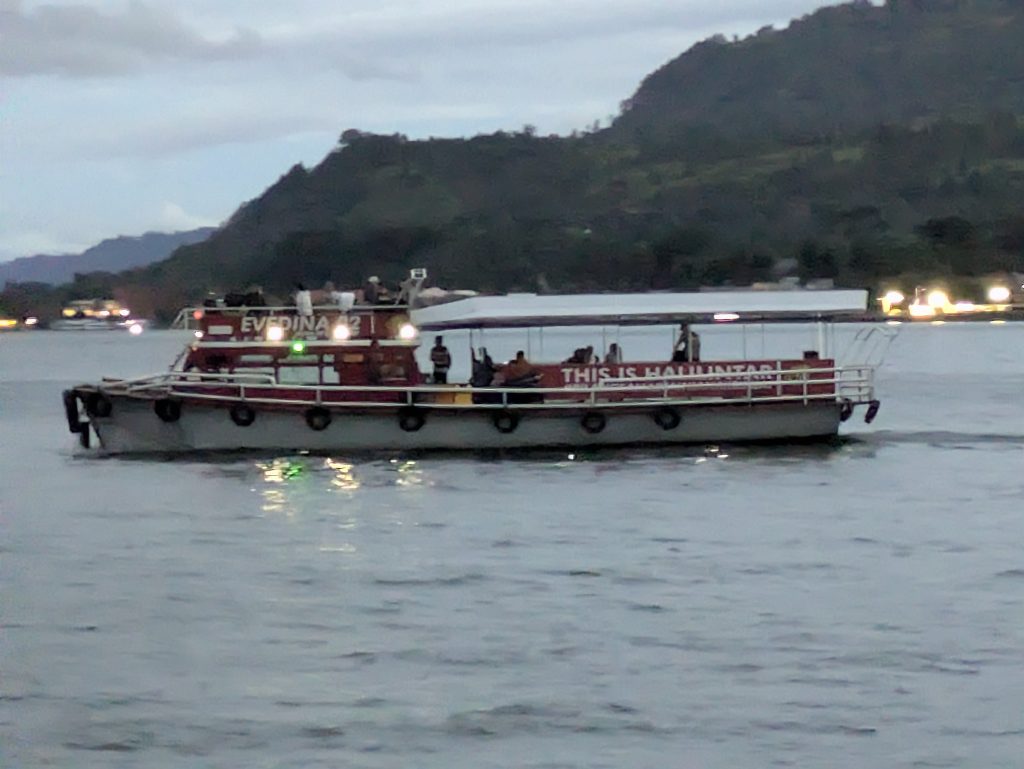
By the time the port appeared, we were smugly early, a whole thirty‑five minutes ahead of schedule, which of course meant the ferry we actually needed was already preparing to leave. A quick scribble in the logbook, a half‑run, half‑shuffle onto the deck, and suddenly we were off, heading towards Tuk Tuk on Samosir Island with the sort of chaotic efficiency that seems to underpin most transport in Sumatra. The ferry was painted a shade of green last seen on school radiators in the 1980s, and furnished with blue metal garden seats that were not fastened down, a design choice that suggested either admirable flexibility or complete disregard for maritime physics. Every time the boat nudged a wave, the seats shuffled an inch, as though trying to migrate to a more comfortable part of the deck.
I spent the crossing telling anyone who’d listen where we were staying, because I knew the ferry would dock at our hotel’s pier if requested. This felt like vital intelligence, the sort of information that could save us from a twenty‑minute walk with backpacks that still smelled faintly of jungle humidity and river water. The crew nodded politely each time I mentioned it, in the way people do when humouring an over‑excited tourist. Sure enough, as we approached Tuk Tuk, the captain swung the boat towards a small jetty and we glided in, bumped gently against the tyres tied to the posts, and disembarked directly onto the hotel’s pier, extremely early for check‑in and feeling disproportionately triumphant, as though we’d outsmarted the entire transport system of Sumatra.


Tuk Tuk: The Peninsular on the Island Inside the Lake Inside the Volcano
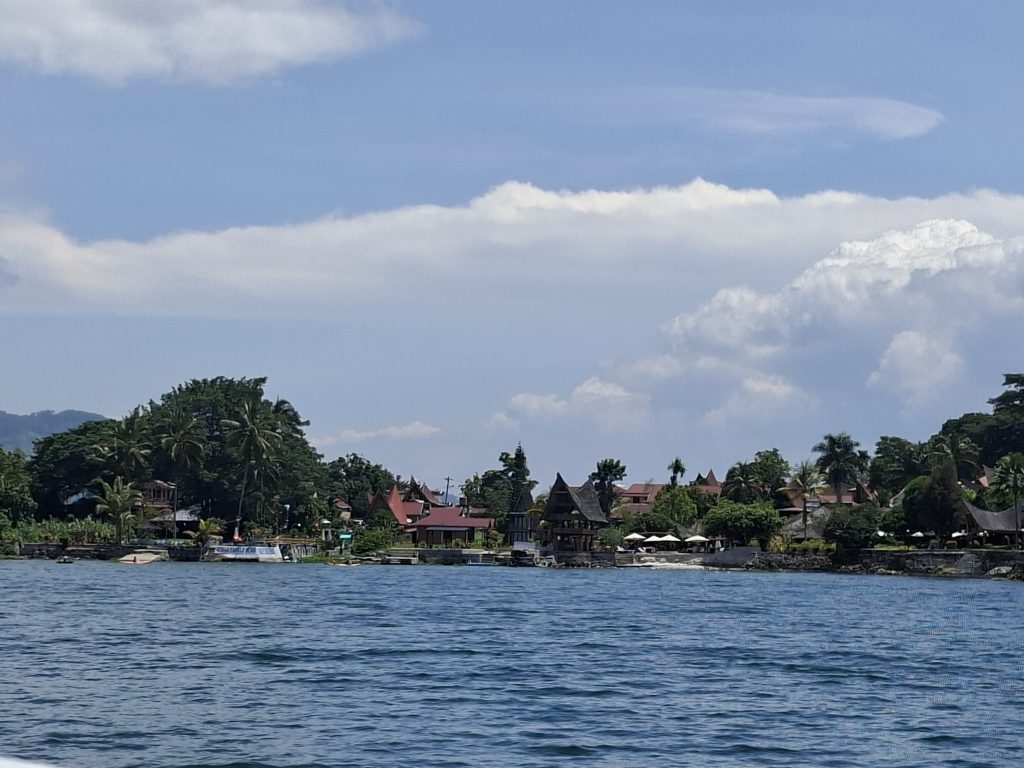
Samosir Island is one of those geographical surprises that makes you pause and rethink what you thought you knew about volcanoes. It sits at 909m, a little bit higher than Great Gable in the Lake District, in the middle of Lake Toba like a giant green stepping stone, an island inside a lake inside the caldera of a supervolcano. Samosir is almost the size of Singapore, though far more relaxed and considerably less inclined to build shopping malls. The island rises gently from the water in folds of forested hills, and small Batak villages where life moves at a pace best described as “unhurried.”
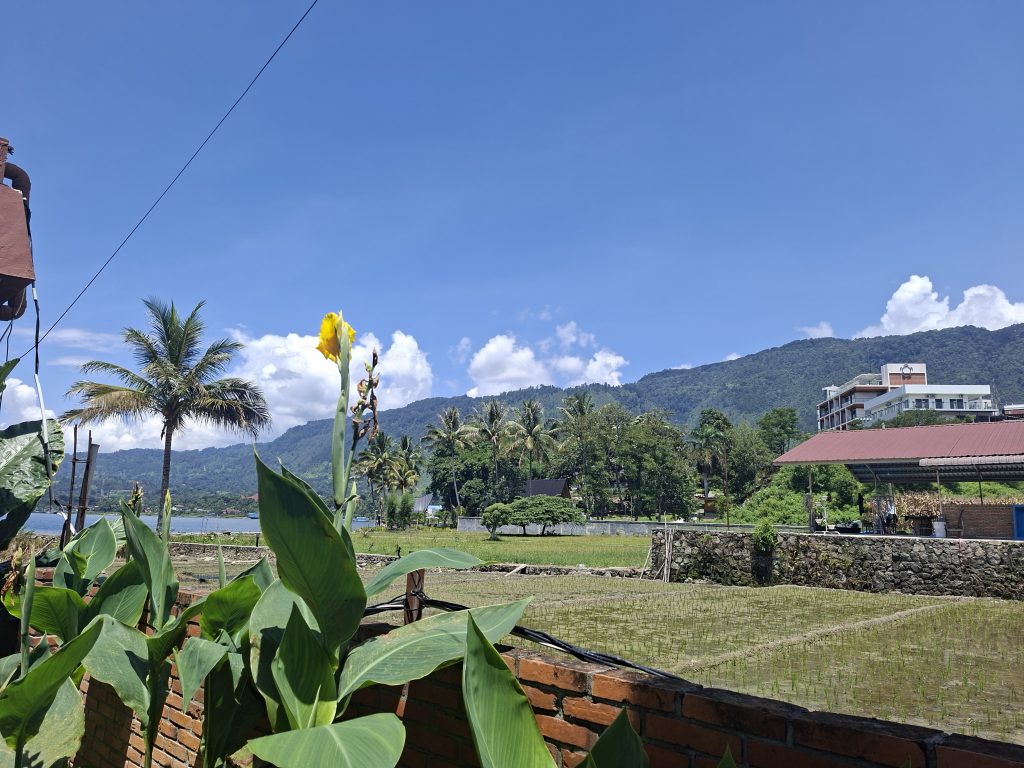
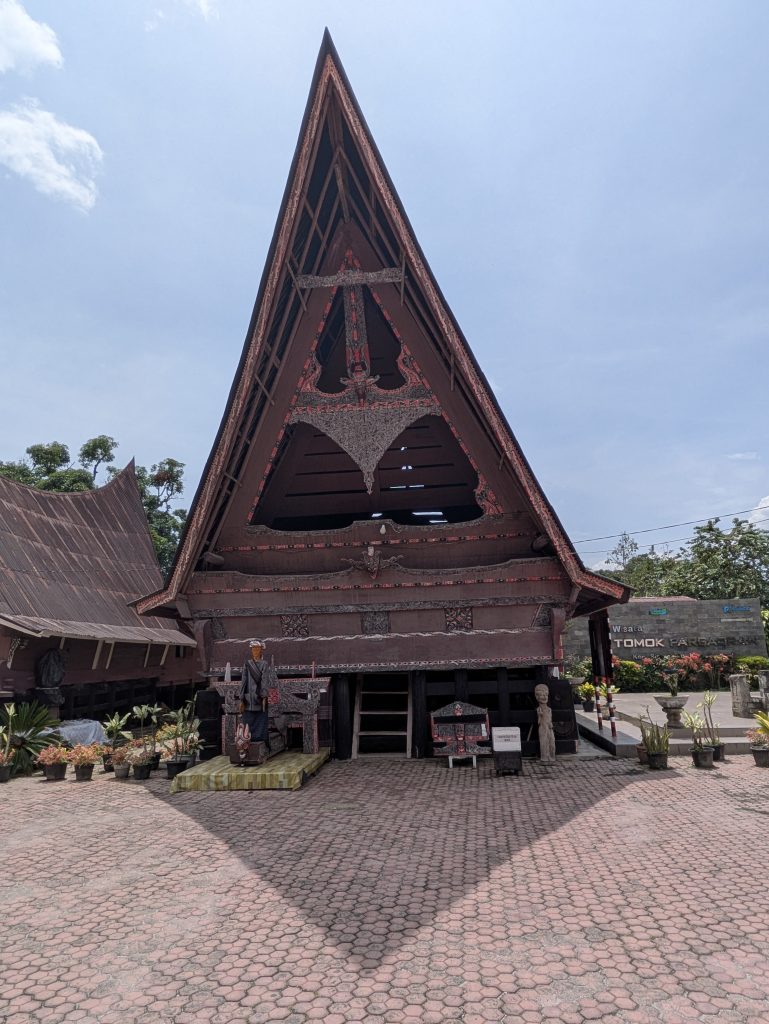
Tuk Tuk, the peninsula where most travellers stay, feels like a place designed for exhaling. Guesthouses and homestays line the shore, many with its own jetty, hammock, and view across the lake. The water is usually impossibly calm, reflecting the sky so perfectly that boats appear to float through clouds. Tuk Tuk has a gentle rhythm: mornings begin with the sound of a cockerel and twitter of birds; afternoons drift by and evenings settle into a chorus of cicadas and the occasional karaoke session drifting across the peninsular. The Batak culture is woven into everything here. Traditional houses with their dramatic, upward‑sweeping roofs, shaped like buffalo horns, stand proudly along the roadsides. Their design is both symbolic and practical: the steep pitch sheds heavy rain, the raised floors protect against flooding, and the horn‑like tips represent strength, prosperity and ancestral protection. Many of these houses are still lived in, their carved wooden beams and geometric motifs telling stories far older than the Indonesian nation itself.
Tomok and the Kings of Samosir
Tuk Tuk is also the gateway to Tomok, a small town that feels part tourist site, the rest a living community, its alleys lined with souvenir stalls, motorbikes, chickens, and all the everyday evidence that plenty of people actually live here. All of it coexists quite happily around one of the most important cultural landmarks on Samosir: the stone sarcophagi of the Batak kings. The most famous of these rulers is King Sidabutar, whose tomb sits beneath towering trees in the centre of the town. The Sidabutar line is believed to be among the earliest settlers on Samosir, arriving long before Christianity reached the Batak highlands. Their tombs are carved from single blocks of stone, decorated with expressive faces, geometric patterns, and stylised buffalo horns, symbols of strength, protection and ancestral authority. The lids are shaped like boats, a reminder of the ancient belief that the dead travel across water to reach the spirit world.
You must wear a sash to enter the tomb area, a gesture of respect that links modern tourism to centuries‑old ritual. The steward takes this responsibility seriously, and the moment more visitors arrived needing sashes, he abandoned my attempt at conversation about why only three kings in 319 years of rule. Batak history was preserved through oral tradition, not written chronicles, and the stories passed down focus on lineage, ritual authority and major events rather than personal details like age or biography. Leadership passed only when a king died, and long reigns were clearly common. The ages of the kings at death and accession are unknown, and were never considered the important part of their legacy. Batak tradition remembers who they were, not how long they lived. And no matter how you stretch the data, it’s difficult to untangle 319 years and three kings.
The kings’ influence was spiritual as much as political. These were not kings in the European sense, no crowns, no palaces, no television series, no armies marching across borders, but hereditary clan leaders whose authority rested on ancestry, ritual knowledge, and the ability to mediate disputes between families. Their burials were major communal events: villagers gathered, ulos cloth was woven specifically for the ceremony, and rituals involving music, chanting and offerings were performed to guide the soul safely to the afterlife. Smaller stone coffins beside the main sarcophagus contain the bones of soldiers, buried close to the king to protect him in the afterlife. Each one may hold the remains of several individuals, the coffins are smaller, not because they were diminutive, but because their bones were gathered from earlier burial sites and interred together during the ceremony.
The monarchy ended not through conflict but through history itself. With Indonesian independence in 1945, the traditional kingship dissolved, and the role became symbolic rather than political. The tombs remain, though, weathered, moss‑covered, and quietly dignified, sitting at the heart of Tomok, surrounded by souvenir stalls and the occasional chicken, yet still the most solemn place on the island.
Standing there, it’s easy to imagine the kings as they were: not distant figures in gilded halls, but leaders rooted in the rhythms of village life, guiding their people through centuries of change on an island born from fire.
Batak Houses
One of the key features of the area is the traditional Batak house design, steeply pitched roofs that curve upward like buffalo horns, built to withstand heavy rain and symbolise protection and strength. The houses are raised on stilts, with carved wooden beams and geometric motifs telling stories far older than the Indonesian nation itself.
We paid our ten thousand rupiah (40p) to walk past four of them and take some pictures. We thought it was a museum, but it quickly became clear they were people’s homes, laundry hanging from the beams, a canvas shower unit close by, and a couple preparing lunch while giving us a look that suggested they’d seen many tourists and remained entirely unfazed by our presence.


Medan: Where History Stands Still and Traffic Doesn’t
I was going to write that we went to Medan for a couple of nights and that’s all she wrote… but as Indonesia’s third‑largest city, it probably deserves more than a shrug. Medan isn’t a place that tries to charm you; it simply gets on with being Medan, loud, sprawling, industrious, and carrying its history with the weary pride of a city that’s seen everything twice.
We stayed in a hotel in the old town, on Jalan Jenderal Ahmad Yani mostly because it was close to the station, but also because everything we might want to see was within walking distance. The neighbourhood was clearly the centre of the rag trade and certainly felt like a place not to linger in the evening.
Between the music, sports and trophy shops, some selling all three in a truly eclectic blend, colonial grandeur still clings on amid the chaos. The Bank Indonesia building, once the De Javasche Bank, stands proudly with its pale green dome and Art Deco detailing, a relic of Dutch confidence built to withstand both monsoons and market crashes. Nearby, the former Nederlandsch Indische Handelsbank, now a BNI branch, wears its 1920s façade like a well‑tailored suit, tall arched windows, geometric grooves, and just enough peeling paint to remind you that time doesn’t stop for architecture. Not all the buildings along this stretch have been quite so fortunate; several other buildings and shophouses are sagging into disrepair, in desperate need of a significant injection of cash before they disappear altogether.
Further along the road, the old Chartered Bank of India, Australia and China steals the show entirely. Its towering Corinthian columns and neoclassical pediment look as though they’ve been borrowed from Athens and dropped into Sumatra. The building now houses Kesawan Department Store and Café, where history has been repurposed with admirable flair, coffee served beneath a ceiling that once promised prosperity, a job it seems to do very well because it was always very busy when we passed by. Then there’s Tip Top Restaurant, still serving cakes and ice cream in its original 1929 building. A few doors down, the Tjong A Fie Mansion offers a quieter kind of grandeur, with its carved wooden screens, tiled floors, and rooms arranged with the kind of symmetry that suggests someone once cared deeply about feng shui. The house is a beautiful blend of Chinese, Malay, and European design, and a reminder that Medan’s story has always been one of convergence. Tjong A Fie was far more than just a wealthy merchant; he was the man who shaped Medan. Born in Guangdong in 1860, he arrived in Sumatra as a young migrant and rose through the ranks with a mix of business acumen, diplomacy and sheer determination. By the early 20th century he had become Medan’s most influential figure, head of the Chinese community, trusted ally of the Sultan of Deli, and a bridge between Chinese, Malay, Indian and Dutch interests at a time when those worlds rarely met peacefully.
Medan may not sweep you off your feet, but it does have a way of revealing itself in layers: the colonial bones, the markets, the industry, the mansions of long‑gone magnates, and the everyday bustle of a city (oh I have not mentioned the traffic!) that acts as the gateway to Sumatra’s interior. We didn’t stay long, but long enough to realise that Medan isn’t a footnote, it’s the prologue to everything else on the island.
The Island That Stays with You
Sumatra leaves you with the kind of memories that cling to your clothes long after the river water has evaporated, a place where jungle humidity wraps around you like a warm blanket, where roads behave like geological experiments, and where villages rebuild themselves with a determination that feels almost volcanic. From the Bahorok River’s jade‑green rush to the calm, sea‑wide expanse of Lake Toba, from orangutans lounging in treetops to Batak kings resting in stone sarcophagi, the island is a reminder that beauty and fragility often share the same space. We arrived expecting adventure; we left with the sense of having stepped through a door into a world that is ancient, alive, and quietly extraordinary, the kind of place that stays with you long after you’ve gone. Our only regret is not giving ourselves more time in Tuk Tuk; there were places we might have explored if we’d allowed even a little more breathing room, though, in truth, it’s the sort of easy‑going place where you’re just as likely to sit on a veranda watching clouds roll over the caldera and the lake shift gently beneath them.