
From Highland Quiet to Coastal Calm: A Passage to Lovina
The road from Munduk to Lovina is less a journey of distance than a gradual unravelling of atmosphere. It begins in the cool, mist-softened highlands, where terraces fold quietly into one another and the air carries the scent of clove and coffee, before winding its way down until the mountains give way to the still, dark sweep of the northern coast. . By the time you reach Lovina, the shift feels complete: from height to shoreline, from inward quiet to outward calm, and from the purposeful rhythm of the hills to a coast that moves, gently and unhurriedly, to the pace of the sea.
There is, to my mind, something faintly ceremonial about the descent from Munduk to Lovina, as though one were passing between two distinct chapters of the island’s character. You begin high in the hills, where the air carries a cool, faint sweetness of clove and coffee, and the landscape rises in folds of deep green, often softened by a veil of mist. The road slips away almost at once into a succession of tight bends, as if it were thinking twice about leaving the mountains behind, with each turn presenting some new composition of terraced slopes, roadside shrines, and glimpses into valleys that seem altogether too quiet for the modern world.
As you continue downward, the drive takes on a gentle, unhurried rhythm. Villages appear and recede without fuss; a handful of houses here, a small temple there, the occasional figure tending a field with the patient steadiness that defines rural Bali. The vegetation begins to loosen and change almost imperceptibly, and the air, once crisp, grows softer and warmer. The road, still winding, feels less insistent, as though it too senses the approach of the coast.
Then, a right turn and quite suddenly, the mountains release you. The slopes ease, the horizon opens, and the shimmer of the sea comes into view, bringing with it a change not merely of scenery but of pace and temperament. By the time you arrive in Lovina, with its dark sands and calm waters, the journey feels less like a transfer and more like a carefully measured transition, from cool solitude to quiet coastal ease, from the inward-looking calm of the highlands to the outward gaze of the sea.
Lovina has about it a quality that might best be described as unassuming grace. Set along a long, dark sweep of volcanic sand on Bali’s northern coast, it currently presents none of the island’s more theatrical gestures; there are no crowded promenades, no insistent music, no elaborate displays of leisure. Instead, the shore lies open and quiet, the sea almost implausibly calm, and the rhythm of the place dictated less by visitors than by the small boats drawn up along the beach and the gentle movement of the water beyond.
After a little while, you begin to notice the peculiar stillness of it all, though not a stillness untouched, but rather one just beginning to shift. Lovina is not so much a single town as a string of modest villages, where family-run cafés and guesthouses sit beside homes and temples with an air of easy coexistence. There are, increasingly, small signs of attention from beyond: a few more boats gathered at dawn, constant attention from hawkers, tables set discreetly along the shore, money being spent to improve the promenade, and a short street full of bars. The gentle suggestion that the outside world is beginning to take notice. Yet it all unfolds without urgency, as though the place itself were quietly deciding how much of this attention it cares to accept. It remains, for the moment, a place that asks very little and yields much. A corner of Bali where tourism has arrived, but has not yet insisted, and where the older rhythm of life continues, calmly and without compromise, just beneath the surface of change.
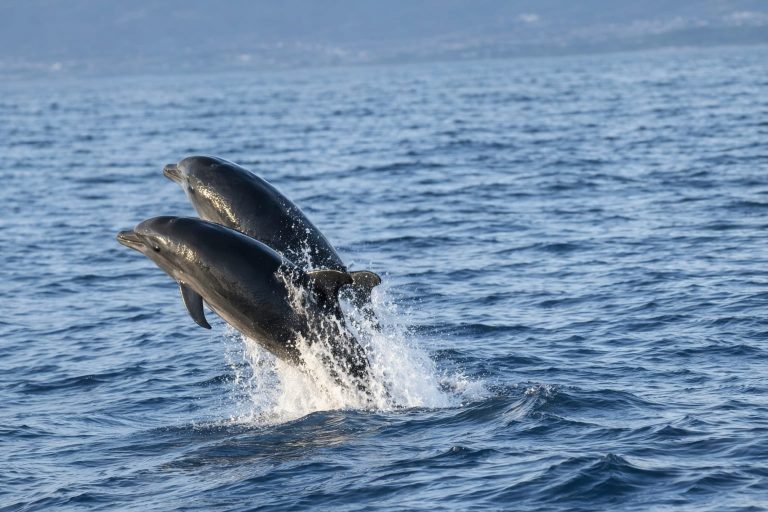
For the visitor, Lovina offers not spectacle so much as a gentler catalogue of pleasures, the chief among them being the calm sea itself, which invites early-morning boat excursions to watch dolphins offshore and provides waters sufficiently placid for easy swimming and beginner snorkelling. On land, its appeal lies in being less a singular attraction than a quietly convenient base from which to explore North Bali: waterfalls in the hills, the Banjar hot springs, and the Brahmavihara Buddhist monastery all lie within easy reach.


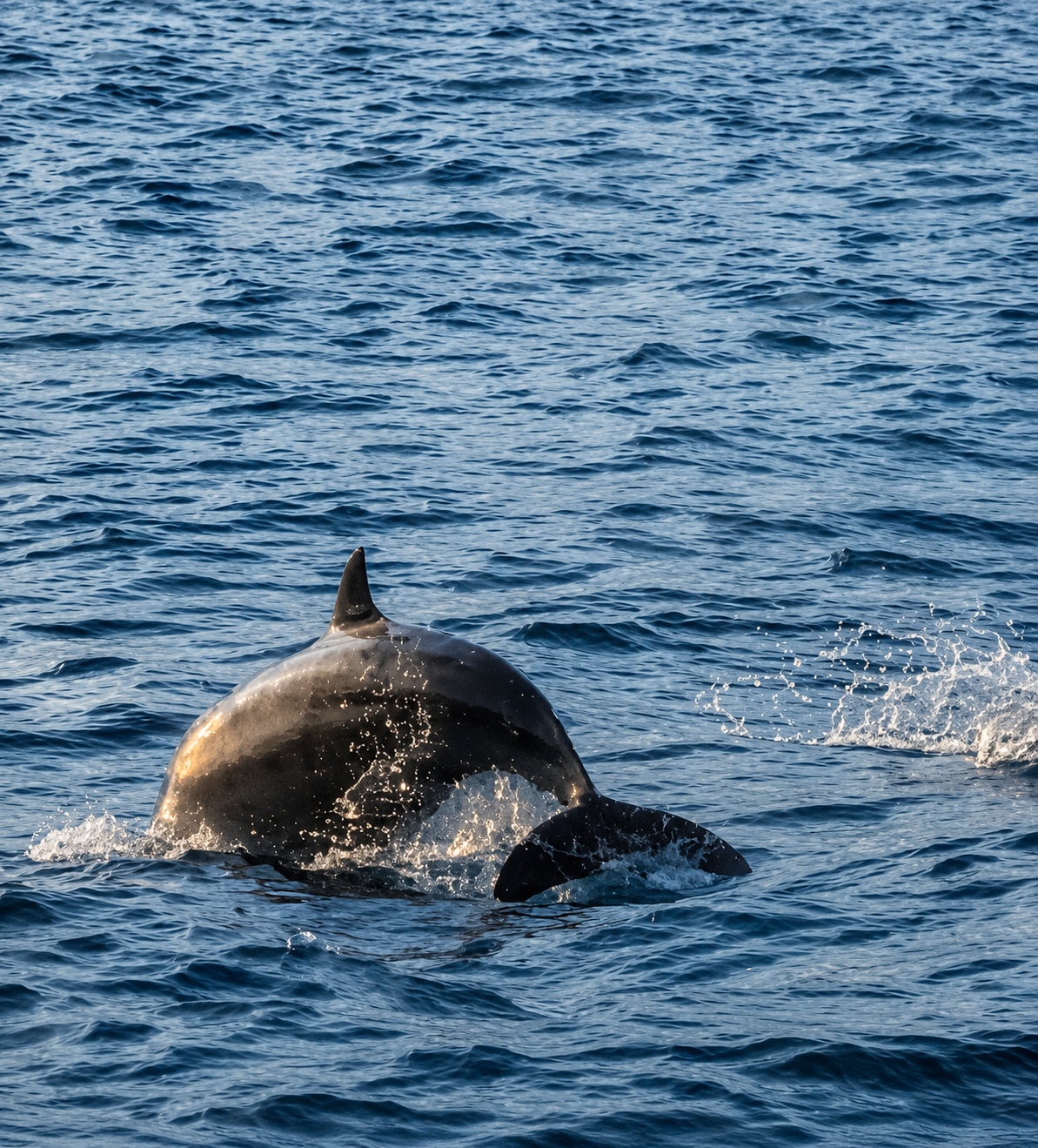
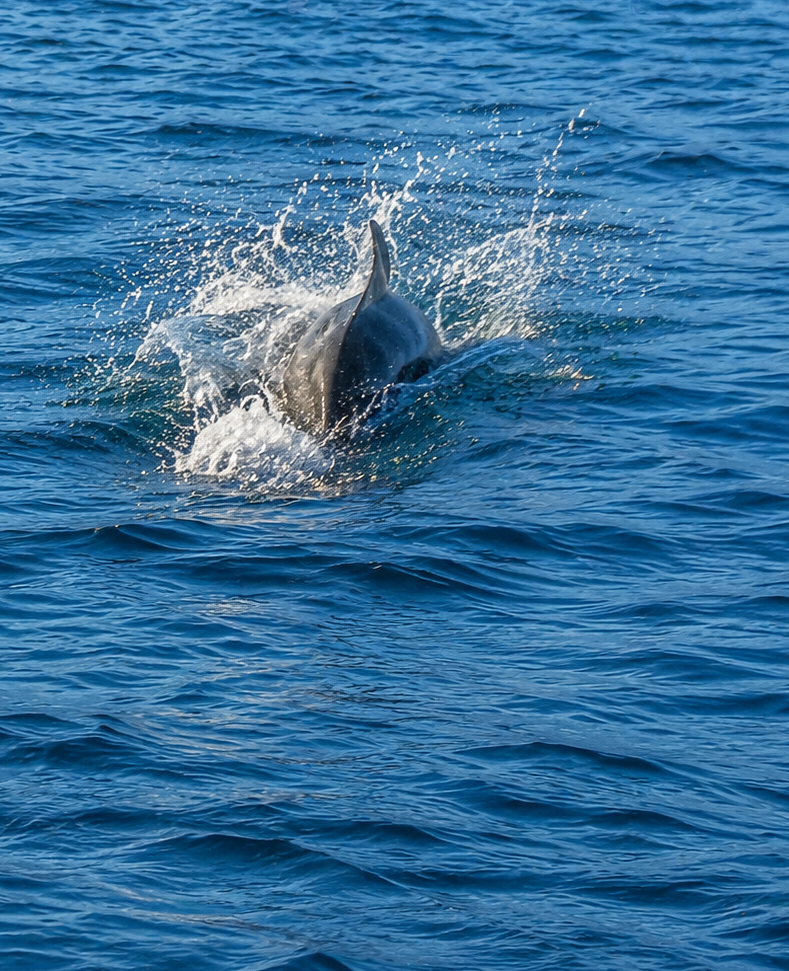
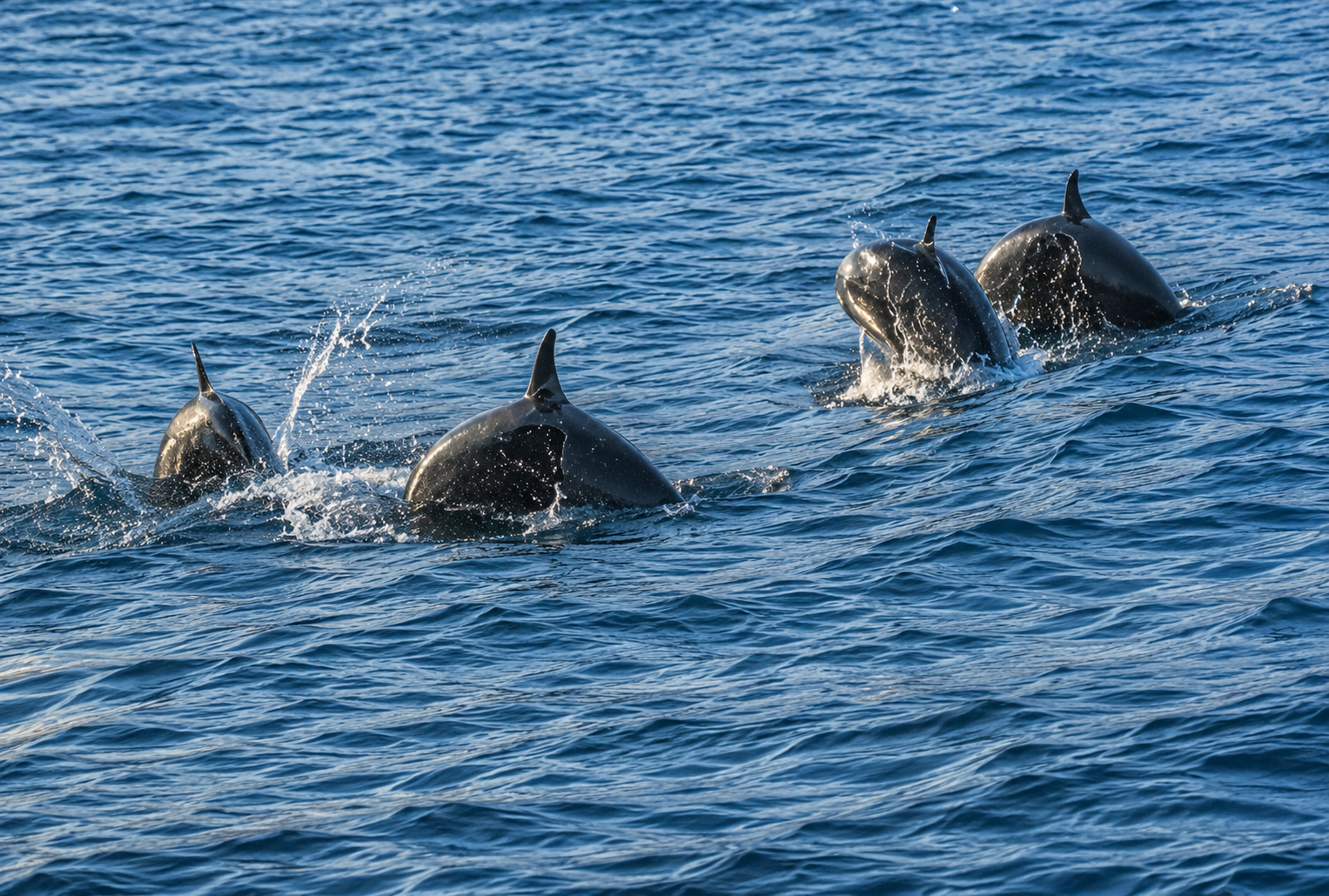

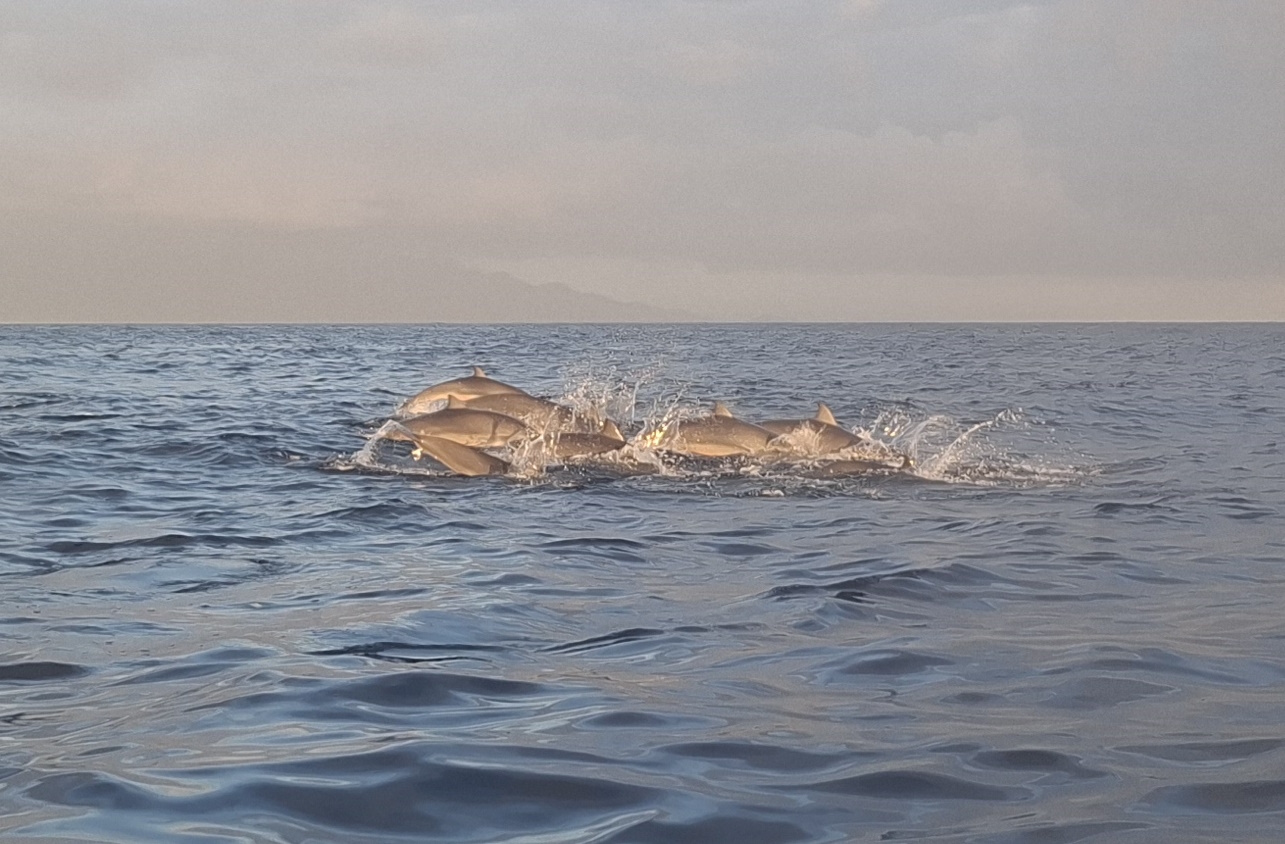
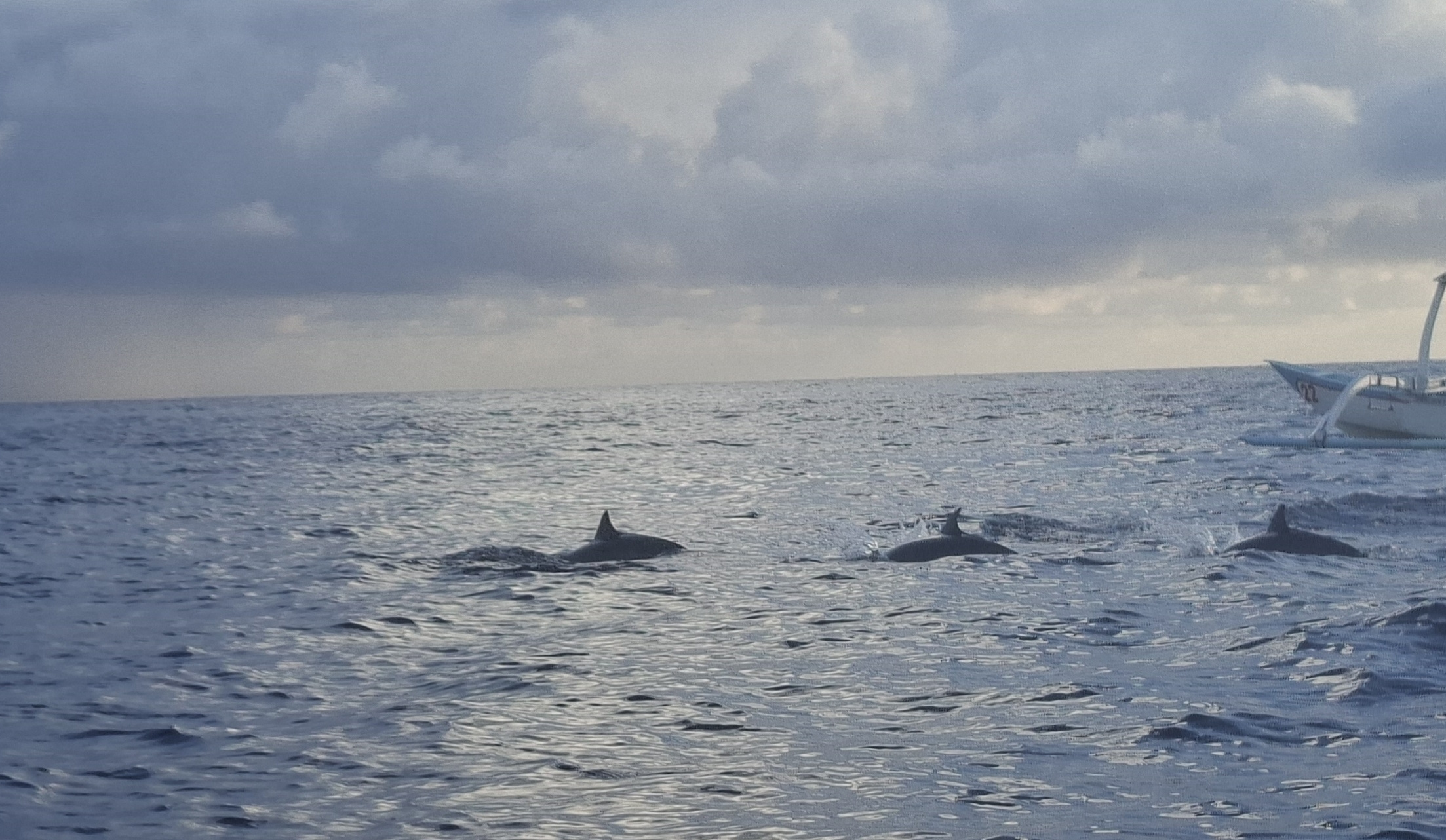
Dolphins at dawn
I was a little unsure about going out to see the dolphins. In India we had ventured out in a small fishing boat to try and watch them, only to find the experience rather spoiled by the larger boats chartered by the main tour companies. A dolphin would break the surface and, almost at once, there would be a disorderly rush of boats converging on the spot—rather like a group of five-year-olds playing football, all charging about in a single, enthusiastic cluster after the ball. Our own day there was redeemed chiefly by abandoning the effort altogether and crossing the bay instead to an old Portuguese plantation house, where a leisurely barbecue lunch proved a far more civilised affair. The following morning we rose with the dawn and simply walked down to the shoreline, where, without fuss or intrusion, we watched dolphins moving in the shallows not far from the beach, a quiet, unhurried spectacle that required nothing more of us than patience.
We also thought of the moments on the ferry across the Bay of Biscay when travelling to northern Spain, when dolphins would appear of their own accord, gliding alongside as though out of curiosity and for the fun of it rather than obligation. The thought occurred, not without some reservation, that the dolphins are under no compulsion to remain: if they did not care for the attention, they would simply vanish into the open water, leaving only the surface undisturbed behind them.
We have now been on the road for over a month, and I believe this is the first morning on which we have not been woken by cockerels. Somewhere in the distance, the adhan is being delivered, while the birds conduct their own, rather more agreeable chorus. Jay wakes and, out of long habit, attributes the disturbance to cockerels regardless. There is little point in lingering, we need to be up early, for this morning it is our turn to venture out onto the Java Sea in search of dolphins.
The departure itself has something of the Wacky Races about it, though with rather more vessels involved. A glance around suggests perhaps thirty boats, all setting off in loose formation towards the same patch of water, guided by a degree of certainty but also by the accumulated instinct and experience of their respective pilots as to where the dolphins might be found. It is an oddly spirited procession, part purposeful, part hopeful, as the small boats fan out across the calm surface of the sea.
The first sighting comes almost by accident. No grand announcement, merely a sudden pointing of arms and a ripple of attention across the water. For a moment there is nothing, and then, as if the sea itself had briefly taken breath, a curve of grey breaks the surface, clean and deliberate, before slipping quietly beneath again. It is enough to set everything in motion. Engines shift, and the loose scatter of boats gathers itself into a purposeful drift in that direction.
What follows has a curious energy to it, part excitement, part anticipation, and not altogether disciplined. The boats edge closer, some with more enthusiasm than grace, each hoping to allow their occupants to catch the elusive arc at just the right moment. Yet the dolphins, for their part, seem entirely unconcerned. They appear and disappear where they choose, surfacing in pairs, alone or as a pod, sometimes further off, sometimes unexpectedly close, moving with a calm assurance that renders the bustle around them faintly irrelevant.
And then, just as quickly, the intensity dissolves. The pod shifts its course and slips from view, leaving the surface momentarily blank once more. The line of boats, briefly gathered with shared purpose, begins to loosen and spread out again across the water, each pilot reading the conditions in an attempt to anticipate where the dolphins might next choose to surface.
What remains is not so much a spectacle as a series of fleeting impressions: the suggestion of movement beneath the surface, the memory of a smooth, effortless rise and fall, and, not least, the faintly frantic jostling for that elusive photograph. After a time, the excitement settles into a more reflective mood, and one is left with the growing sense that the entire encounter has taken place very much on the dolphins’ terms. They have appeared, briefly indulged their audience, and then moved on without the slightest regard for those pursuing them.
It becomes clear, too, that this is not quite the carefree exchange one might imagine. These waters are, after all, productive feeding grounds at that hour, and the dolphins are here with a purpose entirely their own. Unlike the easy, almost companionable moments recalled alongside a ferry, where dolphins seem to accompany the vessel out of curiosity, this feels closer to a stressful encounter they would sooner live without.
Brahmavihara-Arama Buddhist Monastery
There is something quietly unexpected about Brahmavihara‑Arama. Set high in the hills above the northern coast, it reveals itself not with drama but with a kind of deliberate calm. You come upon it by a modest road that rises gently through rice terraces, plantations and scattered houses, and then, almost without ceremony, you are in the car park. The monastery is terraced into the hillside, its roofs and stupas arranged with a studied sense of balance against the wider landscape of sea and mountains beyond.
The approach is a gradual ascent, both literal and atmospheric. Broad steps edged by carved stone and Naga balustrade lead you upwards through a series of courtyards and gardens, each level inviting a slower pace than the last. There are pavilions half concealed among trees, small shrines set beside still pools, and the occasional seated Buddha regarding the scene with a composure that feels quietly instructive. The architecture itself is curiously harmonious, a blending of Buddhist forms with that are unmistakably Balinese.
At the highest point stands the monastery’s most striking feature, a carefully rendered miniature of Borobudur, rising in concentric terraces and crowned with bell-shaped stupas. It is not so much grand as contemplative in scale, inviting you to walk its circumference slowly, to observe the carvings, and to take in the wide view that opens out across rice fields and distant water. The effect is less theatrical than quietly persuasive; you finds yourself pausing without quite intending to, drawn by the simplicity of the design and the stillness of the place, or is that to take advantage of the plant irrigation system that sprays a cool mist of water, providing pleasant relief from the mid-morning heat.
What lingers, above all, is the atmosphere. Despite its evident beauty, Brahmavihara‑Arama carries remarkably little of the self-conscious display that accompanies more celebrated sites. It remains a functioning monastery, and that fact seems to set the tone: voices are lowered, and even the act of passing through it takes on a certain measured quality. It is, in the end, less a place to be seen than one in which to be quietly present, a retreat not only in situation, but in spirit.


Air Panas Banjar Hot Springs: Holy Hot Springs (Must Move on from Batman!)


Air Panas Banjar Hot Springs, or as the sign says Holy Hot Springs, giving me one last chance to pull, unashamedly, at the reference to the Batman television series. The water comes from natural geothermal sources beneath the ground, heated by Bali’s volcanic geology. As with much of the island, groundwater seeps down through the earth, is warmed by residual volcanic heat, and then rises back to the surface as hot, mineral‑rich spring water. By the time it reaches the pools, it is typically around 36–38°C and contains sulphur, which it is widely believed give it therapeutic benefits for muscles, joints, and skin; although I stood underneath one of the jets for ages and did not feel rejuvenated at all.
At Banjar, the spring is channelled through carved stone conduits and emerges through naga spouts in the wall, from which the water flows continuously into the tiered bathing pools allowing the water to circulate steadily, keeping it fresh and in gentle motion rather than still. What you are bathing in, therefore, is not something treated or recirculated, but water that is effectively moving through the system as it arrives from its underground source.
The setting itself is simple. A walk through something similar to Ubud market brings you to the entrance and a series of steps up to a walkway above the pools and around to the café, lockers and toilets. We disappointed the guy in the café who lovingly explained what the specials were and ordered a couple of drinks. The atmosphere, however, remains relaxed and unstructured. There is little in terms of the refinement associated with modern spa culture; instead, you share the space with local families and other travellers who seemed to need as much space as their towel would allow.
The water was okay, although the colour and the temperature you cannot help but think you are swimming in someone else’s bath water, and didn’t necessarily feel any warmer than the sea, and there was not the usual smell of sulphur associated with hot springs. To be honest they certainly fell a long way short of the pools we used in Canada. We were in a bar on the British Columbia side of the Rockies and the barman suggested we hunt out the White Swan Hotsprings which were free and better value than the ones we have to pay for in the area. We found them. Three small pools, the hottest of which was almost too hot to get in to. We had the site to ourselves for a while then a guy walked down the path towards us, stripped naked and climbed in next to Jay. That was perhaps the fastest I have ever seen her move.
At Banjar, there is no snow and pine trees surrounding the pools but gardens, frangipani, ferns, and low planting which unfortunately cannot work hard enough to draw attention away from the pools. I am glad we went but need to be careful that it not becoming a tick list exercise (another one of the rules), however in our defence it was packaged together with the waterfall (below) and the monastery (above).
The day we nearly joined the Red Bull Cliff Divers Championship
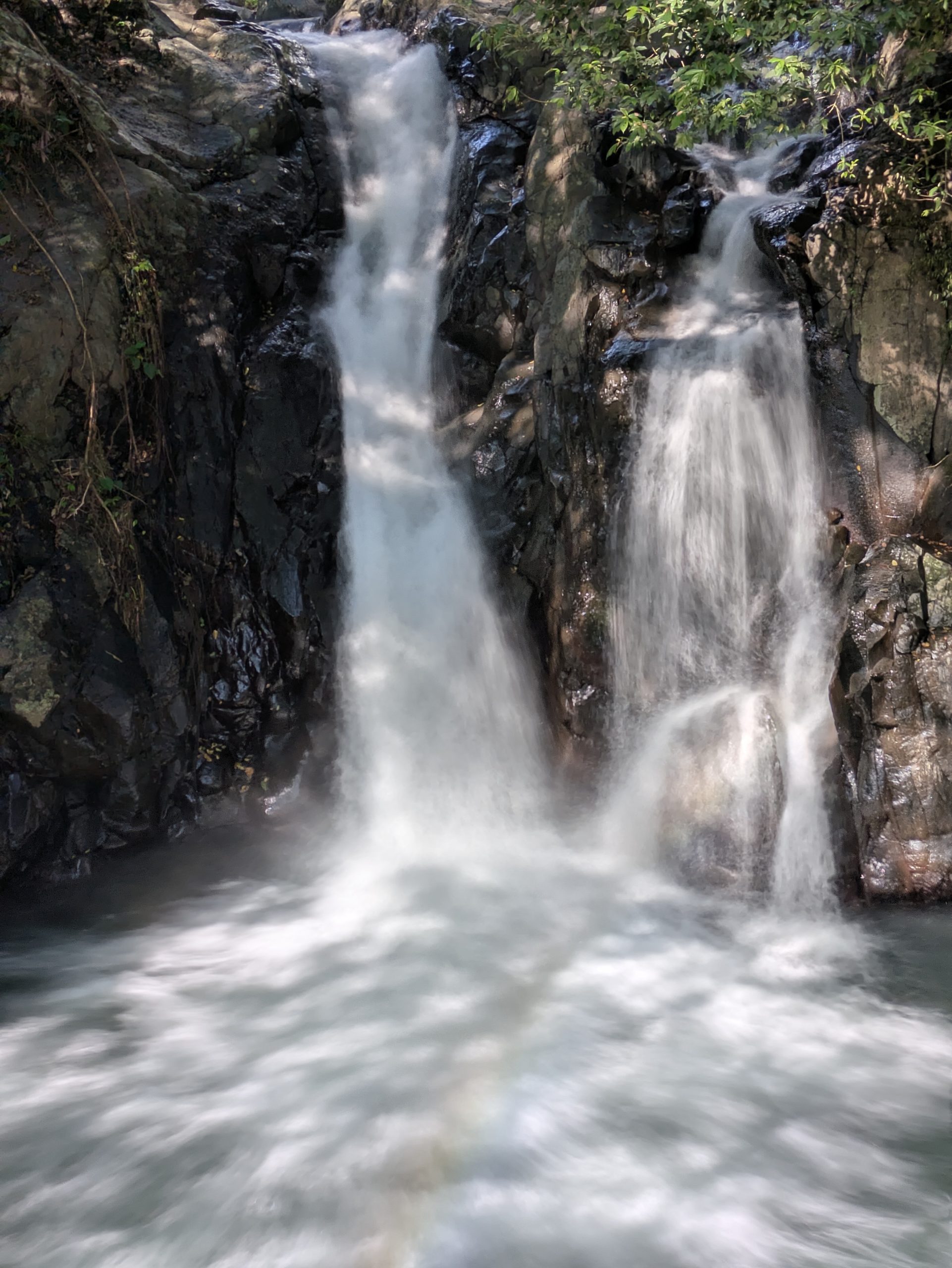
As part of our day trip we headed back into the hills, but on the Lovina side, to visit Aling-Aling Waterfall. It has been clearly identified as a tourist attraction because of the size of the car park, entrance, the need to have a guide and the ornate landscape in which it lies. We paid our dues, picked up our guide and walked over the suspension bridge, which was very bouncy, and as with all waterfalls descended a 20-metre flight of stairs, or more poetically a short descent through shaded paths and dense vegetation. The waterfall reveals itself gradually, the sound arriving before the sight. Then, quite suddenly, it appears: a tall, twin cascade dropping cleanly through a narrow green ravine, dividing into two streams as it falls some thirty or so metres into the pool below. The setting is enclosed and faintly dramatic, with steep walls thickly covered in moss and foliage, giving the impression of a place somewhat set apart from the surrounding world.
What distinguishes Aling‑Aling, however, is not simply the main fall but the arrangement of smaller cascades that lie a short distance downstream. A short walk brings you to a series of lower waterfalls, Kroya, Kembar, and Pucuk, each with its own pool and character, and all within easy reach of one another. Here the atmosphere shifts subtly. Where the main fall retains something of a formal stillness, these smaller sites are more active, shaped by use and familiarity as much as by the water itself. It is in the lower section that you find the more practical engagement with the landscape. Smooth rock faces, worn over time by the steady passage of water, have become natural slides, while ledges beside the pools serve as informal platforms from which the more committed visitor may jump into the water below. When buying our ticket, we declined the invitation to slide down Kroya and the opportunity to dive from three platforms, each slightly higher than the previous one, into the pools at the bottom of Kroya, Kembar and Pucuk. May be forty years ago, but inclined to pull a muscle getting out of bed nevermind plunging ten metres into a pool of water.
Even so, the overall impression remains balanced rather than overtly adventurous. Between these points of activity there is a good deal of quiet space: stretches of water undisturbed, shaded corners where the jungle seems to lean in, and the continuous sound of falling water acting as a steady backdrop. It is this combination, of structure and informality, of spectacle and use, that gives Aling‑Aling its particular character.
The selection of Kroya Waterfall as a venue for the 2026 Red Bull Cliff Diving World Series gave the place a rather different significance from its usual role as a modest stop along the Sambangan trail. Ordinarily, it is a comparatively small fall, no more than twelve metres in height (I know only twelve metres!). However, for the purposes of the event, the landscape had to be adapted. The limited height of the falls was supplemented with the use of temporary structures and existing features, most notably a take‑off point mounted in a tree above the pool. From here, athletes would be able to operate at the heights required for the series, diving from up to 27 metres for men and 21 metres for women, and thereby turning what is normally a small freshwater basin into something approaching a competition venue.
The event itself had been scheduled for a few days before our visit. In the end, however, conditions intervened. Heavy rainfall and rising water levels affected the site to the extent that it was no longer considered suitable for formal competition, and the Kroya stage was abandoned.
However, Red Bull would have you believe, the divers turned up anyway (and it was not a publicity stunt) for a bit of fun diving. There are some videos on Instagram if you want to look them out.

A footnote to our stay in Lovina: I would like to introduce The Global Village Foundation
The Global Village Foundation in Lovina operates as a series of small, practical interventions rather than a single large project. It was founded in 2013, and focuses on supporting the most vulnerable, particularly those facing severe disability or extreme poverty and lacking access to essentials such as healthcare, education, clean water, and adequate housing. Its aim is straightforward: to meet immediate needs while helping people maintain dignity and independence.
Much of its work is tangible and incremental. This includes providing free wheelchairs, medical and food support, assistance with schooling, and improvements to basic living conditions such as water access, sanitation, and safe housing. These are modest but targeted actions that respond directly to visible need.
A distinctive aspect of the foundation is its café, which serves both as a funding source and a social space. Staffed primarily by people with disabilities, particularly those who are deaf, it offers supported employment while promoting inclusion and self‑sufficiency. Overall, the foundation is defined by its low‑key, practical approach, locally embedded, visibly active, and focused on achievable outcomes rather than grand claims. They also make excellent curries and pakoras.

