
A Journey into the Clouds: Bedugul, Wanagiri, Munduk (part 1)
Buses, Breakfasts and Bali Traffic
Our plan to catch the bus from Ubud to Bedugul unravelled almost immediately. I am sure the bus exists, but perhaps only on 12Go.asia, and at a price that made it indistinguishable from getting a Grab (the Uber equivalent). Given that, there seemed little point in adding the extra inconvenience of hunting down a bus stop and hoping the bus remembered it was meant to be running. We opted for the Grab which also meant we were able to enjoy one last fantastic breakfast before departure and only had to worry about why the payment for the car had not gone through.
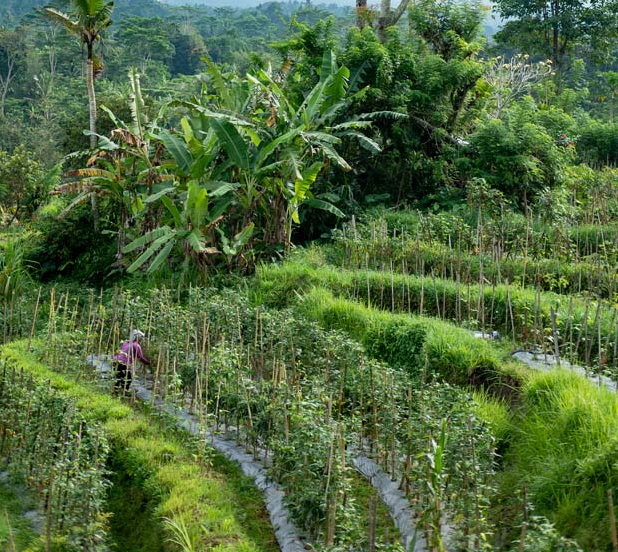
Leaving Ubud took time. The distance between Ubud and Bedugul is only 45km yet the journey time is listed as two hours, and to think I used to grumble at taking two hours to do the 62 miles to Cambridge. As soon as we had gone 100 metres the traffic snarled and stalled, giving us ample opportunity to observe daily Balinese life in slow motion. Gradually, though, the congestion eased and the road began to climb, so we slowed once again behind trucks and under-powered cars and bikes. With the altitude came a quiet transformation in the landscape. The familiar emerald squares of rice paddies gave way to vegetable plots: brassicas, carrots, lettuces, onions. It was oddly reminiscent of the Norfolk Fens, except that here everything was arranged in terraces clinging improbably to hillsides. Imagine Yr Wyddfa (Snowdon) blanketed in market gardens, and you are not far off.



Life in the Caldera
Arriving in Bedugul, you immediately sense that you are standing inside something ancient and immense. This is the cauldron of a long‑extinct volcano. Unlike Mount Rinjani, which last erupted as recently as 2016, or the restless volcanoes of Java we will soon be visiting, Bedugul sits within the caldera of the old Buyan–Bratan volcano, which exhausted its energies millions of years ago. Once a fearsome presence, it now contents itself with mist, cool air, and extraordinarily fertile soil.
The great eruptions of the past have left behind three lakes, Bratan, Buyan, and Tamblingan, nestled neatly into the hollows carved by prehistoric eruptions. Surrounding them are mountains such as Batukaru and Pohan, themselves products of the same volcanic lineage. All are now entirely quiescent, showing no inclination to revive their former theatrics. The result is a landscape that feels serene yet powerful, shaped by extraordinary forces but now softened by time.
You are also very aware of the altitude. Bedugul sits at around 1,300 metres above sea level, and the cloud line seems to drift almost at will. It often drops low enough to blot out the surrounding hills, and sometimes even the lake itself, giving the whole area a cool, slightly otherworldly feel.
After checking into our lodgings, we set off in search of the Hidden Strawberry Gardens. Despite the name, they turned out not to be especially hidden, thanks to a series of helpful signposts. We half‑expected an entry fee, but perhaps because we had inadvertently woken the person in charge, we were waved in without charge and encouraged to wander freely. The strawberries themselves looked as though they would benefit from a few more days of sunshine, so we admired them politely and left with a grateful thank‑you rather than a punnet.
By the time we returned to our chalet, the clouds had begun their descent in earnest. Mist thickened over the lake, the light faded, and the temperature dropped to a positively bracing 24C. We held out as long as we could, but eventually admitted defeat, retreated indoors, and reached for our jumpers.
Pura Ulun Danu Bratan
We have two full days in Bedugul with plans to go to the Ulun Danu Beratan temple and the Balinese Botanical Gardens
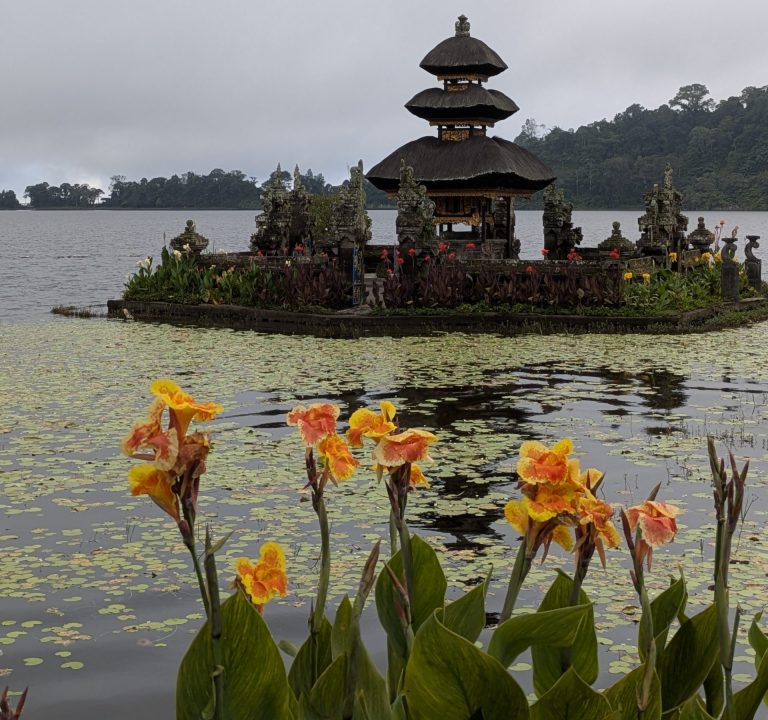
The Ulun Danu Beratan Temple is one of Bali’s most recognisable and photographed landmarks, famous for its serene setting and the illusion that part of the temple floats on water. Officially known as Pura Ulun Danu Bratan, the temple sits on the shores of Lake Bratan. When the lake level rises, the main shrine appears to hover above the surface, framed by mist and mountains, an image so iconic that it has appeared in guidebooks and even on Indonesian currency. Its dramatic location and calm atmosphere make it a visual symbol of Bali’s spiritual relationship with the landscape.
The temple is particularly important because it is dedicated to Dewi Danu, the Balinese goddess of lakes, rivers, and water. Lake Bratan is a vital source of irrigation for central Bali, and Ulun Danu Beratan plays a key role in the island’s traditional subak irrigation system (see rice production in Ubud – oh Hang on a minute I was not allowed to write about it in detail-) linking water management with religious practice. Farmers from across the region historically made offerings here to ensure a steady and balanced supply of water for their crops, reinforcing the temple’s status not just as a place of worship but as an essential part of everyday life and agriculture. The temple was built in 1633 during the period of the Mengwi Kingdom. The complex follows classical Balinese temple design, with open courtyards and multi‑tiered shrines known as meru. The tallest of these, with eleven tiers, is dedicated to Shiva and his consort Parvati, while the wider complex honours several Hindu deities. Unusually, there is also a Buddhist stupa within the grounds, symbolising religious harmony and coexistence in Bali.
Today, Ulun Danu Beratan Temple remains a working place of worship as well as one of Bali’s most admired cultural sites. Its fame rests not only on its striking appearance but on what it represents: the balance between humans, nature, and the divine, and the deep importance of water in sustaining Balinese society.
We took our own advice and set off reasonably early. Most people visit the temple on a day trip but when we first got there, it was pretty quiet so took advantage of rushing straight to the meru to get our pictures without too much tutting. Pictures taken we walked on into the next section and enjoyed a quiet walk round. Heading back over the bridge the scene around the temple had changed significantly. A photo shoot was in progress for a group of teenagers. There must have been around 350 of them and perhaps from that moment on there would have been no opportunity to spend as much time as we did at the temple.
We spent a leisurely couple of hours at the site, occasionally taking a picture, often just people watching, but then a need for a cup of coffee overtook our spiritual contemplations and we went in search of a brew. To give an idea of how busy the temple gets when we left (mid-morning) there were already 25 coaches in the car park, although walking past on the Thursday afternoon, there were even more.


Pura Ulun Danu Bratan




Cock-a-Doodle-Déjà Vu, Sermons and the Pursuit of Quiet
Aren’t cockerels majestic birds? They strut around with such an air of importance, convinced they are in charge of everything they survey. In Bedugul, they also like to play Chinese whispers. It begins at about midnight. One bird, somewhere in the valley, will strike up with a confident “cock‑a‑doodle‑doo”. Over the next twenty minutes, the message is relayed from bird to bird, echoing its way down the entire valley. Once it reaches the bottom, they seem to send it back the other way. And so it goes, back and forth, all night long. By dawn, the poor things miss the the dawn chorus, presumably because they are absolutely knackered from shouting the same message at one another all night. Spoiler, lads: the word is always “cock‑a‑doodle‑doo”. It never changes.
The cockerels did at least get a break from dawn chorus duties on Thursday morning, because the Christians were in town. You watch Michael Palin, Simon Reeve or Michael Portillo turn up somewhere and, by sheer coincidence, it happens to be a major festival. They’re invited to join in, and it all makes for wonderful television. We, on the other hand, got loudspeakers at 6am and a rather earnest service starting at eight, and no we were not invited.
It wasn’t just confined to where we were staying; this was happening all over town. It was Ascension Thursday, forty days after Easter, marking the ascent of Jesus to heaven, and a public holiday in Bali. We thought we might escape the festivities with a quiet day in the botanical gardens. Not a chance. The 81‑hectare site was packed, dotted with groups of varying sizes, each equipped with their own PA systems and determined to deliver marathon services, with lengthy sermons clearly a prerequisite. The sound carried everywhere. It was still going on when we were heading back to our digs after dinner, and continued into the following morning, drifting through the rain from a nearby glamping site.
The botanical gardens themselves, one of four managed by the Indonesian government, are very pleasant. There are large collections of begonias, orchids, roses, cacti and azaleas, along with some fine specimen trees. The highlight for us was probably the begonia house. We were slightly out of sync with the orchids, roses and azaleas, but with the sun out it was a lovely place to wander. It was also a joy to see many families taking advantage of the holiday and enjoying a picnic. This is not a couple of limp cheese and cucumber sandwiches and a flask of squash. No, these are full operations: gas stoves, woks, proper cooking underway, and plenty of impromptu badminton courts set up alongside.


Bali Botanical Gardens


From Caldera to the rim and almost back again
By evening, the clouds rolled in again and the whole scene took on the feel of a slightly theatrical, Hollywood version of Victorian London—misty, diffused, and just a little dramatic, all to the backing track of what sounded like the Indonesian version of “She will be coming round the mountains” from the folks on the hill.
The following morning, our plan was to leave Lake Beratan behind, walk around Lake Buyan, and climb up towards the Garuda Hotel in Wanagiri. That plan unravelled quickly when we woke to torrential rain. Rather than marching ten kilometres through it, we spent the princely sum of £2.50 on a Grab. As it turned out, this was an excellent decision.
After checking into the Garuda Hotel which sits on the ridge line of the Buyan–Bratan volcano, we went for a short walk. About 500 metres in, we paused to take a few photographs. I leaned over to look more closely at a plant, and the ground promptly gave way beneath me and I disappeared into the cladera.

