
A Journey into the Clouds: Bedugul, Wanagiri, Munduk! Part Deux
When we last left our intrepid travellers… a peaceful stroll along a volcanic ridge turned into disaster!
The ground gave way…
The jungle swallowed him whole…
And he vanished into the depths of the Buyan–Bratan caldera!
Not quite at the bottom… but far enough to know one wrong move… and this becomes a much longer story!

For a brief moment, I fully expected to be appearing on 999, with Michael Burke narrating as a helicopter was dispatched to haul me out of a ravine. Thankfully, I managed to straddle some sturdier vegetation on the way down and grab hold of a tree branch. I half expected to turn around and see Jay filming it for YouTube, but instead she calmly took my bag and phone and held onto my hand to stop me sliding any further while I worked out how to extricate myself. My clean clothes were ruined and I was thoroughly muddy, but otherwise I escaped unscathed.
Banyumala: A Descent Worth Every Step (The Ascent… Less So)
Not long after, we spotted a sign pointing to a waterfall, three kilometres, all downhill. By the time we reached the bottom, my app showed we’d descended about 400 metres. By my calculations, that’s a gradient of roughly 1 in 6 (or 16%), and the thought of climbing back up again loomed large in our minds.
The effort down, however, was entirely worth it. The falls are called the Banyumala Twin Waterfalls, which is slightly misleading as there are actually three of them—rather like the Thompson Twins, I suppose.
Once you run out of road, reaching the falls requires a short but moderately steep walk down through the jungle, via a path of steps and track. It adds to the sense of discovery when you finally arrive at the base. What makes Banyumala distinctive is its structure. Rather than a single dramatic drop, the waterfalls split into two main streams, along with several smaller cascades, fanning out over a wide, moss‑covered rock face. The effect is less a crashing torrent and more a gentle curtain of water, flowing into a clear, inviting pool below.
In truth, the “twin” falls are only the centrepiece. The whole valley is alive with water. Turn around after admiring the main falls and you will spot two other equally impressive cascades, largely ignored but worthy of a visit in their own right. The surrounding rock face is threaded with dozens of smaller trickles and ribbons of water, tucked into the ravine and partly hidden by vegetation. It feels less like visiting a single waterfall and more like stepping into an entire amphitheatre of water.
Eventually, thoughts turned to the return climb. After a few days in the relatively cool Bedugul air, it wasn’t long before we were working up a sweat, clinging to the promise of a cold Bintang at the top. At that point, two local lads appeared and offered us a lift on their motorbikes. Now, I know this technically broke one of our previously agreed rules, no motorbikes, but the prospect of that hill prompted a quick renegotiation, and we accepted.
The ride itself was an adventure, but in all honesty, I’m not convinced we would have made it back up on foot even if a whole crate of Bintang had been waiting at the summit. Since we hadn’t earned it the hard way, we did the honourable thing and had an iced coffee… followed by a Bintang 😊

The view from Wanagiri and Banyumala Waterfall Complex
As I am running out of space on the server, I am currently looking at alternatives. I did start with Flickr but soon fell out with that, so now looking at a widget that will allow me to show albums created in Google. Hopefully it works okay but cannot seem to get it to allow fullscreen slideshow.


The Retreat: Treated Like Family (From a Safe Distance)
Over dinner we discussed the two places we had stayed in. The hotel in Bedugul was by the lake and perhaps we were there at the wrong time to fully enjoy it, because of the cold (24C) and the damp. The second hotel in Wanagiri had some great views over Lake Buyan and if you had your own transport would be an excellent base to explore the region, but with no Grab drivers looking to pick up work in the area, there are obvious limitations.
After breakfast and a chance to see more of the crater rim than we had seen to date, we set off on the 5km walk to our next stay. We walked the 750m to the entrance to the lake area we were advised not to go down there with our packs. From what I had seen and read there shouldn’t have been a problem, but I was not going to argue with her so we set off along the road. After a 3km we came to a congested junction, A car had put his front wheel in the storm drain and everything had stopped whilst a group with a plank helped him get it out. As we edged past a guy asked us where we were going and said he was also going that way and gave us a lift over the last 2km. As we sat having a cup of coffee, the weather closed in, so we retreated to the balcony and looked over the valley. In the mid-distance was Munduk, our next destination and in the far distance, the north coast of Bali, hidden behind a hill to the right is Lovina and in front of us is the road to Permuteran and eventually Java. Places that for so long seemed a long way are off are quickly coming into view.
One of the reasons for staying at this homestay was the much talked about way you are treated as part of the family and taken into their home, sharing dinner with them and enjoying their hospitality. We are clearly that aunt and uncle you wish would not come around. They did indeed share their dinner with us, but it was bought down to our jogolo. So, we did not get to have conversations about education in Indonesia and what happens if you cannot afford to send your children to school, how land is distributed and how much of an issue is land grabbing, all in keeping with United Nations Sustainable Development Goals.
The Road to Munduk: Steep, Scenic, and Occasionally Vertical
After breakfast, we set off for Munduk. It wasn’t far, and, reassuringly, it was mostly downhill.
Leaving the retreat, the road feels as though it has been threaded carefully through the landscape rather than imposed upon it. It is lined with small farms, scattered houses, and the occasional shrine, each with its neat offering tray set quietly to one side. Almost immediately, you are aware of the altitude: the air is cooler, the light softer, and the vegetation dense and layered, with coffee plants, fruit trees, and ferns competing for space along the verges. The road also quickly reminds you that this is a landscape shaped more by gravity than by design. For the most part, the journey is downhill—sometimes gently, but often with a determination that requires rather more attention than you might expect.
At first, the descent feels manageable, the road slipping gradually through dense greenery and scattered plots of coffee and fruit. Before long, however, it reveals its true character, dropping more steeply in short stretches—at times feeling close to a 1 in 3 gradient. These sections are enough to make you instinctively ease off the pace. Cars rely heavily on engine braking, while on foot you find yourself leaning back to keep control, discovering muscles you had almost forgotten existed.
What makes the route particularly striking is the sense of exposure. At various points, the land falls away quite abruptly, offering glimpses into the folds of the valley below. Terraces stack tightly along the slopes, emphasising just how much height you are losing as you descend. You are never quite in freefall, but the road has a very clear and consistent purpose: downward.
The route undulates as well, the descent broken by occasional flatter sections or brief rises, just enough to keep you honest before tipping you downhill once more.
There is a strong sense that this is a working landscape rather than a tourist corridor. You pass modest warungs, local homes, and neatly tended vegetable plots, all arranged in that distinctive highland fashion—practical, terraced, and often improbably clinging to the terrain.
As you draw closer to Munduk, the road begins to feel slightly more settled. There is a gradual increase in signs of village life: more cafés, houses, and small shops appearing intermittently along the roadside. Even so, it never becomes busy in the way southern Bali does. Instead, it retains a quiet, almost self-contained atmosphere.
The final kilometre has one last trick to play. Having lost around 700 metres of altitude over the previous four kilometres, the road turns upward again, reclaiming about 100 metres just to keep things interesting. It’s a timely reminder for any leg muscles that had been feeling smug during the descent that they are, in fact, still very much part of the operation.
We did make a couple of stops along the way. The first came about halfway, prompted by the need for a much-appreciated bottle of Sprite and a few generous pauses to catch our breath. The second was somewhere we had earmarked in advance, though, in reality, it turned out to be rather smaller than expected and we did nearly walk right past it.
It was a café (The Tea Party) set within a clove farm. The path up to it was steep and slippery, particularly with packs, and we were grateful for a helping hand from the owner. He welcomed us warmly and offered a drink, wedang secang, brewed from the bright red shavings of the secang tree along with a selection of spices grown nearby. I rather wish we had been filming, because adding a squeeze of lime turned the drink from deep red to a vivid pink. Out of respect for the magic, I will refrain from mentioning that this is, of course, simply the effect of changing pH on anthocyanins.
He then talked us through his farm and the spices they grow. Having experienced similar tours in India and, come to think of it, Sri Lanka we braced ourselves for the inevitable appearance of a gift shop. But no. He was simply happy to share what he does, with no pressure at all.
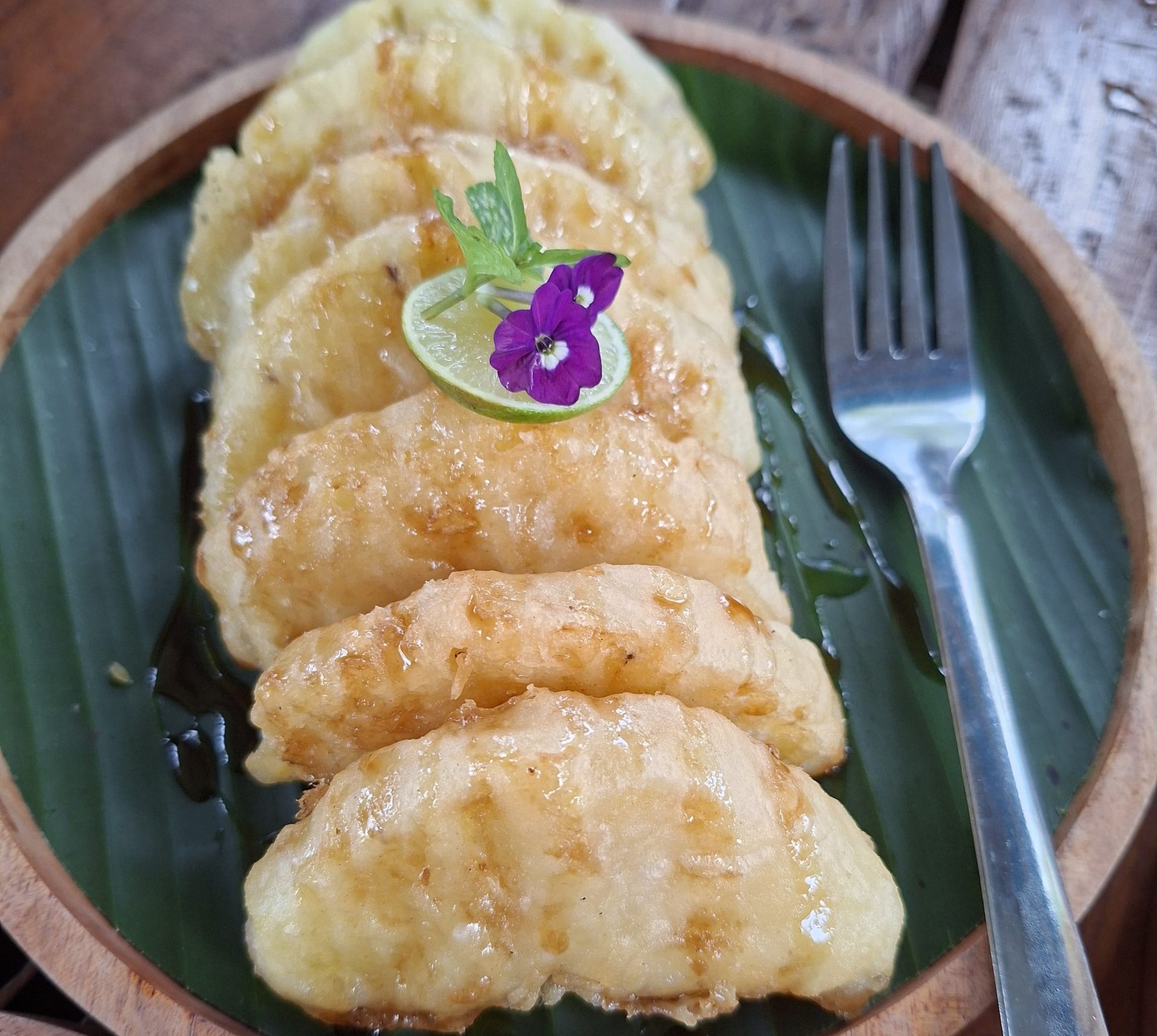
We did, however, buy iced coffees, which were excellent, with what tasted suspiciously like a hint of vanilla, and a selection of pancake rolls and pineapple fritters. The latter may quite genuinely be the best I’ve ever had. I have a distant memory of eating something similar in Nottingham, drowned in syrup, but I am fairly certain these were better and the portion more generous.
Either way, it all helped make that final kilometre a little easier.
We arrived in Munduk and the priority was to find somewhere to get some washing done. I was down to my last pair of shorts and t-shirt, which I added to my kit for swimming. The homestay had a laundry service (linked to her sister’s laundrette and it was the same price as the laundrettes IDR 100,000 (£4.21) and even the socks and pants came back ironed!



Red Coral (Munduk) Waterfall: Powerful, Peaceful, and Conveniently Ours

The trek down to Red Coral Waterfall was, all things considered, fairly manageable—though Jay might have offered a slightly different opinion. Compared to some of the more demanding routes we would tackle later in the day, this one felt relatively gentle. After paying the entrance fee, we followed a short, winding path that hugged the edge of the river, the sound of flowing water accompanying us as we made our way towards the falls.
Before long, the jungle opened up to reveal Red Coral Waterfall, also known as Munduk Waterfall. Its name comes from the reddish hue of the surrounding rock face, which is said to glow warmly when caught in the right light. Unfortunately, the clouds had begun to gather by the time we arrived, muting that effect somewhat, but the scene was no less captivating. The waterfall itself drops around 20 metres in a powerful cascade, carving its way down through the rock before crashing into a shallow pool below.
There was something striking about the contrast, the force of the water as it thundered down, set against the stillness of the surrounding jungle. Fine mist hung in the air, cooling the space, while the thick greenery framed the falls on all sides. Despite its energy, the place felt calm and almost secluded, as though tucked away from the rest of the world.
When we first arrived, a small handful of other visitors were already gathered near the base, taking in the view. But with a little patience, and absolutely no complaints whatsoever, we soon found ourselves alone. The change was immediate. Without the distraction of voices or movement, the sound of the waterfall filled the space entirely, creating a peaceful, almost meditative atmosphere.
We lingered for around fifteen minutes, soaking it all in and, of course, capturing the obligatory photos, purely for documentation purposes, of course. As we prepared to leave, a few more groups began to filter down the path, their voices echoing faintly through the trees. It felt like the perfect cue to move on, leaving just as the quiet moment we’d enjoyed began to slip away.
Not Quite Melanting: An Interlude at Labuhan Kebo
Leaving Red Coral Waterfall behind, we picked up the trail towards Melanting, expecting a straightforward connection between the two. So, it came as quite a surprise, bordering on mild confusion, when another waterfall suddenly revealed itself through the trees. For a brief moment, I was convinced we’d taken a wrong turn and somehow looped back to the start of the trail. Looking back at the route now, it’s clear what had happened. The road up the hill we had abandoned earlier in the day, mainly because we were already fed up with walking uphill and it seemed a long way off, actually led to the Golden Valley Waterfall. At the time, though, all we knew was that we’d stumbled upon something unexpected.
Despite the initial uncertainty, it was a pleasant surprise, even if it meant tackling yet another series of steps, downwards first, and inevitably back up again. By this point, the weather had begun to turn. Rain filtered gently through the canopy, dampening the steps and making the descent just that little bit more cautious and hiding the fact our shorts were already wet through with sweat.
Unlike some of Bali’s more popular waterfalls, Labuhan Kebo feels wonderfully untouched. Hidden deep within dense jungle, it has a quiet, almost secretive atmosphere, as though it exists just out of reach of the usual crowds. Rather than a single dramatic drop, the waterfall unfolds in tiers, the water flowing softly over a series of rock ledges, creating a layered, almost sculptural effect. The gentle, continuous movement gives it a calmer presence, slightly less thunderous, more soothing.
There’s also a story woven into the place. According to local folklore, a shepherd from Munduk village would bring his buffalo here to bathe while he cut grass high on the cliffs above. One day, he fell, the buffalo took themselves home, and his body was later discovered at the base of the falls. The name “Labuhan Kebo” reflects this tale—labuh meaning “to fall” and kebo meaning “buffalo”, adding a quiet sense of history and gravity to an otherwise tranquil setting.
When we arrived, a man armed with an impressively professional camera was patiently waiting for a group ahead of him to leave so he could capture some long-distance shots. We lingered respectfully, letting him take his time. The wait paid off, as soon after we found ourselves alone once again, with nothing but the rush of water and the steady patter of rain for company.
After taking several more Instagram style shots, we considered taking a few long distance shots ourselves, but just as we were getting into position, another couple arrived, with a guide in tow. It felt only right to pass on the solitude we’d been lucky enough to enjoy, so we quietly made our way out.
The climb back up was every bit as demanding as expected, especially with the rain now properly set in, but reaching the top felt like a small victory. At the entrance hut, the woman working there kindly let us sit for a while, officially to shelter from the rain, though in truth it was just as much about catching our breath. While we rested, we double-checked that we were indeed on the right path towards Melanting Waterfall… determined not to miss it.

Is it Melanting waterfall?
Like a modern-day Lewis and Clark, we set off along the path looking for the Melanting Waterfall, the air thick with humidity and the scent of damp earth. Before long, we came across another small hut tucked into the greenery, where we paid the entrance fee and began our descent. The trail quickly dropped away beneath us, steep, slick in places, and broken up by uneven, time-worn steps. It demanded care with every footstep, but somewhere below, the steady roar of rushing water echoed through the valley, pulling us onwards.
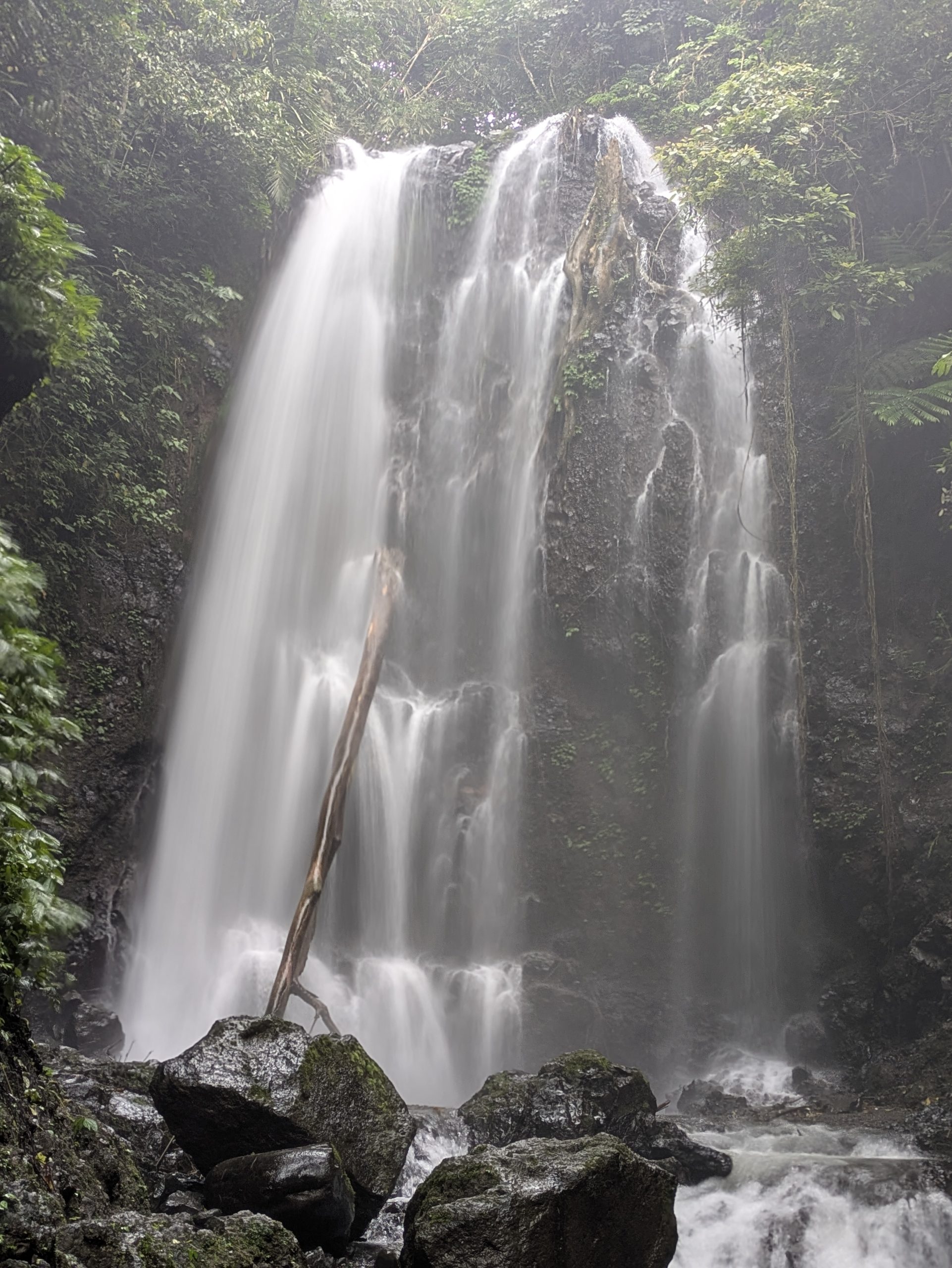
Eventually, the path opened out at the valley floor, where we were greeted by the sight of a waterfall cascading through dense jungle. It was beautiful, framed by lush vegetation and moss-covered rock, but it felt distant and oddly unreachable. We couldn’t quite tell if this was Melanting itself or something else entirely, as there was no clear way to get close. Having just paid specifically to visit Melanting Waterfall, I had expected something a little more accessible, similar to other falls we had visited. Even so, we paused to take in the scene, snapping a few photos from some precarious rocky outcrops, as the cool mist drifted through the air.
Our next goal was to find the viewing area, for those picture-perfect Instagram shots. To continue, we had to cross a bamboo bridge that looked decidedly less reassuring than we would have liked, a replacement for a collapsed concrete bridge a little further down river. The bridge creaked gently underfoot and swayed ever so slightly above the rushing water below. On the other side, the jungle quickly swallowed us up again. We stopped to ask another couple for directions, they admitted they’d had no luck themselves, having wandered in circles through the undergrowth. Undeterred and with the trail becoming less defined, we pressed on following the river, convinced it would eventually lead us to what we assumed must be the “real” Melanting Waterfall.
The route climbed gradually uphill, threading its way through thick jungle. Occasionally, there were hints of a proper trail, but these were often interrupted by patches of tangled roots, loose stones, and slick mud. At one point, a small landslide had swallowed part of the path entirely, forcing us to pick our way carefully across wet, reddish rocks with an almost sheer drop on our right side. The colour of the rocks was striking against the surrounding green, giving the moment an almost otherworldly feel, like stepping across the remnants of something ancient.
Not long after, we caught up with a young couple, their presence offering a small sense of reassurance that we weren’t completely lost. Still, it was clear they were navigating by guesswork too, and the shared uncertainty only added to the adventure.
Eventually, the rough jungle trail gave way to a more solid concrete track, an unexpected sign of civilisation. I am sure the option of going down the hill would have taken us to the waterfall, but we decided to call it a day and headed up the hill in search of refreshments.
The route gradually brought us back towards familiar ground, eventually reconnecting us with the path we should have taken from the start, the one we had dismissed earlier near the school. It was a slightly frustrating realisation, but also a satisfying one.
Because, in truth, had we taken the straightforward route from the beginning, we would have missed everything else. We wouldn’t have stumbled upon hidden waterfalls, crossed that precarious bamboo bridge, or wandered through the untamed jungle with no clear sense of direction. In our own roundabout way, we did find Melanting Waterfall—just not in the way we had expected. And somehow, that made the experience all the more memorable.

